Commercial mediation in Saudi Arabia offers businesses a structured way to explore settlement before entering lengthy litigation or escalating a commercial dispute. It is not an automatic substitute for the Commercial Court, and it is not suitable for every case.
Mediation is usually more useful where the parties have an ongoing commercial relationship, the dispute can realistically be negotiated, or confidentiality and reduced escalation are important.
This guide addresses that question from a practical Saudi business perspective. It also explains mediation clauses, the distinction between mediation, settlement and arbitration, and what should be documented if mediation succeeds or fails.
For the judicial side of commercial disputes, see our guide to commercial court jurisdiction.
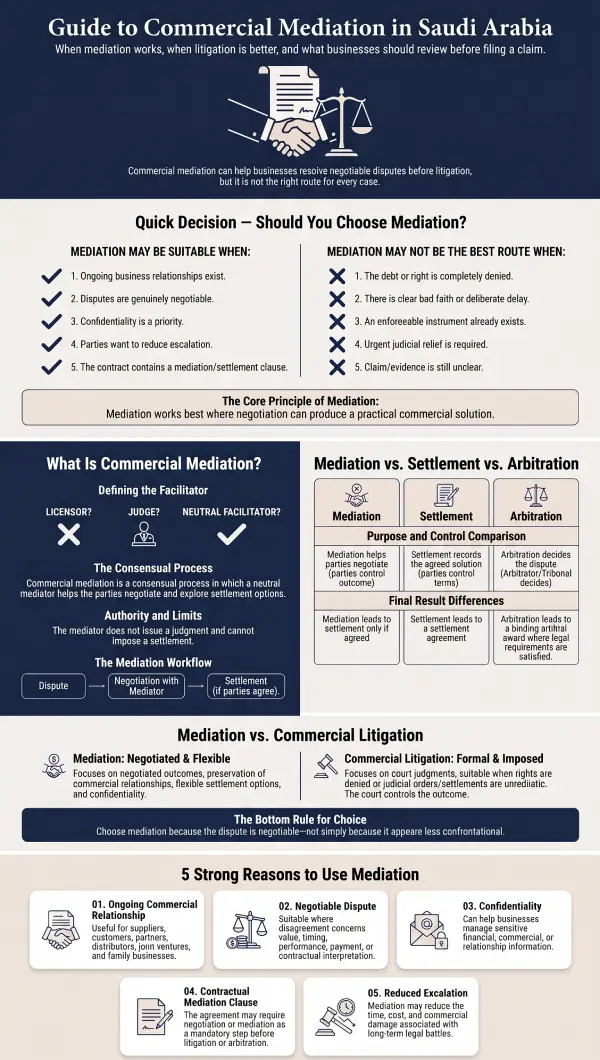
Quick Answer: When Should You Choose Commercial Mediation?
Choose commercial mediation in Saudi Arabia when the dispute can realistically be resolved through negotiation rather than requiring a court judgment.
Examples include disputes between business partners who want to preserve the company, supplier-customer disputes where the relationship remains valuable, disagreements over payment, performance quality, or interpretation of a contractual term.
Mediation may also be useful where public disclosure of the dispute could harm commercial reputation or expose sensitive financial information.
Do you have a commercial dispute and need to decide whether mediation or litigation should come first? Reviewing the contract and supporting documents before escalation can help identify the more proportionate route, particularly where the agreement contains a settlement clause or the parties have an ongoing business relationship.
Prefer to understand when mediation may be suitable first? Continue reading the guide below.
Decision Summary Table
| Situation | Is Mediation Suitable? | Likely Route |
|---|---|---|
| Negotiable dispute between partners | Yes | Mediation |
| Fixed financial claim supported by an enforceable instrument | Usually not | Enforcement |
| Complete denial of the debt | Usually not | Litigation |
| Ongoing contract between two companies | Often yes | Mediation before litigation |
| Contract contains a mediation clause | Requires review | Depends on the wording |
What Is Commercial Mediation?
Commercial mediation is a consensual process in which a neutral mediator helps the parties negotiate and explore settlement options.
The mediator does not act as a judge, does not issue a judgment, and cannot impose a solution. The mediator’s role is to structure discussions, narrow the issues in dispute, and help the parties explore possible outcomes.
In practice, commercial mediation in Saudi Arabia can be useful where a dispute appears to be purely financial but is actually connected to performance, trust, contract interpretation, or an ongoing commercial relationship.
For example, a supplier may claim unpaid invoices while the customer disputes the quality of part of the supply. Litigation could convert the relationship into a full legal confrontation.
Mediation may instead allow the parties to explore a practical arrangement such as:
- a partial price reduction;
- replacement supply;
- an instalment payment schedule; or
- an adjustment to future performance.
Is Commercial Mediation Binding?
The mediation process itself does not impose a binding decision.
If the parties do not reach an agreement, the mediator cannot force a result. What may become binding is the settlement agreement reached through mediation if it is clearly drafted, signed and documented through an appropriate legal route.
It is therefore important to distinguish between the mediation sessions and the final settlement.
The mediation sessions are a negotiation process. The settlement agreement is a separate document that should define matters such as:
- obligations;
- payment amounts;
- payment dates;
- consequences of breach; and
- the agreed enforcement mechanism.
Is Commercial Mediation Confidential?
Confidentiality is one of the main commercial reasons parties may choose commercial mediation in Saudi Arabia.
Businesses may wish to avoid disclosing pricing structures, financial information, supply terms, shareholder disputes, or details of relationships with customers and suppliers.
However, confidentiality should not be treated as absolute in every situation.
Its scope may depend on:
- the parties’ agreement;
- the applicable mediation rules;
- the institution administering the mediation; and
- the nature of the information concerned.
Some information may later be relevant if it exists independently of the mediation process or is required to implement or enforce a settlement.
Before mediation begins, the parties should therefore consider defining:
- what information is confidential;
- who is bound by confidentiality;
- whether confidentiality covers written submissions;
- whether it covers settlement proposals;
- whether it covers private meetings with the mediator; and
- what happens if confidentiality is breached.
Mediation vs Settlement vs Arbitration
Mediation, settlement and arbitration are often treated as interchangeable terms, but they describe different legal processes.
In commercial mediation in Saudi Arabia, a neutral mediator helps the parties negotiate. The process does not necessarily end in an agreement, and the mediator does not impose a solution.
A settlement is the agreed outcome when the parties reach specific terms resolving all or part of the dispute.
Arbitration, by contrast, is an adjudicative process in which an arbitrator or arbitral tribunal issues a binding award where the applicable legal requirements are satisfied.
The distinction matters when choosing a dispute resolution route.
A business seeking a negotiated solution that preserves the commercial relationship may prefer mediation.
A party requiring a binding decision outside the courts may consider arbitration where a valid arbitration agreement exists.
A party requiring a judicial judgment or urgent court measure may need litigation instead.
Mediation or Arbitration?
Mediation is useful where there is genuine room to negotiate.
Examples include disputes over:
- the value of an outstanding payment;
- payment schedules;
- delayed performance;
- quality of performance; or
- interpretation of contractual obligations.
It may also be suitable where preserving the business relationship is important.
Arbitration is generally different. It is designed to resolve a dispute through a binding decision issued by an arbitrator or tribunal, particularly where the contract contains a valid arbitration clause.
The two procedures should therefore not be confused:
Mediation helps the parties reach an agreement.
Arbitration resolves the dispute through an award.
A contract may also contain a multi-tier dispute resolution clause requiring negotiation, then mediation, then arbitration.
Where this structure exists, the clause should be reviewed carefully before moving from one stage to the next.
For more information, see our guide to commercial arbitration.
Mediation or Commercial Litigation?
Commercial litigation is generally more appropriate where the other party denies the right entirely, there is no genuine willingness to negotiate, or a court judgment or urgent judicial measure is required.
Mediation is more suitable where the dispute leaves room for compromise or where the parties want to preserve their commercial relationship.
The practical distinction is straightforward:
Litigation produces a judgment.
Mediation produces a settlement only if the parties agree.
Mediation should therefore not be chosen merely because it appears less confrontational. It should be used where there is a realistic possibility that negotiation can produce a better commercial outcome.
When Is Commercial Mediation Suitable Before Litigation?
Commercial mediation in Saudi Arabia is most useful before litigation when it serves a clear commercial purpose.
It is not enough that the dispute is commercial. There should be genuine room for negotiation, together with a reason to reduce escalation, preserve the relationship, maintain confidentiality, or reach a flexible solution that a court may not normally impose.
There Is an Ongoing Commercial Relationship
Mediation is particularly useful where the parties do not want the commercial relationship to end.
Examples include:
- supplier and customer relationships;
- distributor and principal relationships;
- business partners;
- joint ventures; and
- family businesses.
Litigation may resolve the legal dispute but destroy the relationship.
Mediation may allow the parties to address the dispute while keeping the contract, company, or wider commercial relationship intact.
For example, a distributor and supplier may disagree over repeated shipping delays.
Litigation could end the relationship entirely.
Mediation may instead lead to:
- a revised delivery schedule;
- revised pricing;
- an agreed compensation mechanism; or
- a new performance structure.
The Dispute Is Open to Negotiation
Not every financial claim is suitable for mediation.
Mediation is more useful where the dispute concerns not only whether a right exists, but also its value, timing, or method of performance.
Examples include disagreements over:
- the amount payable;
- delayed performance;
- quality of work;
- payment scheduling;
- interpretation of a contractual clause; or
- calculation of delay charges.
In these cases, a mediator can help the parties build a practical compromise.
Where the other party completely denies the relationship or refuses to make any realistic proposal, mediation may offer less value.
Confidentiality Is Important
Confidentiality may be particularly important in shareholder disputes, family businesses, and contracts involving sensitive commercial or financial information.
Even the disclosure of a dispute may affect:
- business reputation;
- supplier relationships;
- investor confidence; or
- customer relationships.
Mediation may therefore be attractive where the objective is not limited to recovering money but also includes controlling the commercial impact of the dispute.
In some cases, reducing the wider damage caused by the dispute is as important as the financial outcome.
The Contract Contains a Mediation or Amicable Settlement Clause
A contract may require the parties to attempt negotiation, settlement, or mediation before litigation or arbitration.
Where such a clause exists, it should not simply be ignored.
The clause should be examined carefully:
- Is mediation mandatory or optional?
- Does it identify a mediation institution?
- Does it set a time limit?
- Does it explain what happens if mediation fails?
- How should failure or refusal to mediate be documented?
Where the clause is clear, it may affect the timing of litigation or procedural arguments raised by the other party.
The Parties Want to Reduce Dispute Costs
Mediation may reduce time and expense where the dispute is capable of settlement at an early stage.
However, it is not automatically the cheaper option.
If the other party uses mediation to delay proceedings, if urgent relief is required, or if the claimant already holds an enforceable instrument, mediation may simply add another procedural stage without producing meaningful value.
Cost should therefore be assessed together with the probability of settlement.
When Is Mediation Not the Best Option?
Mediation is not a sign of weakness, but it is not suitable for every commercial dispute.
In some cases, litigation, arbitration, or enforcement may provide a more direct route.
Complete Denial of the Debt or Right
Where the other party completely denies the contractual relationship, debt, or underlying obligation, there may be little room for genuine negotiation.
The core issue may be evidence and adjudication rather than compromise.
Mediation may still occasionally succeed despite a denial, particularly where the other party is willing to explore a commercial settlement.
However, it is often not the first choice where the other party’s position is completely closed.
Clear Bad Faith or Delay
Caution is needed where there are signs that the other party is using mediation merely to gain time, obtain information about the claimant’s evidence, or delay litigation.
Mediation should not become an open-ended process.
It may be sensible to define:
- a clear duration;
- the scope of discussions; and
- how unsuccessful mediation will be documented.
Where there is no genuine engagement, litigation or arbitration may be more appropriate.
An Enforceable Instrument Is Already Available
Where a creditor already holds a valid enforceable instrument, enforcement may be more direct than mediation or substantive litigation.
The issue in such cases may no longer be proving the underlying right. It may instead be compelling performance through enforcement procedures.
Mediation could still be useful to agree on instalments or a practical repayment arrangement.
However, it should not unnecessarily delay enforcement of an established right.
For more detail on the distinction between a financial demand, litigation and enforcement, see our guide to filing a financial claim.
Urgent Judicial Relief Is Required
Mediation may not be sufficient where a party requires urgent or interim judicial relief.
Examples may include situations where action is required to preserve evidence, prevent a transaction, or protect the parties’ position before circumstances change.
In such cases, it is important to assess whether an urgent court application should be made before attempting settlement.
A mediator does not have the court’s power to issue binding orders against an unwilling party.
The Evidence or Claim Is Unclear
Do not enter mediation without knowing what you are asking for.
Where the claim is undefined, documents are disorganized, or the disputed amount is unclear, a party may enter negotiations from a weak position.
Before mediation, organize:
- the contract;
- invoices;
- purchase orders;
- account statements;
- correspondence; and
- documents showing performance or breach.
A well-prepared mediation position depends on a structured understanding of the rights, risks, evidence and realistic settlement options.
The Effect of a Mediation Clause in Commercial Contracts
A mediation clause regulates an attempt to resolve the dispute before litigation or arbitration.
In contracts involving commercial mediation in Saudi Arabia, this clause may affect the timing of a claim and the evidence required to show that the agreed pre-dispute procedure was followed.
Key points include:
- Purpose: to create an organized negotiation process before escalation.
- Difference from arbitration: mediation assists agreement; arbitration ends in an arbitral award.
- Common names: mediation clause, negotiation clause, amicable settlement clause, or dispute resolution clause.
- Practical effect: the clause should not be treated as purely decorative wording where it is drafted as a clear precondition.
Multi-Tier Dispute Resolution Clauses
Some commercial contracts provide a sequence such as:
- Direct negotiation.
- Mediation or amicable settlement.
- Arbitration or litigation if settlement fails.
For the clause to operate effectively, it should clearly define:
- the sequence of the stages;
- the duration of each stage;
- the institution or mechanism used for mediation;
- the method of giving notice; and
- how failure or completion of mediation is established.
When Is a Mediation Clause Unclear?
A mediation clause may be weak or ambiguous where important elements are missing.
Examples include:
- no mediation institution or mechanism is identified;
- no time period is stated;
- the clause does not address refusal to participate;
- the consequences of failed mediation are unclear; or
- there is no method for proving completion or failure.
A clause such as:
“Disputes shall be resolved amicably before going to court.”
may be too general for practical use.
A stronger clause normally identifies the relevant period, procedure, notice mechanism, and how unsuccessful mediation is documented.
Does a Mediation Clause Prevent Litigation?
There is no single answer for every contract.
Its effect depends on matters such as:
- the wording of the clause;
- whether it is mandatory or optional;
- the nature of the claim;
- applicable legal and procedural requirements; and
- whether an attempt to mediate or its failure can be established.
Where a clause clearly creates a pre-litigation stage, it may affect the timing or procedural treatment of the claim.
Where the clause is general, optional, or impossible to apply, its effect may be more limited.
Can Mediation Affect the Admissibility of a Commercial Claim?
The use of conciliation or commercial mediation in Saudi Arabia may affect the filing or admissibility of certain commercial claims where a pre-filing procedural requirement or clear contractual condition applies.
However, the effect should not be generalized to every commercial dispute.
The Implementing Regulations of the Commercial Courts Law refer to conciliation and mediation before filing certain claims and explain forms of evidence that may establish prior recourse to settlement procedures.
This may include:
- a document confirming the end of conciliation;
- evidence that the procedure was started; and
- evidence that the relevant period has expired.
The filing of a commercial claim does not necessarily prevent conciliation or mediation from continuing where the applicable rules permit it.
The practical point is that a party preparing a commercial claim should first ask:
- Is prior notice required?
- Does the contract contain an amicable settlement clause?
- Does it require mediation before litigation?
- Is there evidence that settlement was attempted or became impossible?
What May Need to Be Proven Before Filing?
Depending on the case, a party may need to establish matters such as:
- prior notice;
- an attempted conciliation or mediation process;
- a record showing that settlement failed; or
- a document confirming that mediation ended.
These documents are not required in every commercial dispute.
They should therefore be treated as part of the pre-litigation review rather than as a fixed checklist for all claims.
What Happens if Mediation Fails?
Failure of mediation does not extinguish the underlying right.
If the parties do not settle, the interested party may move to the appropriate route, such as:
- litigation;
- arbitration; or
- enforcement,
depending on the contract, evidence, and nature of the claim.
Commercial Mediation at the Saudi Center for Commercial Arbitration (SCCA)
Institutional mediation is administered under the rules and procedures of a designated institution.
For commercial mediation in Saudi Arabia, the Saudi Center for Commercial Arbitration (SCCA) provides commercial mediation services and mediation rules.
The SCCA describes mediation as a confidential, voluntary, and private process in which a neutral mediator assists the parties in reaching an amicable settlement while the parties retain control over the terms of any settlement.
The Center also announced the 2026 Mediation Rules, an updated edition effective from 1 August 2026.
These rules address matters such as:
- commencement of mediation;
- notices;
- time periods;
- appointment of the mediator;
- replacement of the mediator; and
- administration of the procedure.
Institutional mediation should therefore be understood as an organized framework for mediation, not as a guarantee that settlement will be reached.
When Is Institutional Mediation Suitable?
Institutional mediation may be useful for:
- high-value contracts;
- sensitive commercial disputes;
- multi-party disputes; or
- cases requiring structured administration of deadlines and procedures.
It may also be useful where confidentiality is important and the parties prefer a formally managed process.
However, institutional mediation is not always necessary.
A simpler ad hoc mediation may be sufficient for a straightforward dispute between two cooperative parties.
Institutional vs Ad Hoc Mediation
Institutional mediation is administered under published rules and procedures.
It is generally more structured in relation to:
- filing the request;
- appointment of the mediator;
- administration of meetings; and
- procedural management.
Ad hoc mediation is arranged directly by the parties without institutional administration.
It can offer greater flexibility but requires the parties to agree clearly on matters such as:
- the mediator;
- confidentiality;
- duration;
- the effect of failed mediation; and
- documentation of the outcome.
The larger or more sensitive the dispute, the more important a clear procedural framework becomes.
Commercial Mediation Steps in Brief
Commercial mediation usually begins with the contract.
The first step is to determine whether the agreement contains:
- a mediation clause;
- an amicable settlement clause;
- a time limit;
- an identified institution; or
- a mechanism for proving that settlement failed.
The party should then define the dispute clearly:
- What amount is claimed?
- What obligation has allegedly been breached?
- What documents support the claim?
- What outcomes would be acceptable?
The next step is to send any required notice or mediation request under the contract or applicable rules.
A mediator or mediation institution is then selected.
Sessions may be joint or separate depending on how the process is managed.
If mediation succeeds, the parties should prepare a clear settlement agreement.
If it fails, the end or failure of mediation should be documented appropriately, especially where this may affect later litigation or arbitration.
What Documents Are Important?
Relevant documents may include:
- the original contract;
- invoices;
- purchase orders;
- account statements;
- correspondence;
- delivery records;
- formal notices;
- technical reports; and
- accounting reports.
Simply collecting documents is not enough.
They should be arranged chronologically and linked to the facts they support.
Effective mediation depends on presenting the rights, evidence, risks, and commercial options in an organized way.
What Should Be Documented After Mediation Ends?
The result of mediation should be documented carefully.
If mediation succeeds, the settlement agreement should clearly state:
- each party’s obligations;
- the amounts payable;
- payment dates;
- performance steps;
- consequences of breach; and
- any agreed enforcement arrangements.
Can a Mediation Settlement Be Enforced?
A settlement agreement may be enforceable where it is drafted and documented through an appropriate legally recognized route.
If it remains an ordinary private agreement without formal documentation, its legal effect and method of enforcement may require separate assessment.
For international settlement agreements resulting from mediation, the Singapore Convention on Mediation provides a framework for recognition and enforcement within its scope and conditions.
Saudi Arabia ratified the Convention on 5 May 2020, and it entered into force for Saudi Arabia on 5 November 2020.
Successful mediation should therefore not end with an oral understanding.
The settlement should be converted into a clear document capable of practical implementation.
Common Mistakes Before Starting Mediation
One common mistake is entering mediation with poorly organized evidence.
A party that does not understand the value of its claim or its strengths and weaknesses enters negotiations from an unstable position.
Another mistake is ignoring the mediation clause in the contract.
The clause may affect the timing of litigation or how an attempted settlement must be documented. The dispute resolution provision should therefore be reviewed before any formal step is taken.
Parties may also make the mistake of continuing mediation with a bad-faith counterparty without setting a time limit or procedural boundaries.
In that situation, mediation can become little more than delay.
Another error is confusing mediation with arbitration.
A mediator does not decide the dispute. An arbitrator does not merely facilitate negotiations. Each process has a different legal function.
One of the most serious mistakes is giving up substantive rights through vague settlement wording.
A short phrase may appear harmless but later affect a party’s ability to claim, enforce, or pursue another remedy.
When Should You Seek Professional Review Before Mediation?
Professional review may be particularly useful where:
- the amount in dispute is significant;
- the agreement contains a mediation clause;
- the contract includes a multi-tier dispute resolution clause;
- the dispute is between business partners; or
- correspondence contains wording that could be interpreted as an admission or waiver.
Review becomes more important where litigation or arbitration may follow if mediation fails.
The wording of notices, documentation of failed mediation, and drafting of the final settlement may all affect later proceedings.
If you have a commercial dispute and need to determine whether mediation or litigation should come first, a professional review of the contract and documents may be arranged through Professional Communication before escalation.
Legal Summary
Commercial mediation in Saudi Arabia can be an effective pre-litigation option where the dispute is genuinely negotiable and the parties have an interest in preserving the commercial relationship, maintaining confidentiality, or reducing escalation.
It is often less suitable where:
- the underlying right is completely denied;
- there is clear bad faith or deliberate delay;
- a valid enforceable instrument is already available; or
- urgent judicial intervention is required.
Frequently Asked Questions About Commercial Mediation
What is commercial mediation in Saudi Arabia?
Commercial mediation is a consensual process in which a neutral mediator helps businesses negotiate and explore settlement without imposing a decision.
When is commercial mediation suitable before litigation?
It is most suitable where the dispute is genuinely negotiable, the parties have an ongoing commercial relationship, or confidentiality and reduced escalation are important.
Is commercial mediation legally binding?
The mediation process itself is not binding. A settlement reached through mediation may become binding depending on how it is drafted, signed and documented.
Is commercial mediation confidential?
It is generally conducted on a confidential basis, but the exact scope depends on the parties’ agreement, the applicable rules and the mediation institution.
What is the difference between mediation and arbitration?
Mediation helps the parties reach their own agreement. Arbitration ends with a decision issued by an arbitrator or tribunal.
Can a mediation clause affect a commercial claim?
Yes. A clear mediation or amicable settlement clause may affect the timing of litigation and the steps that should be completed before filing.
What happens if commercial mediation fails?
The underlying right does not disappear. The appropriate next step may be litigation, arbitration or enforcement, depending on the contract and the nature of the claim.
When is mediation not the best option?
Mediation may be less suitable where the debt is completely denied, there is bad faith or delay, urgent judicial relief is required, or an enforceable instrument already exists.
What documents should be prepared before mediation?
Key documents may include the contract, invoices, purchase orders, account statements, correspondence, delivery records, notices and relevant technical or accounting reports.
Can a settlement reached through mediation be enforced?
Potentially yes, if it is properly drafted and documented through a legally recognized route. Its enforceability depends on the form of the settlement and the applicable legal framework.