A commercial reply memorandum is the defendant’s first practical opportunity to present a clear position on the statement of claim. It should not be a general denial. It should organize the facts, defenses, supporting documents, and final requests in a way that helps the court understand the dispute.
When a commercial statement of claim is served, a common mistake is to respond quickly with a broad statement such as: “I deny the claim.” That response is usually not enough if the claim includes contracts, invoices, account statements, correspondence, or an arbitration clause. A proper reply should explain what is admitted, what is denied, what needs correction, and which procedural or substantive defenses are being raised.
This guide explains how to prepare a commercial reply memorandum in Saudi Arabia from a practical litigation perspective: how to read the statement of claim, organize the facts, identify procedural defenses, present substantive defenses, and attach the documents that support the defendant’s position.
For the broader framework of commercial disputes, you may also review the guide on commercial disputes in Saudi Arabia.
Quick Answer: How Do You Write a Commercial Reply Memorandum?
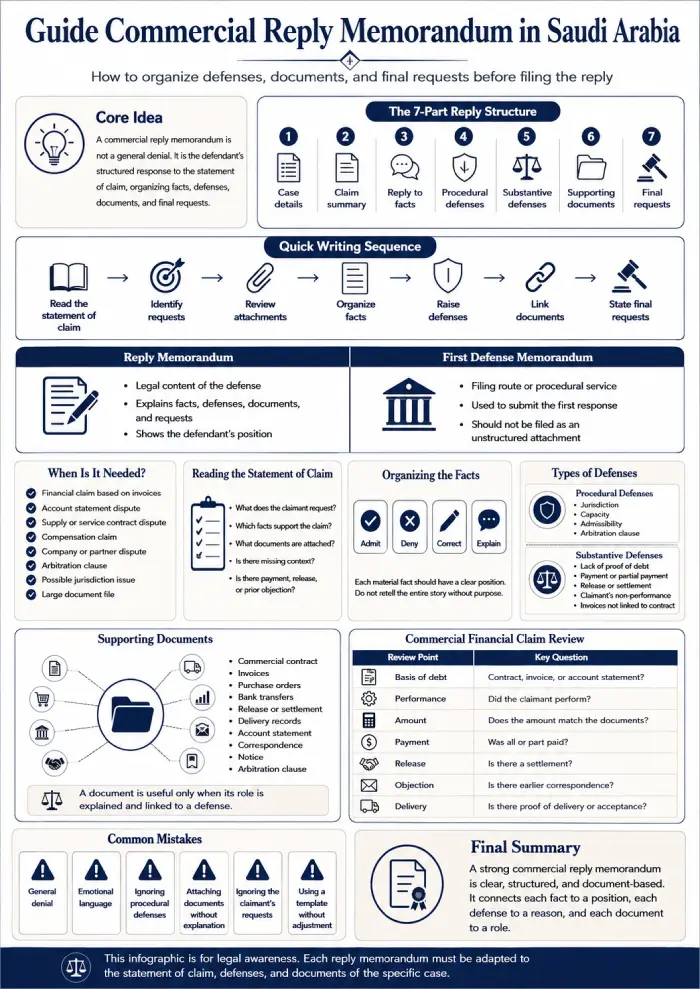
A commercial reply memorandum should be written in a clear sequence: read the statement of claim, identify the claimant’s requests, review the attachments, organize the facts, raise procedural defenses where relevant, present substantive defenses, and conclude with specific final requests.
Have you received a commercial statement of claim and are unsure how to structure your reply before the hearing? A focused review of your commercial reply memorandum can help organize the defenses, connect each document to the claimant’s requests, and avoid a broad response that may not support your position.
Prefer to understand the reply structure first? Continue reading the guide.
| Memorandum Section | Practical Purpose |
|---|---|
| Case details | Identifies the court, case number, parties, and capacity of the filer |
| Claim summary | Summarizes what the claimant requests without copying the full statement |
| Reply to facts | Admission, denial, correction, or clarification of each material fact |
| Procedural defenses | Jurisdiction, capacity, admissibility, or arbitration clause where relevant |
| Substantive defenses | Payment, settlement, lack of debt, or claimant’s non-performance |
| Documents | Links each defense to a supporting attachment |
| Final requests | States clearly what the defendant asks the court to decide |
The Ministry of Justice provides the First Defense Memorandum Request service within judicial services. It allows the beneficiary to select the case, add a new memorandum, enter the request details, and submit it electronically. For this reason, the first reply should be organized before filing, not uploaded as an unstructured attachment.
What Is a Reply Memorandum in a Commercial Case?
A reply memorandum in a commercial case is a defense document filed by the defendant or the defendant’s representative in response to the commercial statement of claim. It explains the defendant’s position on the facts, requests, and documents submitted by the claimant.
It is not a general letter, a brief objection, or a place for emotional statements. It is a structured defense document. It starts with understanding what the claimant is asking for, then identifies the points of dispute, and then presents the defenses and attachments that support the defendant’s position.
For example, if the claimant demands payment based on invoices, it is not enough for the defendant to say: “There is no debt.” A stronger reply explains the basis of the objection. Are the invoices not linked to a contract? Was delivery not completed? Was part of the amount already paid? Is there a settlement release? Does the account statement show a different balance? Does correspondence prove a prior objection?
In that sense, a commercial reply memorandum is a tool for organizing the defense before the hearing. It is not a merely formal response to a judicial document.
Difference Between a Reply Memorandum and the First Defense Memorandum
A commercial reply memorandum is the legal content that explains the defendant’s position. The first defense memorandum is the route or service through which the first response may be submitted before the hearing or within the designated electronic stage.
The practical difference is simple:
| Item | Meaning |
|---|---|
| Reply memorandum | The text containing facts, defenses, documents, and requests |
| First defense memorandum | The procedure for submitting the first response in the case |
| Common mistake | Filing a long document without structure, or a short reply that does not answer the requests |
The first memorandum does not necessarily end the defense, but it often shapes the first impression of the defendant’s position. It should therefore be clear, coherent, and connected to the documents.
When Do You Need a Commercial Reply Memorandum?
You need a reply memorandum whenever a commercial statement of claim includes requests that require a specific answer. The need is not based only on the value of the claim. It also depends on the documents and defenses involved.
The need is especially clear in the following situations:
- A financial claim based on invoices or an account statement.
- A dispute arising from a supply, distribution, or service contract.
- A compensation claim based on alleged breach of contract.
- A dispute between partners or a claim involving a company.
- A statement of claim involving an arbitration clause or possible jurisdiction defense.
- A claim relying on incomplete or selective correspondence.
- A case with many documents that need to be organized.
- A claim that mixes correct facts with inaccurate conclusions.
In these situations, a broad response is not enough. You need to explain what you admit, what you deny, which document supports your position, and what outcome you ask the court to reach.
Reading the Statement of Claim Before Writing the Reply
The first step is not writing. It is analytical reading. Read the statement of claim as a case file, not as one paragraph.
Start by identifying the requests. Is the claimant seeking payment, compensation, contract termination, confirmation of debt, or delivery of documents? Each request needs a specific answer.
Then review the facts on which the claimant built the request. Do not reply to every sentence in detail. Focus on facts that may affect the outcome: the contract, performance, breach, payment, delivery, correspondence, notice, or arbitration clause.
After that, review the attached documents. Ask the following questions about each document:
- What is the claimant trying to prove with it?
- Does the document actually prove that point?
- Is there another version or correspondence that changes its meaning?
- Is the document linked to the request, or is it only a side attachment?
- Is there a release, transfer, or earlier objection?
If you need to understand how the claimant’s statement of claim is usually structured, you may review the guide on commercial lawsuit petition. This page, however, focuses on the defendant’s reply.
Organizing the Facts in the Reply Memorandum
Facts in a reply memorandum do not mean retelling the entire story. Each material fact should be connected to a clear position: admission, denial, correction, or defense.
If a fact is correct, do not deny it without reason. If it is incomplete, correct it. If it is wrong, deny it and explain why. If it is correct but does not lead to the result claimed by the claimant, explain that clearly.
Practical example:
| Statement in the Claim | Professional Reply |
|---|---|
| A contract exists between the parties | We admit the contract within its stated scope and deny any obligation beyond that scope |
| The goods were fully delivered | We do not admit full delivery; delivery records show only partial delivery |
| Invoices are outstanding | Invoices alone are not sufficient unless linked to delivery or acceptance |
| No payment was made | Part of the amount was paid under the attached transfers |
| Correspondence shows acceptance | The correspondence is selective; the full context shows an objection |
This method makes the memorandum easier to read. It also prevents the reply from becoming long without helping the defense.
Organizing Defenses in the Reply Memorandum
The order of defenses affects the clarity of the memorandum. Do not always start with the merits of the claim before checking procedural defenses that may affect the direction of the case.
Procedural Defenses
Procedural defenses relate to the procedure, jurisdiction, admissibility, or capacity of the parties. Examples include lack of jurisdiction, inadmissibility, lack of capacity, or reliance on an arbitration clause where one exists.
These defenses should not be used automatically. Each defense must have a real basis in the file. If the contract includes an arbitration clause, its effect should be reviewed before discussing the merits of the claim. If the claimant filed the case against the wrong party, capacity should be addressed clearly.
Where a defense concerns the competent court, you may review the guide on commercial court jurisdiction to understand the general framework without turning this article into a separate jurisdiction guide.
Substantive Defenses
Substantive defenses relate to the right itself. They answer the question: is the claimant’s demand proven, and are the documents sufficient to support it?
Examples include:
- Lack of proof of debt.
- Full or partial payment.
- Existence of a settlement or release.
- The claimant’s failure to perform its obligation.
- Invalidity or unreliability of invoices.
- Invoices not being linked to the contract.
- No commercial relationship supporting the claim.
- A prior objection proven by correspondence.
- A mismatch between the account statement and the claimed amount.
A substantive defense becomes stronger when it is linked to a document. Do not simply write: “The claimant is wrong.” Explain why, and refer to a clear attachment.
Documents Supporting a Commercial Reply Memorandum
A document in a reply memorandum is not just an attachment. Its value appears when you explain what it proves and how it supports the defense.
| Document | What It Proves | When It Helps |
|---|---|---|
| Commercial contract | Scope of relationship and obligations | When responding to requests outside the agreement |
| Invoices | Claim value or part of it | When reviewing the basis of the debt or objecting to it |
| Purchase orders | Request for goods or services | In supply and repeated-dealing relationships |
| Bank transfers | Payment or partial payment | When arguing that the obligation is fully or partly discharged |
| Release or settlement | End of a claim or settlement of an amount | When there is acknowledgment that the debt or part of it is closed |
| Delivery records | Performance or non-performance | In disputes over delivery or delay |
| Account statement | Transaction history between the parties | In ongoing commercial relationships |
| Correspondence | Admission, objection, negotiation, or amendment | When explaining the context of dealing |
| Notice | Prior demand or objection | When showing the sequence of the dispute before litigation |
| Arbitration clause | Agreed dispute resolution route | When relying on an arbitration agreement |
Digital correspondence, such as emails or electronic messages, should be submitted in a way that preserves its source, context, and date. Saudi Evidence Law includes specific rules on digital evidence, including official digital evidence and digital extracts when statutory requirements are met. For that reason, not every message should be described as conclusive evidence. Its weight depends on how it is presented and its surrounding context.
How Do You Reply to a Commercial Financial Claim?
A reply to a commercial financial claim starts with one question: what is the basis of the amount?
The basis may be a contract, invoices, an account statement, a purchase order, supply, or performed services. Do not treat all financial claims in the same way. An invoice claim is different from a compensation claim, and an account statement claim is different from a partnership dispute.
When preparing the reply, examine the following points:
| Review Point | Practical Question |
|---|---|
| Basis of debt | Is the amount based on a contract, invoice, or account statement? |
| Performance | Did the claimant perform what corresponds to the claim? |
| Amount | Does the amount match the documents? |
| Payment | Was all or part of the amount paid? |
| Release | Is there a settlement or acknowledgment ending the claim? |
| Objections | Is there correspondence proving an earlier objection? |
| Supply or delivery | Are there delivery records or proof of acceptance? |
If the claim relates to profits or partnership, a simple denial of the amount may not be enough. The accounts, statements, and documents supporting the figure should be reviewed. Depending on the case file, the appropriate response may be to request accounting review or to limit the claim to the amount supported by evidence.
Simplified Template for a Commercial Reply Memorandum
The following template is for guidance only. It is not a final form for all cases. It must be adapted to the statement of claim, defenses, and documents.
Case and Party Details
Before the Commercial Court in: (……)
Case number: (……)
Circuit: (……)
Claimant: (……)
Defendant: (……)
Filed by: Defendant / Defendant’s representative.
Summary of the Claimant’s Allegations
The claimant alleges that the defendant owes an amount of (……), arising from (contract / invoices / account statement / commercial dealing), and requests an order for (……).
Reply to the Facts
First: The defendant admits the commercial relationship within the limits of (……), and denies anything beyond that scope.
Second: The defendant does not admit the claimed amount because (……).
Third: The documents relied upon by the claimant do not prove the full claim for the following reasons: (……).
Defenses
The defendant raises the following defenses:
- Procedural defense: (lack of jurisdiction / arbitration clause / lack of capacity / inadmissibility), depending on the case.
- Substantive defense: (lack of proof of debt / partial payment / release or settlement / claimant’s non-performance / invoices not linked to the contract).
Documents
The defendant attaches:
- The contract or agreement.
- Transfers or proof of payment.
- Release or settlement, if any.
- Supporting correspondence.
- Account statement.
- Any document that limits or disproves the claimant’s demand.
Final Requests
The defendant respectfully requests the court to:
- Dismiss the claim or reject the unsupported part of it.
- Alternatively, limit the claim to the amount supported by documents, if any.
- Rule in accordance with the documents and defenses submitted.
Common Mistakes When Preparing the Reply
- General denial. A statement such as “I deny everything in the claim” is not enough where the statement of claim includes specific documents that require a response.
- Emotional language. The memorandum is not the place to attack the claimant’s intentions. It should present facts, defenses, and documents.
- Ignoring procedural defenses. An arbitration clause, jurisdiction issue, or capacity defense may require attention before discussing the merits.
- Attaching many documents without explanation. An unexplained document may not serve its intended purpose.
- Ignoring the claimant’s requests. A defendant may respond to the facts but fail to ask clearly for dismissal, rejection of part of the claim, or limitation of the claim to a specific amount.
- Using a ready-made template without adjustment. A template gives structure, but it does not know the facts and documents of your case.
When Do You Need Legal Review Before Filing the Reply?
You may need legal review before filing a commercial reply memorandum if the claim value is high, the file contains many documents, an arbitration clause exists, a jurisdiction issue may be raised, or the dispute relates to a company, partnership, or ongoing commercial relationship.
Legal review is also useful when the statement of claim relies on documents that look valid on their face but need context. An invoice may exist, but delivery may not be proven. A contract may be valid, but the claimant may not have performed its obligation. Correspondence may be selective and omit the part that supports the defendant’s position.
Have you received a commercial statement of claim and need to organize the reply before the hearing?
Reviewing the memorandum can help identify the defenses, connect the documents, and avoid a general response that does not support your position.
Legal Summary
The strength of a commercial reply memorandum does not come from its length. It comes from its structure. Start by understanding the statement of claim, identify the requests, review the documents, arrange the defenses, and connect each defense to a clear attachment.
Each fact should have a position. Each defense should have a reason. Each document should have a role. This is how a commercial reply memorandum becomes an organized defense tool, not a general answer to an existing claim.
This article has been prepared for legal awareness regarding a commercial reply memorandum in Saudi Arabia, focusing on reading the statement of claim, organizing facts, defenses, documents, and requests before filing the reply. It does not replace reviewing the statement of claim and documents of each specific case.
Licence No.: 40462
Last updated: September 2026
FAQs About a Commercial Reply Memorandum
Warning: Undefined array key "name" in /home/u798195860/domains/mohammedaldosari.sa/public_html/wp-content/plugins/seo-by-rank-math-pro/includes/modules/schema/shortcode/faqpage.php on line 31
Warning: Undefined array key "text" in /home/u798195860/domains/mohammedaldosari.sa/public_html/wp-content/plugins/seo-by-rank-math-pro/includes/modules/schema/shortcode/faqpage.php on line 32
How do I start reviewing a commercial statement of claim before drafting the reply?
Start by identifying what the claimant is asking for, then review the facts and attached documents. Do not begin drafting until you understand the claim value, legal basis, supporting evidence, and the specific requests that need a response.
What should I write first in a commercial reply memorandum?
Begin with case and party details, then provide a short summary of the claimant’s allegations. After that, move to your reply on the facts, procedural defenses, substantive defenses, supporting documents, and final requests.
How do I respond if the claimant relies only on invoices?
Check whether the invoices are linked to a contract, purchase order, delivery record, or clear acceptance. If the invoices are not connected to performance or delivery, explain that the invoices alone do not prove the full claim.
What should I do if part of the claimed amount was already paid?
Mention the payment clearly in the reply and attach bank transfers, receipts, account statements, or correspondence confirming payment. The defense should explain whether the payment was full, partial, or linked to specific invoices.
How do I use an arbitration clause in the reply memorandum?
If the contract includes an arbitration clause, review it before discussing the merits of the claim. The reply should raise the clause clearly and explain why it may affect the court route or the way the dispute should proceed.
How do I organize procedural defenses in the memorandum?
List procedural defenses before discussing the merits where they are relevant. These may include jurisdiction, capacity, admissibility, or arbitration, depending on the facts and documents of the case.
How do I organize substantive defenses in the memorandum?
Substantive defenses should respond to the claim itself. For example, explain lack of proof of debt, payment, release or settlement, claimant’s non-performance, or why invoices are not linked to the contract.
What documents should I attach to support my reply?
Attach documents that directly support your defenses, such as the contract, invoices, purchase orders, bank transfers, release or settlement, delivery records, account statements, correspondence, notices, or arbitration clause.
How do I avoid a weak general denial?
Do not write only “I deny the claim.” Instead, respond to each material fact with admission, denial, correction, or explanation, and connect your position to a document or specific defense.