Legal Review Author:
Lawyer Mohammed Aboud Al-Dossari
Licensed lawyer in the Kingdom of Saudi Arabia — License No. 40462
Published: September 24, 2026
Reviewed by: Lawyer Mohammed Aboud Al-Dossari
Last Legal Review: September 27, 2026
Director liability in Saudi Arabia becomes relevant when a dispute goes beyond an ordinary corporate debt and involves an act or omission attributable to company management that allegedly caused loss to a third party.
A director does not become personally liable simply because the company has financial difficulties, fails to pay a debt, or loses a transaction. Article 28 of the Saudi Companies Law links liability to a breach of the Law or the company’s constitutional documents, or to an error, negligence, or omission in the performance of management duties.
This distinction matters from the outset. A claimant should separate two questions: does the company owe an obligation to the injured party, and is there a separate legal basis for holding the director personally accountable for management conduct?
This guide assesses seven points: the claimant’s status, the director’s conduct, the legal basis of liability, the loss, causation, attribution of the conduct, and the evidence connecting those elements.
Quick Answer
Director liability in Saudi Arabia does not arise merely because the company owes money or suffered a poor commercial outcome. There must be an identifiable act or omission attributable to the director, falling within a breach of law, company documents, error, negligence, or omission, together with proven third-party loss and a causal connection between the conduct and that loss.
A third party having a claim against the company does not automatically mean that the same claim exists against the director personally. Director liability requires a separate legal basis.
Saudi Companies Law — Bureau of Experts at the Council of Ministers, particularly Article 28. Verified September 2026.
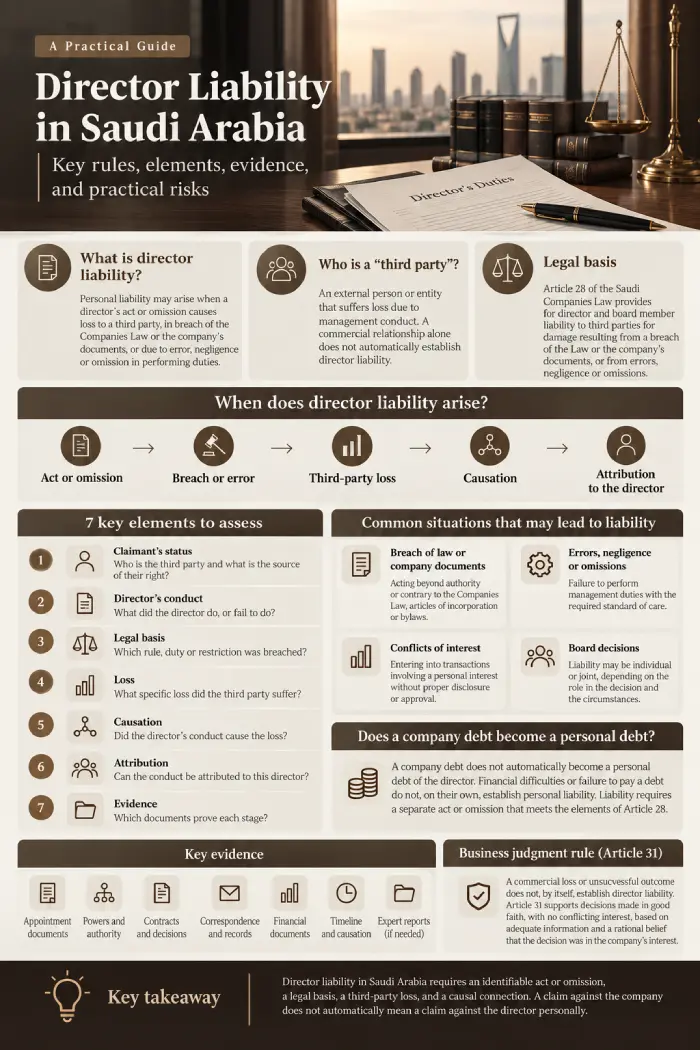
When Does Director Liability in Saudi Arabia Arise?
Liability to a third party arises only when the relevant elements work together. Loss alone does not establish responsibility if no specific conduct can be attributed to the director. Likewise, proving a breach is not enough unless the claimant can show that the alleged loss resulted from that breach.
Article 28 provides that directors and board members may be liable to compensate third parties for damage resulting from a breach of the Companies Law, the company’s articles of incorporation or bylaws, or from errors, negligence, or omissions committed in performing their duties.
The analysis should therefore begin with the act or omission itself, not with the amount claimed. The next steps are to identify the legal duty or restriction involved, establish the loss, and determine whether the director’s conduct caused that loss.
| Issue to Examine | Main Question |
|---|---|
| Act or omission | What did the director do, or fail to do? |
| Legal basis | Which legal rule, duty, or restriction was allegedly breached? |
| Loss | What specific loss did the third party suffer? |
| Causation | Did the director’s conduct cause the loss, or was another factor responsible? |
| Attribution | Can the conduct be attributed to this director personally? |
| Timing | When did the conduct occur, and when did the loss arise? |
| Evidence | Which document proves each stage of the claim? |
Who Is a “Third Party” Under Article 28?
Article 28 refers to third parties separately from the company, shareholders, and partners. However, the provision does not contain a closed list identifying every person who may fall within that category.
For this article, a third party means an external person or entity claiming to have suffered loss because of management conduct. The claimant’s legal position may arise from a contract, commercial dealing, or another relationship with the company.
A commercial relationship alone does not establish director liability in Saudi Arabia. The key question is whether the third party suffered loss that can be linked to a breach, error, negligence, or omission attributable to management.
This is why management liability is different from an ordinary contractual claim. A supplier, creditor, or customer may have a valid claim against the company under a contract. Moving from that corporate claim to a personal claim against the director requires a separate and provable legal basis.
Does a Company Debt Become a Personal Debt of the Director?
A debt owed by the company does not, by itself, establish director liability in Saudi Arabia, nor does it automatically convert the company’s obligation into a personal obligation of its director.
Under the Companies Law, a company acquires legal personality after registration in the Commercial Register. Article 9 also addresses the transfer to the company of contracts and acts entered into on its behalf by its founders. Liability under Article 28 is different because it focuses on management conduct and the damage resulting from that conduct.
Three legal issues should therefore remain separate: the company’s debt, the liability of shareholders or partners according to the company’s legal form, and the director’s liability for management conduct.
A company’s failure to pay an amount due does not prove that the director personally owes that amount. However, if a separate act attributable to the director falls within Article 28 and causes loss, the director’s potential liability may need to be assessed independently from the company’s underlying debt.
Saudi Companies Law — Ministry of investment, particularly Articles 9, 28, and 31. Verified September 2026.
What Management Errors May Give Rise to Liability?
Article 28 does not limit liability to one type of misconduct. It refers to breaches of the Companies Law, the company’s articles of incorporation or bylaws, as well as errors, negligence, and omissions in the performance of management duties.
For that reason, director liability in Saudi Arabia should be assessed by identifying the conduct itself rather than simply describing the final commercial result as unsuccessful.
Breach of Law or Company Documents
Liability may arise from breaching a statutory requirement or a restriction contained in the company’s articles of incorporation or bylaws. However, establishing a breach does not remove the need to prove that the breach caused the loss being claimed.
Where the dispute mainly concerns the director’s authority to sign, borrow, mortgage, dispose of assets, or otherwise bind the company, see Director Liability for Exceeding Authority. The narrower question here is whether an established breach caused identifiable loss to a third party.
Error, Negligence, and Omission
It is not enough to state that the director managed the company poorly. The claimant should identify what the director was required to do, what was actually done or left undone, and what information and circumstances existed at the time.
Some disputes focus on the degree of care exercised, the independence of the decision, or the information available before the act took place. The Duty of Care and Loyalty of a Company Director explains the management standard itself. This guide focuses on whether the effect of that conduct extended to a third party and caused legally attributable loss.
Why Is Causation Central to Director Liability?
Causation connects the alleged management conduct with the loss for which compensation is sought.
A management breach may have occurred, yet the claimant’s loss may have resulted from a separate event, another person’s conduct, or an unrelated commercial development. In that situation, proving the breach alone does not establish director liability in Saudi Arabia.
By contrast, documents and dates may establish a clear sequence beginning with the director’s conduct and ending with a specific financial or commercial loss.
Practical Evidence Rule
Proving an error does not eliminate the need to prove loss. Likewise, proving loss does not eliminate the need to show that the loss resulted from the director’s act or omission.
A liability file should therefore be built around the event, the resulting loss, and the chronological link between them rather than around a general allegation of poor management.
What Evidence Is Important in a Third-Party Director Liability Claim?
A claim involving director liability in Saudi Arabia should not begin with the amount of compensation requested. It should begin with the event said to have created liability and the evidence supporting each stage.
| Issue | Potentially Relevant Documents |
|---|---|
| Director’s status | Appointment resolution and company records |
| Scope of authority | Articles of incorporation, bylaws, and delegations |
| Alleged conduct | Contract, resolution, minutes, and correspondence |
| Basis of breach | Applicable legal provision, company document, or restriction |
| Loss | Contracts, claims, records, and relevant financial documents |
| Causation | Timeline, correspondence, reports, and expert evidence where required |
No single document proves every type of management dispute. The evidential value of each document depends on the fact it is intended to establish and its connection with both the alleged conduct and the loss.
Financial statements, correspondence, or meeting minutes should not be described as conclusive proof of liability simply because they exist. Each document must be read in context and alongside the remaining evidence.
How Should the Loss Timeline Be Built?
A clear timeline helps identify weaknesses early. If there is no convincing link between the director’s conduct and the loss, the main issue may be causation rather than the quantity of evidence available.
What If More Than One Director Participated in the Decision?
The involvement of several decision-makers does not automatically mean that every participant is liable in the same way.
Article 28 contains rules relevant to individual and shared liability and to the way decisions are adopted. A separate guide on Liability for Board Decisions addresses unanimous decisions, majority decisions, objections, and absence in greater detail.
For present purposes, the main task is to identify the act that allegedly caused loss to the third party, determine who participated in that act, and then assess whether Article 28 applies. This prevents director liability in Saudi Arabia from being treated as automatic simply because a person held a management position at the time.
Is a Commercial Loss Enough to Establish Director Liability?
Article 31 provides a framework for evaluating a decision made or voted on in good faith by a director or board member. The rule is connected to the absence of a personal interest in the decision, an appropriate level of information in the circumstances based on a reasonable belief, and a firm and rational belief that the decision serves the company’s interests.
The burden of proving otherwise rests on the claimant. For Article 31, a “decision” includes acting or refraining from acting in relation to the company’s business.
This means the decision should be assessed according to the circumstances and information available when it was made, rather than solely through hindsight after the commercial outcome is known.
This framework is often compared in English-language corporate law discussions with the Business Judgment Rule, although the Saudi statutory analysis should remain anchored in Article 31 itself.
What If the Director Has a Personal Interest?
If the dispute mainly concerns a director’s direct or indirect personal interest in a contract or decision, the search intent moves beyond third-party liability alone.
In that situation, Director Conflicts of Interest addresses disclosure, authorization, and direct and indirect interests separately.
For this guide, a personal interest matters only to the extent that it is connected to the conduct alleged to have caused the third party’s loss.
7 Tests for Assessing Director Liability to Third Parties
Director liability in Saudi Arabia can be assessed through seven connected tests. These are not additional statutory procedural requirements. They are a practical framework for analyzing Article 28, the underlying facts, and the available evidence.
| Test | Question to Resolve |
|---|---|
| 1. Claimant’s status | What is the claimant’s relationship with the company and the source of the claim? |
| 2. Director’s conduct | What specific act or omission is attributed to the director? |
| 3. Basis of liability | Is there a breach, error, negligence, or omission? |
| 4. Loss | What specific loss did the third party suffer? |
| 5. Causation | Did the director’s conduct cause that loss? |
| 6. Attribution | Was the act individual or part of a collective decision? |
| 7. Evidence | Do the documents connect the previous elements in time and substance? |
Where Does This Analysis End and a Liability Claim Begin?
This article ends at the point where it is possible to assess whether there is a legal basis for holding the director responsible for loss suffered by a third party.
Once the questions become procedural — who may file the claim, what requirements apply, what effect a release of liability may have, and what limitation periods apply — the search intent changes.
For those issues, see Liability Claims under the Saudi Companies Law, which addresses procedural requirements and applicable periods separately.
Scope of This Guide
This article explains when director liability in Saudi Arabia may need to be considered where a third party suffers loss, and how to distinguish the company’s own obligation from a separate basis for management liability.
Main Statutory Scope: Articles 28 and 31 of the Saudi Companies Law | Last Verified: September 2026
Frequently Asked Questions About Director Liability to Third Parties
متى يسأل المدير عن ضرر أصاب شخصًا من الغير؟
تنشأ المساءلة عندما يوجد فعل أو امتناع منسوب إلى المدير يدخل في مخالفة نظام الشركات أو وثائق الشركة، أو يمثل خطأ أو إهمالًا أو تقصيرًا، وينشأ عنه ضرر للغير. ولا يكفي وجود الضرر وحده، بل يجب أيضًا بيان الصلة بين فعل الإدارة والضرر محل المطالبة.
هل عدم سداد الشركة لدين يجعل المدير مسؤولًا شخصيًا؟
ليس بمجرده. وجود دين ثابت على الشركة لا يثبت تلقائيًا مسؤولية المدير بموجب المادة 28. يجب وجود سبب مستقل يتعلق بسلوكه الإداري، مثل مخالفة أو خطأ أو إهمال أو تقصير، مع إثبات أن هذا السبب أدى إلى ضرر محدد أصاب صاحب المطالبة.
ما المقصود بالغير في المادة 28؟
تذكر المادة 28 الغير بصورة مستقلة عن الشركة والشركاء والمساهمين، دون قائمة مغلقة في النص نفسه. لذلك يتحدد مركز المتضرر بحسب علاقته بالشركة والواقعة ومصدر الضرر، مع بقاء الشرط الأساسي هو إثبات ضرر نشأ بسبب أحد أسباب مسؤولية الإدارة التي يقررها النظام.
هل يكفي إثبات مخالفة المدير للحصول على تعويض؟
لا يكفي إثبات المخالفة مجردة عن أثرها. فالمادة 28 تربط التعويض بالضرر الذي ينشأ بسبب المخالفة أو الخطأ أو الإهمال أو التقصير. ولذلك يجب تحديد الضرر نفسه ثم بيان العلاقة التي تربطه بالسلوك المنسوب إلى المدير بدل افتراض السببية تلقائيًا.
هل الخسارة التجارية دليل على خطأ المدير؟
لا. النتيجة السلبية وحدها لا تثبت المسؤولية. فالمادة 31 تنظر إلى ظروف القرار والمعلومات المتاحة ومصلحة صاحبه واعتقاده العقلاني بأن القرار يحقق مصالح الشركة. ولذلك يجب تقييم ما كان معلومًا وقت اتخاذ القرار، لا الحكم عليه فقط بعد معرفة نتيجته التجارية.
ما أهم مستندات إثبات مسؤولية المدير تجاه الغير؟
تختلف المستندات بحسب الواقعة، لكن الفحص يبدأ عادة بوثائق صفة المدير وصلاحياته، ثم القرار أو العقد أو المراسلات التي تثبت الفعل، والمستند الذي يبين المخالفة، وما يثبت الضرر. ويجب ترتيبها زمنيًا لإظهار العلاقة بين التصرف المنسوب إلى المدير والنتيجة محل المطالبة.
Legal Conclusion
Director liability in Saudi Arabia does not begin with an unpaid debt, a commercial loss, or a general allegation of poor management. It begins with a specific event attributable to the director.
The next question is whether that conduct amounts to a breach, error, negligence, or omission and whether it caused identifiable loss to a third party.
The company’s liability should remain separate from the director’s liability. The scope of authority should also be distinguished from the question of loss, while collective decisions should be separated from individual conduct. This prevents Article 28 from being treated as a general rule making management responsible for every negative result of the company’s business.
Article 31 also prevents a commercial decision from being judged solely by its eventual outcome. The analysis returns instead to the director’s interests, the information available, and the circumstances existing when the decision was made.
Disclaimer
This article provides general legal information only. It does not constitute legal advice for a specific case and does not create a lawyer-client relationship.
The assessment of liability may differ depending on the company’s legal form and documents, the director’s status and authority, the nature of the conduct, the loss suffered, the claimant’s legal position, and the evidence available.
About the Author
Lawyer Mohammed Aboud Al-Dossari
Licensed lawyer in the Kingdom of Saudi Arabia — License No. 40462.