Legal content prepared by:
Attorney Mohammed Al-Dossary
Licensed Attorney in the Kingdom of Saudi Arabia — License No. 40462 — Practicing since 2013.
Last legal source review: October 13, 2026
Interest and standing in annulment actions should be examined before moving to the legality of the administrative decision itself. A possible defect in a decision does not automatically give every person the right to seek its annulment. Article 13 of the Board of Grievances Law refers to actions for annulment brought by persons concerned against final administrative decisions.
The starting point is therefore the claimant’s legal connection to the decision. What legal position was affected? What practical effect did the decision create? What benefit could annulment provide? And is the person bringing the action the person concerned, or someone legally authorised to act on that person’s behalf?
Questions about lack of jurisdiction, procedural defects, grounds, application or interpretation of the law, and abuse of power belong to the separate analysis of judicial review of administrative decisions.
Quick Answer:
Interest and standing in annulment actions address two different issues. Interest concerns the legitimate practical benefit the claimant may obtain from the judgment and the claimant’s connection to the decision. Standing concerns whether the correct person is bringing the case, representing the person concerned, or being named as the opposing party. A general objection to an administrative decision is not enough.
Legal Basis Article 13 of the Board of Grievances Law addresses actions seeking annulment of final administrative decisions brought by persons concerned. Article 60 of the Law of Procedure before the Board of Grievances provides for supplementary application of the Law of Civil Procedure in matters not specifically governed by that Law, to the extent consistent with the nature of administrative disputes.
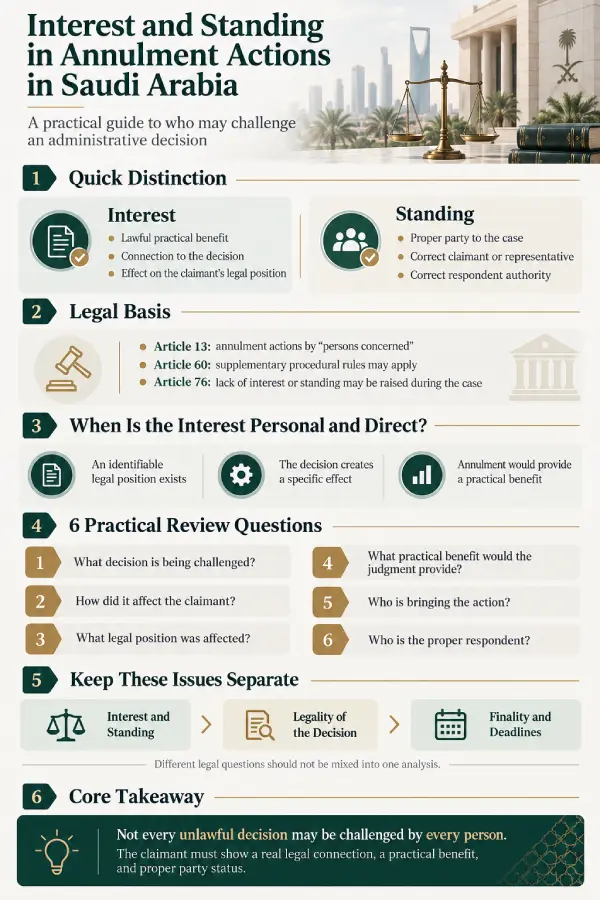
What Do Interest and Standing in Annulment Actions Mean?
The two concepts are connected to whether an action can properly proceed, but they do not answer the same question.
Interest asks why the claimant needs the judgment and what legitimate practical benefit it may produce.
Standing asks whether the correct person is bringing the action and whether the proceedings are directed against the proper party.
Interest: What Practical Benefit Would the Judgment Provide?
Article 3 of the Saudi Law of Civil Procedure establishes the general requirement of a legitimate interest in bringing a claim or raising a defence.
The provision also recognises potential interest in a limited context, including where a claim is brought as a precaution against imminent harm or to preserve a right whose evidence may otherwise be lost.
In administrative litigation, the rule must be read through the supplementary framework established by Article 60 of the Law of Procedure before the Board of Grievances and in a manner consistent with the nature of administrative disputes.
In an annulment action, interest is easier to identify when the decision affects a legal position belonging to the claimant and annulment could remove that effect or provide another identifiable lawful benefit.
A general belief that a decision is unfair, unsuitable, or unlawful does not by itself establish sufficient interest where the claimant has no specific legal connection to its effects.
Standing: Who Is the Proper Party?
Standing concerns the proper party to the proceedings.
The person whose legal position is affected may bring the action personally. A legally authorised representative may also act on that person’s behalf where the requirements for representation are satisfied.
Standing also matters on the respondent side. The correct administrative authority must be identified.
The fact that a particular official signed the decision does not necessarily mean that the case should be directed against that official personally. The authority’s legal structure and its relationship to the decision must be examined.
Article 76 of the Law of Civil Procedure permits a plea of inadmissibility based on lack of capacity, interest, or standing to be raised at any stage. The court may also address such matters on its own motion.
In administrative litigation, that rule is applied within the supplementary framework provided by Article 60 of the Law of Procedure before the Board of Grievances.
What Is the Difference Between Interest and Standing in Annulment Actions?
A practical way to distinguish interest and standing in annulment actions is to ask two different questions.
If the question is:
“What lawful practical benefit would this person obtain from the judgment?”
the issue is interest.
If the question is:
“Is this the proper person to bring the action, represent the claimant, or be named as the respondent?”
the issue is standing.
| Review Point | Interest | Standing |
|---|---|---|
| Core question | What legitimate practical benefit would the judgment provide? | Who is the proper party to the proceedings? |
| Main focus | The effect of the decision on the claimant and the benefit of annulment. | The party’s legal relationship to the case, representation, and the proper respondent. |
| If absent | The action may face an objection for lack of interest. | The action may face an objection for lack of standing. |
| Relationship | Often clearest where the claimant is directly affected. | Remains important in representation and respondent-party issues. |
Quotable Definition:
Interest asks what legitimate practical benefit the judgment could provide. Standing asks who is legally entitled to bring or defend the proceedings. The two concepts may overlap, but they are not identical.
When Is the Claimant’s Interest Personal and Direct?
When assessing interest and standing in annulment actions, Saudi administrative judicial materials show the importance of identifying a personal and direct interest.
A general claim that a decision violates the law or harms the public does not by itself give every person sufficient interest to challenge it.
A personal and direct interest does not necessarily require the claimant to be named in the decision. The key issue is whether a real legal connection exists between the decision and a legal position that belongs to that claimant.
Three questions help clarify that connection:
- What legal position exists? This may involve employment status, a licence, participation in a regulated process, or another legally recognised position.
- What did the decision change? Identify the concrete effect of the decision on that position.
- What would annulment achieve? Identify the practical and lawful benefit that could follow from the judgment.
Interest is not limited to financial loss. The relevant effect may concern employment status, licensing, a regulatory entitlement, or another legally protected benefit.
At the same time, a remote effect, general concern, or disagreement with an authority is not enough unless there is a practical connection between the claimant, the decision, and the relief sought.
Who Are the “Persons Concerned” in an Annulment Action?
Article 13 of the Board of Grievances Law uses the expression “persons concerned” when referring to actions for annulment of final administrative decisions.
The provision does not create a closed list of persons who qualify in every type of case.
The better approach is to examine the legal relationship in the particular dispute. What legal position does the person rely on? How did the decision affect that position? And what would change if the requested judgment were granted?
For example, a person who formally participated in a regulated competition and whose position was affected by a related decision is not in the same situation as someone who merely followed that competition from outside.
Similarly, an employment decision may directly affect the legal position of one employee without creating the same connection for every other employee within the authority.
These examples illustrate the analysis only. They do not establish that any specific action will be admitted.
Practical Rule:
A personal and direct interest is easier to identify where the claimant has an identifiable legal position, the decision creates a specific effect on that position, and the requested judgment may provide a legitimate practical benefit.
How Are the Claimant’s and Respondent’s Standing Assessed?
The assessment of interest and standing in annulment actions does not stop with the claimant.
For the claimant, the first step is to identify who owns the legal position affected by the decision.
If the person brings the action for their own interest, the analysis focuses on the connection between that person and the decision.
If someone acts on another person’s behalf, the legal basis for that representation should be checked.
On the other side of the case, the correct administrative authority must be identified by reference to the legal structure governing the decision.
It is not enough to rely only on the name of the official who signed the letter or decision.
Article 76(2) of the Law of Civil Procedure contains an important distinction. If the court determines that an objection based on a defect in the defendant’s capacity is justified, the case is postponed so the person with proper capacity can be notified.
For that reason, it is too broad to say that every standing defect causes an action to be immediately dismissed.
The claimant’s position and the respondent’s position should be analysed separately.
When Can Lack of Interest or Standing Make an Action Inadmissible?
When reviewing interest and standing in annulment actions, Article 76 of the Law of Civil Procedure is relevant because it allows an objection based on lack of capacity, interest, or standing to be raised at any stage. The court may also address the issue on its own motion.
In administrative litigation, this operates through the supplementary framework of Article 60 of the Law of Procedure before the Board of Grievances, to the extent consistent with the nature of the dispute.
Interest may be absent where no legitimate practical benefit would result from the judgment, or where the claimant cannot connect the decision to a legal position specific to them.
Interest can also change while the case is pending.
If the authority withdraws the decision, replaces it, or removes some of its effects, the legal consequence should not be assumed automatically.
The more useful question is:
Have all relevant effects disappeared, or does the claimant still have a practical interest in obtaining a judgment?
Standing may be absent where the person bringing the action neither owns the relevant legal position nor validly represents the person concerned.
A separate issue arises where proceedings are directed against a party that does not have the proper legal relationship to the dispute.
These questions should also be kept separate from statutory challenge periods.
A claimant may have sufficient interest and standing while a different issue arises because of the grievance or filing deadline. For that separate analysis, see: Administrative Decision Finality
Is Public Interest Alone Enough to Seek Annulment?
The role of annulment actions in protecting legality does not mean that every person may challenge every administrative decision they believe is unlawful.
Article 13 refers to persons concerned. The claimant’s relationship to the decision therefore remains central.
Published Saudi administrative judicial materials distinguish a claimant’s personal connection to a decision from the broader public interest in ensuring that administrative authorities comply with the law.
The key question is therefore not only:
“Is the decision unlawful?”
A prior question is:
“Does this claimant have a sufficient legal interest in seeking its annulment?”
Once that issue is addressed, the analysis can move to the legality of the administrative decision and the relevant grounds of challenge.
How Do Interest and Standing Relate to Legality and Challenge Deadlines?
To place interest and standing in annulment actions correctly within Saudi administrative-law analysis, three separate issues should be kept apart.
| Issue | Main Question | Where It Belongs |
|---|---|---|
| Interest and standing | Is the claimant a person concerned, and are the parties properly connected to the case? | This article |
| Legality of the decision | Is there a defect in jurisdiction, procedure, grounds, application of law, or purpose? | Judicial review of administrative decisions |
| Finality and deadlines | Is the annulment route still available from a procedural and timing perspective? | Administrative Decision Finality |
A decision may appear legally defective while the claimant lacks sufficient interest.
A claimant may also have a valid interest and proper standing while a separate time-limit issue prevents the court from reaching the merits.
Keeping these questions separate improves legal analysis and prevents different search intents from being absorbed into one page.
Practical Evidence Block: 6 Questions for Reviewing Interest and Standing
Before examining the substantive grounds for annulment, interest and standing in annulment actions can be organised through six practical questions.
This framework helps organise the facts and documents. It is an analytical tool, not a separate statutory test.
| Review Question | What to Identify | What to Check |
|---|---|---|
| 1. What decision is being challenged? | The administrative act that created the disputed effect. | The decision and related official correspondence. |
| 2. How did it affect the claimant? | The concrete change created by the decision. | Documents showing the claimant’s position before and after the decision. |
| 3. What legal position was affected? | A right, employment status, licence, regulatory relationship, or other recognised interest. | The governing law or regulation and documents establishing that position. |
| 4. What practical benefit would the judgment provide? | What would actually change if annulment were granted? | The relief sought and any continuing effects of the decision. |
| 5. Who is bringing the action? | The person concerned or a properly authorised representative. | Identity, authority to act, or power of attorney where relevant. |
| 6. Who is the proper respondent? | The authority legally connected to the decision. | The decision, the authority’s legal structure, and the source of decision-making power. |
Frequently Asked Questions About Interest and Standing in Annulment Actions
How Do I Know Whether I Have a Personal Interest in Challenging an Administrative Decision?
Start by identifying the legal position that belongs to you. Then identify the effect the decision had on that position and the practical benefit that annulment could provide. A general disagreement with an administrative authority is not enough by itself.
Are Interest and Standing the Same Thing?
No. Interest concerns the legitimate practical benefit that may result from the judgment and the claimant's connection to the decision. Standing concerns whether the correct party is bringing or defending the proceedings. The concepts may overlap, but they are not identical.
Can I Have an Interest If the Decision Was Not Issued in My Name?
Possibly. The name on the decision is not the only factor. The analysis should examine whether the decision directly affected a legal position belonging to you and whether annulment could provide a legitimate practical benefit.
What Happens If the Wrong Administrative Authority Is Named?
The answer depends on the nature of the defect and the applicable procedural rule. The respondent's position should be examined separately from the claimant's position. Article 76(2) of the Law of Civil Procedure specifically addresses a defect relating to the defendant's capacity.
Does Withdrawal of the Decision Always End the Claimant's Interest?
Not necessarily. The relevant question is whether the effects of the decision have fully disappeared and whether any practical benefit from a judgment still remains. The result may therefore depend on the relief sought, any replacement decision, and continuing legal effects.
What Should Be Reviewed Before the Grounds for Annulment?
First identify the administrative decision, the person concerned, the legal position affected, the practical benefit sought, and the proper parties.
Legal Conclusion
Interest and standing in annulment actions are not simply questions about whether a claimant has suffered harm.
Interest asks whether the claimant has a legitimate practical benefit connected to the administrative decision.
Standing asks whether the correct person is bringing the action and whether the proceedings are directed against the proper party.
The expression “persons concerned” in Article 13 of the Board of Grievances Law is important because it connects an annulment action to persons who have a genuine legal relationship with the decision, rather than to a general interest in administrative legality.
A useful first review is therefore to identify six elements: the decision, its effect, the legal position affected, the benefit sought, the person concerned, and the proper respondent.
Once those points are clear, separate questions about the legality of the decision, grievance requirements, and statutory deadlines can be assessed without mixing several different legal issues into one analysis.
Disclaimer:
This content is provided for general legal education only. It does not constitute legal advice for any individual matter, and reading it does not create an attorney-client relationship. The legal assessment may differ depending on the administrative decision, facts, documents, applicable Saudi law or regulation, procedural stage, and relevant statutory deadlines.