Legal content prepared by:
Attorney Mohammed Aboud Al-Dossary
Saudi-licensed attorney — License No. 40462 — practicing since 2013.
Last statutory source check: October 17, 2026
Variable income in maintenance cases does not mean that the maintenance payer has no financial capacity. It should also not be reduced to the highest or lowest month shown in the records. A payer may be self-employed, earn changing commissions, or receive higher business income during one season and lower income during another without having a single monthly figure that accurately represents the whole year.
Article 46 of the Saudi Personal Status Law requires maintenance assessment to take into account the circumstances of the person entitled to maintenance and the financial capacity of the person liable to pay it. The review of changing income therefore starts with identifiable financial resources, their nature, and their continuity rather than with an artificial monthly salary figure.
This page is a focused extension of proving the maintenance payer’s income in a maintenance claim.
It does not repeat every method of proving income. Instead, it focuses on situations where financial resources change over time and one monthly salary figure does not reflect the full picture.
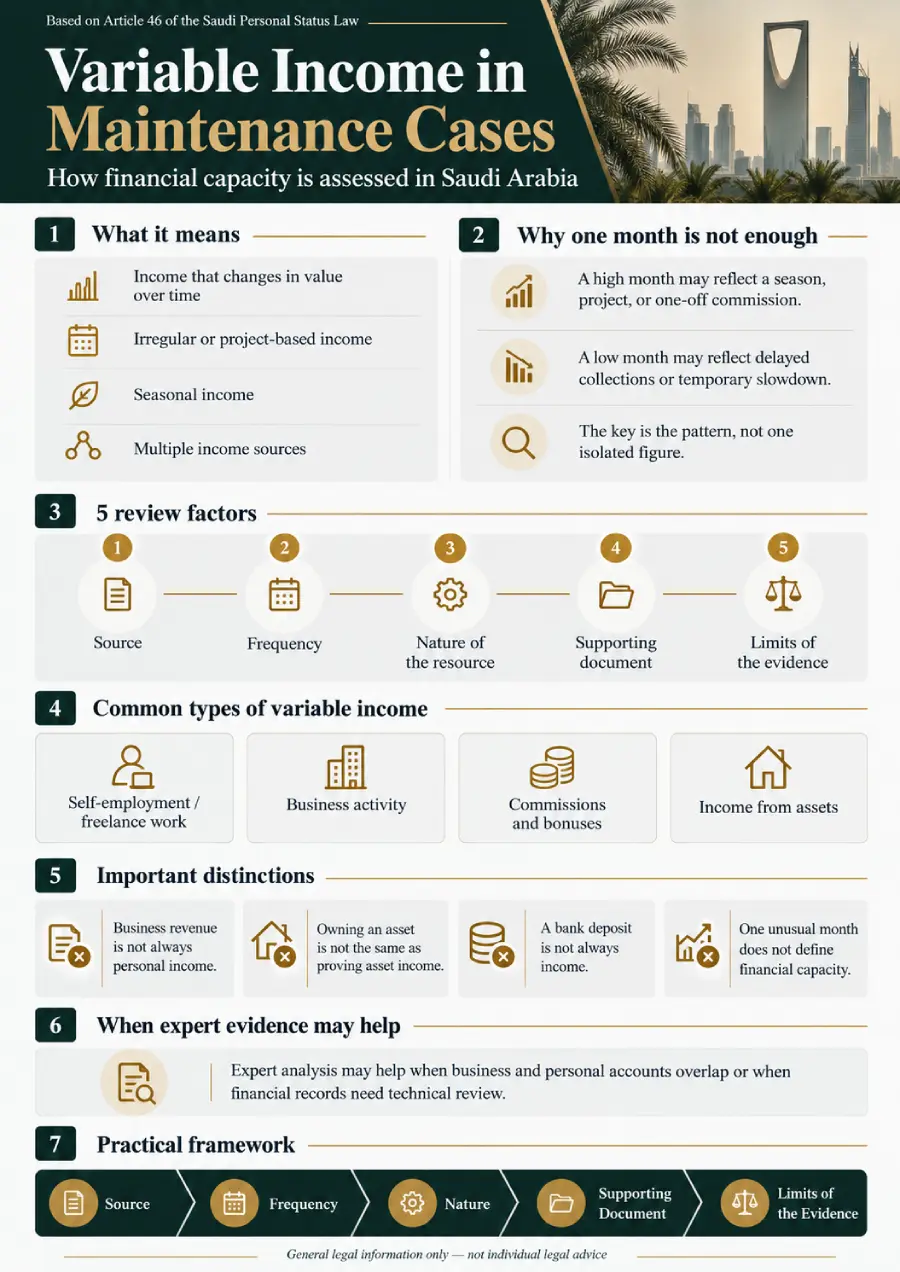
The review follows five connected questions:
Source → Frequency → Nature of the Resource → Supporting Document → Limits of the Evidence.
Direct answer:
Variable income in maintenance cases should be assessed through the pattern of financial resources that can actually be proved, not by selecting one unusually high or low month. The review considers the source, frequency, nature, and supporting documents for each resource, while separating personal income from gross business revenue or one-off financial transactions.
Does the maintenance payer’s income change from month to month, or depend on commissions, self-employment, or business activity? The issue may be how the financial records should be interpreted rather than whether income exists at all. The first step is to separate recurring resources from exceptional payments.
Find Out When a Legal Review May Be Appropriate
If you first want to understand how changing income is assessed, continue reading before taking any further step.
What Does Variable Income in Maintenance Cases Mean?
Variable income in maintenance cases is a practical description of financial resources whose value or timing changes from one period to another. The Saudi Personal Status Law does not create a separate statutory category under that exact label. The concept is useful because it helps explain financial capacity where a fixed monthly salary does not tell the full story.
Changing income may take several forms. A resource may exist throughout the year but change in amount, arise only during a particular season, depend on completed projects, or come from several sources received at different times.
| Type | What it means | Example |
|---|---|---|
| Variable income | An existing resource whose value changes over time. | Sales or performance commissions. |
| Irregular income | A resource that is not received on fixed dates. | Project-based or intermittent professional services. |
| Seasonal income | Income concentrated during a particular season. | A business whose activity rises during specific periods. |
| Multiple income sources | Several resources with different values or payment dates. | Freelance work combined with rental income or commissions. |
The key distinction is that a financial resource is not the same as a financial transaction. Money entering an account proves that a transaction occurred, but it does not by itself establish whether the amount was personal income, financing, reimbursement, or business revenue.
Irregular income should also not be treated as another expression for concealed income. Income may fluctuate simply because of the nature of the work or business. Concealment is a separate issue and requires separate evidence.
Why Is One High or Low Month Not Enough?
The Saudi Personal Status Law does not provide a rule that the highest month must always represent the payer’s financial capacity. Nor does it make the lowest month the permanent measure of that capacity.
When reviewing variable income in maintenance cases, a high month may reflect a strong season, a large project, or a one-off commission. A low month may result from delayed collections, temporary market conditions, or the timing of payments.
The problem with relying on one month is that a limited period is turned into a permanent description of the person’s financial position. A more accurate analysis looks for a pattern that can be explained by the supporting records.
Analytical rule:
One unusually high month does not by itself prove permanent income, and one low month does not prove continuing financial weakness. The better questions are: Why did the figure change? Does the pattern repeat? Which document explains the resource?
The phrase average income should therefore not be treated as a ready-made legal formula. Looking at more than one period may help identify a pattern, but Saudi law does not impose one fixed averaging period or one calculation method for every variable-income case.
The same applies to seasonal income. A longer period may help reveal the financial cycle of a seasonal activity, but it would be unsafe to assume that one season’s income must automatically be divided by twelve unless that method is supported by the facts and evidence of the particular case.
How Is Variable Income in Maintenance Cases Assessed?
Where there is no clear fixed salary, the question changes from “What is the payer’s monthly salary?” to: Which financial resources can be proved, and what is the nature of each one?
A review of variable income in maintenance cases can be organised around five practical factors. They help separate a genuine financial resource from a one-off or differently characterised transaction.
| Factor | Question | Why it matters |
|---|---|---|
| Source | Where did the money come from? | Separates employment, business, asset income, and personal transfers. |
| Frequency | Does the resource recur or appear only once? | Helps distinguish a pattern from an exceptional event. |
| Nature | Is it a personal resource or another type of financial movement? | Prevents every payment from being treated as income. |
| Supporting document | Which document explains the resource? | Connects the assertion to evidence that can be reviewed. |
| Limits of the evidence | What does the document actually prove? | Prevents a document from being given a wider meaning than it supports. |
This framework is not a statutory formula. It is a practical way to organise financial information before reaching a conclusion about the maintenance payer’s financial capacity.
The important point is that financial capacity is broader than salary alone. At the same time, it is not simply the total amount of money that passed through an account or the total capital value of everything a person owns.
How Do Different Types of Variable Income Differ?
Not all forms of variable income in maintenance cases should be read in the same way. Freelance income differs from business revenue, commissions differ from asset income, and an annual bonus differs from a one-off payment.
Self-Employment and Freelance Work
Contracts, invoices, completed work, and transfers linked to services may help show that a self-employed activity exists and generates financial resources. However, the total value of invoices or receipts does not automatically equal the individual’s personal income.
Business Activity
Business revenue must be separated from the money that actually reaches the owner personally. Large sums moving through a business account may reflect sales, purchases, operating expenses, and other commercial activity. Account turnover alone therefore does not establish the owner’s personal income.
Commissions and Bonuses
A recurring commission connected with regular work differs from an exceptional bonus or a payment arising from one transaction. The reason for the payment and how often it is received are therefore important.
Income From Assets
Ownership of an asset is different from the income generated by that asset. Owning property does not by itself prove rental income. A lease and related payments may, however, help establish that an income-producing resource exists.
Key distinction:
Having a business is not the same as proving its profit. Owning an asset is not the same as proving its yield. Gross revenue is also not necessarily personal income. The significance of each figure depends on its nature and the document that explains it.
What Role Does a Bank Statement Play?
A bank statement may help show when payments were received and whether certain transfers repeat. But it does not, by itself, determine the nature of every amount.
For this reason, an assessment of variable income in maintenance cases should not become an exercise in adding every bank deposit and treating the total as income.
A recurring deposit may deserve closer review. A large one-off payment may instead represent the sale of an asset, financing, or a settlement. A transfer between the person’s own accounts may simply reflect movement of existing funds.
Where the specific issue is the difference between a salary certificate and bank activity, see the separate guide on bank statement vs salary in maintenance cases.
7 Practical Factors for Reviewing Variable Income in Maintenance Cases
The following seven factors help organise variable income in maintenance cases. They are not seven statutory conditions. They are a practical framework for reviewing evidence without drawing a conclusion from one isolated figure.
- Source of the money:
Identify the employer, client, business, asset, or other source that generated the payment. A known source can be analysed more reliably than an unexplained deposit. - Frequency:
Repetition may indicate a pattern, but it does not by itself establish the legal or financial nature of the payment. - Continuity:
Distinguish between a resource that appears across several periods and a recent or exceptional transaction. - Ownership of the resource:
Money moving through a person’s account does not always mean that it is personal income belonging to that person. - Nature of the payment:
Commission, rent, business profit, loan proceeds, and asset-sale proceeds are not the same type of financial event. - Business revenue versus personal income:
Gross business sales or receipts do not automatically equal the amount that reaches the owner personally. - Supporting document and its limits:
Each document proves only certain facts. It should not be used to support a conclusion that goes beyond its evidential scope.
Practical Review Block: How Should Changing Income Be Organised?
Instead of creating an artificial monthly salary for someone with variable income in maintenance cases, place every material resource against five questions:
- Source: employment, business, client, property, investment, or another source?
- Frequency: regular, seasonal, or one-off?
- Nature: personal income, business revenue, asset-sale proceeds, financing, or another transaction?
- Supporting document: which contract, invoice, statement, record, or financial document explains it?
- Limits of the evidence: what does that document actually establish, and what cannot be concluded from it alone?
This converts fluctuating figures into specific evidential questions instead of forcing every case into one monthly number.
When Can Financial Expert Evidence Help?
Not every case involving changing income requires an expert. The picture may be clear where contracts, transfers, and other records can be directly connected to identifiable sources.
Expert evidence may become useful where personal and business accounts overlap, several companies or income streams are involved, or accounting records require technical analysis beyond a straightforward reading of the documents.
Article 110 of the Saudi Law of Evidence allows the court to appoint one or more experts where technical expertise is required to decide an issue in the case.
Article 121 also provides that an expert opinion does not bind the court. If the court does not adopt all or part of that opinion, it must state the reasons in its judgment.
Role of expert evidence:
Expert analysis may help explain complex financial records. It does not turn every deposit into income, does not make business turnover equal to personal income, and does not replace the court’s assessment of the evidence.
FAQs About Variable Income in Maintenance Cases
How is variable income assessed in a Saudi maintenance case?
Variable income in maintenance cases is not usually understood from one unusually high or low month. The financial picture should be built from identifiable resources, their frequency, nature, continuity, and supporting documents. The purpose is to understand the payer’s financial capacity without treating every payment or business receipt as personal income.
Does the court use the highest month when income changes?
There is no general rule in the Saudi Personal Status Law requiring the highest-income month to be used as the permanent measure of financial capacity. A high month may reflect a seasonal peak, major project, or exceptional commission. The surrounding pattern and supporting records are therefore more informative than one isolated figure.
Is there a fixed average period for variable income in Saudi Arabia?
Saudi law does not set one universal averaging period for every variable-income case. Looking at several periods may help reveal whether income is regular, seasonal, or project-based, but the relevant period should reflect the nature of the income. An arithmetic average should not be treated as an automatic legal formula.
How can self-employment income be shown if there is no salary certificate?
Self-employment income may be examined through contracts, invoices, completed work, client payments, bank records, and other documents connected with the activity. However, total receipts do not automatically equal personal income. The records should help distinguish business turnover, operating amounts, and money that actually represents a personal financial resource.
Does a commercial registration prove the owner’s income?
No. A commercial registration can help establish the existence of a registered business, but it does not by itself prove the amount of profit or personal income received by the owner. Additional financial records may be needed to understand business revenue, expenses, distributions, and the amounts that actually reach the individual.
When can financial expert evidence help with variable income?
Expert evidence may be useful when personal and business accounts overlap, several income sources exist, or accounting records require technical interpretation. The expert may help explain the financial data within the assigned scope, but the expert’s opinion does not replace the court’s assessment of the evidence or determine the outcome by itself.
Conclusion
Variable income in maintenance cases should not be read from the highest month, the lowest month, or the total of every payment that appeared in an account. The broader statutory consideration is the maintenance payer’s financial capacity, so the analysis should focus on financial resources that can be proved, their nature, and their continuity.
A self-employed person does not need an artificial salary figure before the financial position can be understood. Business revenue does not automatically equal the owner’s personal income. Commissions and bonuses must be assessed according to their nature and frequency, and ownership of an asset is different from income generated by that asset.
The practical framework can be reduced to:
Source → Frequency → Nature → Supporting Document → Limits of the Evidence.
Once the issue moves from general information to an active court file, the appropriate next step is to assess the documents in their full factual context rather than apply one number or one averaging method to every case.
About the Author
Attorney Mohammed Aboud Al-Dossary is a Saudi-licensed attorney, License No. 40462, practicing since 2013. His professional licensing details can be verified through the Licensing and Membership page.
Disclaimer:
This content is provided for general legal information only. It does not constitute an assessment of any individual’s income or a specific maintenance case. It is not case-specific legal advice and does not replace a review of the relevant facts, documents, and evidence. Reading this article does not create an attorney-client relationship.