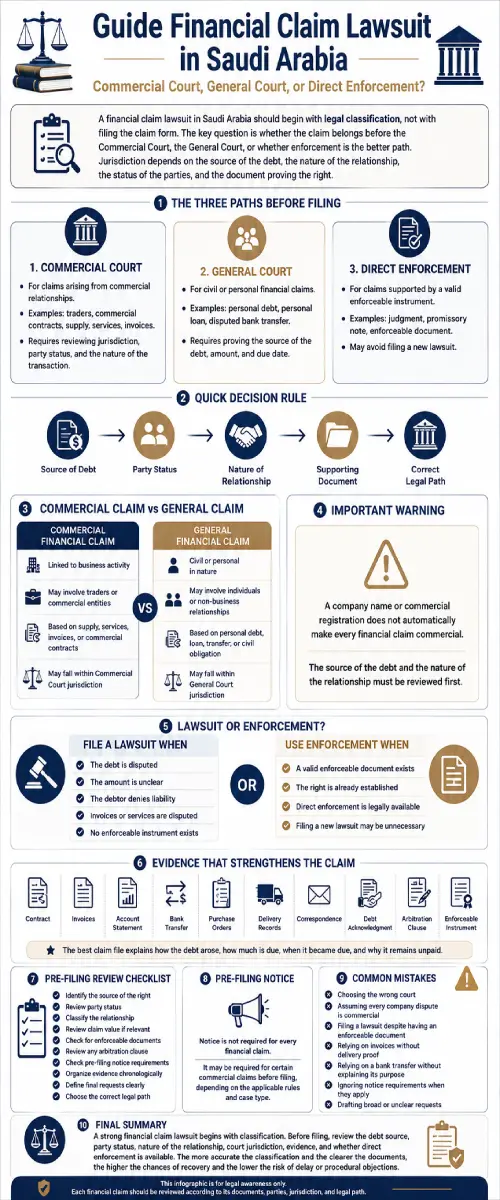
A financial claim lawsuit in Saudi Arabia should not start with filing a claim form. It should start with a more important question: does the claim belong before the Commercial Court, the General Court, or should the creditor proceed directly to enforcement?
A due amount alone does not decide jurisdiction. A company name or commercial registration also does not automatically make the claim commercial. The key factors are the source of the debt, the nature of the relationship, the status of the parties, and the document proving the right.
This article explains how to review the legal path before filing. It clarifies when a financial claim is commercial, when it remains general or civil in nature, when enforcement may be the better route, and which documents help classify the claim before taking action. For the broader framework of business-related disputes, see the guide on commercial disputes in Saudi Arabia.
Quick Answer: Where Should You File a Financial Claim Lawsuit?
A financial claim lawsuit should be filed before the competent court based on the source of the debt, the status of the parties, and the nature of the legal relationship.
If the dispute arises between traders because of their commercial activities, or falls within the jurisdiction of the Commercial Court, the commercial route may apply. If the claim is civil or personal and does not fall under a specialized court, the General Court may be the proper route. If the creditor already holds a valid enforceable instrument, enforcement may be more suitable than filing a new lawsuit.
The Saudi Commercial Courts Law identifies several forms of commercial jurisdiction, including disputes arising between traders due to their commercial activities and certain claims filed against a trader in relation to commercial contracts.
| Situation | What should be reviewed first? | Possible route |
|---|---|---|
| Personal debt between individuals | Cause of debt and proof of entitlement | General Court |
| Disputed bank transfer | Purpose of the transfer and right to refund | Usually General Court |
| Dispute between traders | Party status and nature of activity | Commercial Court, if jurisdiction applies |
| Claim arising from a commercial contract | Contract, amount, and defendant’s status | Commercial jurisdiction review |
| Supply or services between businesses | Contract, delivery, and invoices | May be commercial |
| Promissory note, judgment, or enforceable instrument | Validity for enforcement | Enforcement |
| A company is one party only | Nature of the transaction | Not enough by itself |
The Three Paths Before Filing a Financial Claim Lawsuit
Before filing a financial claim lawsuit in Saudi Arabia, the amount should not be your only focus. The more important step is choosing the correct route from the beginning. A financial claim may be commercial, general, or directly enforceable without a new lawsuit.
The first path is the Commercial Court. This may apply when the claim arises from a commercial relationship that falls within commercial jurisdiction, such as dealings between traders, a commercial contract, supply, or services connected to business activity.
The second path is the General Court. This usually appears when the claim is civil or personal, such as a debt between individuals, a personal loan, or a bank transfer that is not linked to commercial activity.
The third path is enforcement. This applies when the creditor has a valid enforceable instrument, such as a judgment, promissory note, or another document that can be enforced directly. In this case, filing a new financial claim lawsuit may not be necessary.
Before choosing the court or starting the procedure, review three points: the source of the debt, the status of the parties, and the type of document proving the claim. This step helps avoid choosing the wrong route from the start.
What Is a Financial Claim Lawsuit?
A financial claim lawsuit is a court claim in which the creditor asks the court to order another party to pay a specific amount. It is usually needed when the right requires a judicial ruling to establish the debt, determine its amount, or compel payment.
The debt may arise from a contract, supply transaction, service, loan, bank transfer, invoices, account statement, or acknowledgment of debt. But the claimant must do more than state that an amount is due. The claim should explain why the amount is due, how much is due, when it became due, and which documents connect the defendant to the obligation.
For example, an invoice alone may not be strong enough. The relationship behind the invoice should be reviewed. Was there a contract, purchase order, delivery record, completion document, or acceptance? Similarly, a bank transfer proves that money moved, but it does not always prove why the money was transferred or why it must be returned.
For this reason, a financial claim lawsuit should be preceded by a clear review: what is the source of the amount, what evidence supports it, is the debtor disputing the debt or only the amount, and is there an enforceable document that makes court filing unnecessary?
Commercial Financial Claim or General Financial Claim: What Is the Difference?
The difference between a commercial financial claim and a general financial claim is not based on the amount alone. It depends on the relationship that created the debt. A claim may involve money but remain civil. It may also involve money and be commercial if it is connected to a commercial activity or contract.
A commercial claim usually arises from business activity, such as supply between establishments, commercial services, dealings between traders, or a claim connected to a commercial contract. A general claim may arise from a personal loan, a bank transfer between individuals, or a civil obligation unrelated to business activity.
It is not accurate to assume that every claim between two companies is commercial. It is also not accurate to assume that every claim against a company must go to the Commercial Court. The legal act that created the debt must be reviewed: was it a commercial act? Was it made between traders? Does it fall within Commercial Court jurisdiction? Is there a claim value or special condition that affects the route?
Where jurisdiction is unclear, the article on commercial court jurisdiction may help clarify the general framework without turning this article into a full jurisdiction guide.
When Is a Financial Claim Lawsuit Commercial?
A financial claim lawsuit is commercial when the dispute falls within one of the forms of jurisdiction assigned to the Commercial Court. One clear example is a dispute between traders arising from their commercial activities.
Depending on the file, this may include supply claims, commercial services, dealings between establishments, amounts arising from ongoing business activity, and certain contractual disputes filed against a trader under the applicable rules.
A common mistake is to overgeneralize. Some commercial contract claims filed against a trader are affected by the original claim value under Article 16 of the Commercial Courts Law, including the specific category where the original claim exceeds SAR 100,000. But this threshold should not be applied to every commercial dispute. The correct approach is to identify the exact type of claim and the jurisdictional basis that applies.
Therefore, the right question before filing a financial claim lawsuit is not only: how much is the amount? The better questions are: who are the parties, what is the source of the debt, what type of contract exists, and did the claim arise from a commercial activity covered by the law?
When Does the Financial Claim Belong Before the General Court?
A financial claim belongs before the General Court when it is civil in nature and does not fall within the jurisdiction of a specialized court or judicial body.
Examples may include a personal debt between individuals, a personal loan, a claim for refund of money, a disputed bank transfer, or a civil obligation not connected to business activity. In these cases, the existence of a due amount is not enough to classify the dispute as commercial.
The General Court generally hears claims that fall within its jurisdiction when no specialized court has jurisdiction. Before filing, the source of the debt must be reviewed. Is the relationship commercial or personal? Were the parties acting as traders in this specific transaction? Do the documents reflect business activity, or only a personal transfer or civil dealing?
For example, if a person transfers money to another person and later asks for a refund, the claim does not become commercial simply because one of them owns a commercial registration. The reason for the transfer must be examined. Was it a loan, price, deposit, debt payment, or part of a business transaction? This classification directs the legal path.
Financial Claim Lawsuit or Enforcement Request?
Not every financial claim requires a lawsuit. If the creditor has a valid enforceable instrument, enforcement may be more appropriate than filing a new lawsuit to prove an already established right.
A lawsuit is suitable when the existence or amount of the right is disputed. This may happen when the debtor denies the debt, disputes the amount, claims payment, objects to invoices or services, or when there is no instrument that allows direct enforcement.
Enforcement is more suitable when the creditor has a document that can be submitted through the approved enforcement route. The Saudi Ministry of Justice provides enforcement services for enforceable instruments, including monetary claims, judgments, and other enforceable documents.
Before filing a financial claim lawsuit, ask a practical question: do I need a judgment to establish my right, or do I already have a document that can be enforced? This review may save time, reduce cost, and avoid an unnecessary litigation path.
Evidence That Helps Classify and Prove the Claim
The strongest financial claim file answers four questions: how did the debt arise, how much is due, when did it become due, and why has it not been paid?
| Document | Purpose in the claim | Practical note |
|---|---|---|
| Contract | Shows the source of the obligation | Important for distinguishing commercial and civil relationships |
| Invoices | Show the claimed amount | Usually need to be connected to performance or delivery |
| Account statement | Shows transaction history | Useful in ongoing business relationships |
| Bank transfer | Proves movement of funds | Does not always prove the reason for transfer |
| Purchase orders | Connect the request to supply | Strengthens commercial claim files |
| Delivery records | Prove performance or partial performance | Important in supply and service claims |
| Correspondence | Shows acknowledgment, objection, or context | Helps explain the relationship |
| Debt acknowledgment | Supports the existence of the obligation | Its strength depends on wording and context |
| Arbitration clause | May affect the dispute route | Should be reviewed before filing |
| Enforceable instrument | May allow direct enforcement | May remove the need for a new lawsuit |
Digital correspondence can also be relevant. Under the Saudi Evidence Law, digital evidence is regulated and may have the evidentiary effect of written evidence when the legal requirements are met. Messages and emails may therefore be useful, but their strength depends on attribution, context, connection to the dispute, and supporting evidence.
Is Notice Required Before Filing the Claim?
Notice is not a general requirement for every financial claim. However, it may be required in certain commercial claims before filing.
The Ministry of Justice service for financial claim notice is used to notify a contractual counterparty to perform its obligation. It is linked to the requirements for filing certain commercial cases under Article 19 of the Commercial Courts Law.
Therefore, avoid the absolute statement that every financial claim requires a prior notice. The more accurate approach is to check whether the claim falls within the commercial cases that require pre-filing notice.
This review matters because failing to issue notice where required may affect the filing route. On the other hand, sending a notice where it is not required may still be useful in some cases, because it documents the demand, shows seriousness, and may support early settlement.
How to Review the Claim Before Filing
The purpose of this section is not to explain the Najiz interface step by step. It is to organize the professional review before choosing the legal path.
Use this sequence:
- Identify the source of the right: contract, loan, supply, service, transfer, or acknowledgment.
- Review the status of the parties: individuals, traders, companies, or establishments.
- Classify the relationship: commercial, civil, or subject to a special route.
- Review the claim value if it affects the applicable jurisdictional category.
- Check whether a valid enforceable instrument exists.
- Review any arbitration clause in the contract.
- Check whether pre-filing notice is required.
- Organize the evidence according to the timeline of the relationship and due date.
- Define the requests clearly: principal amount, compensation if applicable, or any connected request.
- Choose the correct path: commercial lawsuit, general lawsuit, enforcement, or professional review before filing.
This sequence makes a financial claim lawsuit based on legal classification rather than a quick selection in an electronic filing system.
Common Mistakes That Delay Financial Claims
The first mistake is choosing the wrong court. A due amount does not automatically make the case commercial, and the existence of a company on one side does not settle jurisdiction.
The second mistake is filing a lawsuit despite having an enforceable instrument. If enforcement is available, it may be more suitable than starting a new claim to prove the same right.
The third mistake is attaching invoices without proof of delivery or service. An invoice may be disputed if it is not connected to a contract, purchase order, completion record, delivery document, or acceptance correspondence.
The fourth mistake is relying on a bank transfer without explaining its purpose. A transfer proves that money moved, but it does not always explain the legal nature of the obligation.
The fifth mistake is ignoring notice requirements where they apply to certain commercial claims. If the route is commercial, pre-filing requirements should be checked before submission.
The sixth mistake is drafting requests in broad terms. A financial claim should be specific: amount, reason, supporting documents, due date, and clear final requests.
When Do You Need Professional Review Before Filing?
Professional review becomes important when the route is unclear: is the claim commercial or general? Is a lawsuit required, or is the document enforceable? Is there an arbitration clause or a possible jurisdictional objection?
Review is also useful when the claim value is high, the contract involves multiple parties, one party is a company and the other is an individual, the evidence is mainly digital, there are partial payments or set-off issues, or both parties have mutual claims.
These are not minor details. Choosing the wrong route may delay recovery and require restructuring the file. Reviewing the relationship and documents before filing may be more important than rushing to submit the claim.
If you have a financial claim and are unsure whether to start before the Commercial Court, the General Court, or through enforcement, you may request a professional review through professional communication to assess the claim, contract, and available evidence before filing.
Legal Summary
A financial claim lawsuit starts with legal classification, not with an electronic platform. Ask first: what is the source of the debt? What is the status of the parties? Is the relationship commercial or civil? Is there a specialized jurisdiction? Do you have an enforceable instrument that makes a lawsuit unnecessary?
If the claim arises from a commercial transaction falling within Commercial Court jurisdiction, the route differs from a personal or civil claim before the General Court. If you have a valid enforceable instrument, a new lawsuit may not be required at all.
The practical result is clear: the more accurate the classification and the clearer the documents, the lower the risk of delay, jurisdictional objections, or choosing a path that does not fit the claim.
FAQs About a Financial Claim Lawsuit
What is a financial claim lawsuit in Saudi Arabia?
A financial claim lawsuit is a court claim where a creditor asks the court to order another party to pay a specific amount. It is usually needed when the debt, amount, or liability requires a judicial decision.
When should a financial claim lawsuit be filed before the Commercial Court?
It may be filed before the Commercial Court when the claim arises from a commercial relationship, such as dealings between traders, commercial contracts, supply, services, or business-related invoices.
When does a financial claim belong before the General Court?
A financial claim may belong before the General Court when it is civil or personal in nature, such as a personal loan, debt between individuals, or a bank transfer not linked to business activity.
What is the difference between a commercial claim and a general claim?
A commercial claim is linked to business activity or commercial transactions. A general claim is usually based on a civil or personal relationship that does not fall within a specialized commercial route.
Should I file a lawsuit or request enforcement?
File a lawsuit when the debt or amount is disputed and needs a judgment. Use enforcement when you already have a valid enforceable instrument, such as a judgment or promissory note.
Does a company name make the claim commercial?
No. A company name or commercial registration does not automatically make every financial claim commercial. The source of the debt and nature of the relationship must be reviewed first.
Can invoices alone support a financial claim lawsuit?
Invoices may support the claim, but they are usually stronger when linked to a contract, purchase order, delivery record, completion document, or correspondence confirming the transaction.
Is a bank transfer enough to prove the debt?
A bank transfer proves that money moved, but it does not always prove why it was transferred or why it must be returned. Supporting evidence is usually needed.
Is notice required before filing a financial claim?
Notice is not required for every financial claim. It may be required in certain commercial claims before filing, depending on the nature of the case and applicable rules.
What should be reviewed before filing a financial claim lawsuit?
Review the source of the debt, party status, relationship type, claim value, evidence, enforceable documents, arbitration clause, notice requirements, and the correct legal route before filing.
Official Sources: