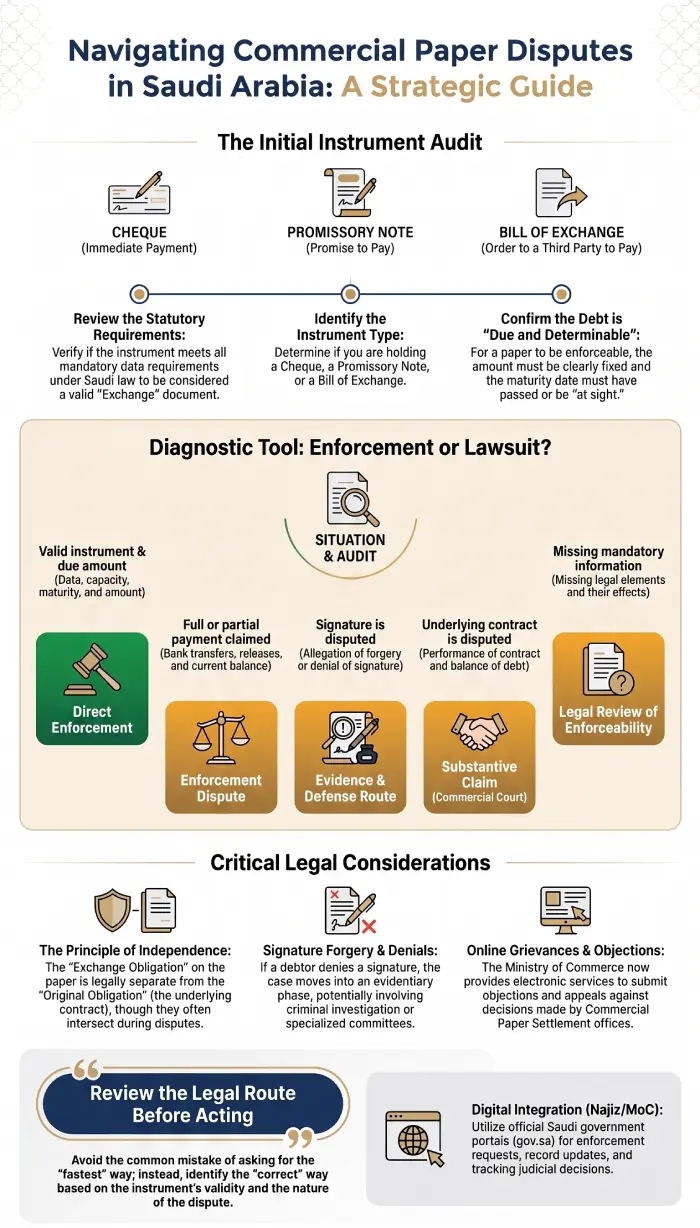
commercial paper disputes in Saudi Arabia should not begin with the question, “What is the fastest way to enforce this instrument?” The first step is to review the instrument itself. Is it a cheque, promissory note, or bill of exchange? Does it meet the statutory requirements? Is the amount due and clearly determined? Is the dispute about payment, signature, the outstanding balance, or the underlying contract?
Under the Saudi Enforcement Law, commercial papers are recognised as enforcement instruments. Compulsory enforcement, however, requires a due and determinable right, and the enforcement judge reviews whether the instrument satisfies the applicable legal requirements. The practical question is whether the case should proceed through enforcement, an enforcement dispute, or a claim concerning the underlying obligation.
Quick Answer: Enforcement or Lawsuit?
In commercial paper disputes, enforcement is usually the first route to examine where the instrument satisfies the statutory requirements and the claimed amount is due and determined. The position changes when the court must examine matters beyond the face of the instrument, such as prior payment, the actual debt, the validity of a signature, or obligations arising from the underlying contract.
| Situation | What to Review | Potential Route |
|---|---|---|
| Valid instrument and due amount | Data, capacity, maturity and amount | Enforcement |
| Full or partial payment | Transfers, releases and balance | Defense or enforcement dispute |
| Signature disputed | Denial or allegation of forgery | Evidence and defense route |
| Underlying debt disputed | Contract, performance and balance | Substantive claim, subject to jurisdiction |
| Missing information | Missing element and legal effect | Review enforceability first |
Do you hold a cheque or promissory note but are unsure whether to enforce it or take another legal route? Reviewing the instrument, contract and payment records before acting can help identify whether the matter is better treated as enforcement, an enforcement dispute, or a substantive claim.
Review the Legal Route Before Acting
Prefer to understand the options first? Continue through the guide before deciding on the next step.
What Are Commercial Paper Disputes?
The term commercial paper disputes refers to legal disagreements involving cheques, promissory notes, or bills of exchange. A dispute may concern the validity of the instrument, payment of its value, enforcement, prior settlement, the signature, or the transaction that led to its issue.
Four concepts should be kept separate:
- Claim for payment: asking the debtor to pay the amount represented by the instrument or the underlying debt.
- Enforcement: using the instrument as an enforcement instrument once the statutory requirements are met.
- Enforcement dispute: a dispute arising from enforcement and concerning whether the legal requirements for enforcement are satisfied.
- Underlying claim: a dispute requiring the court or competent body to examine the debt, contract, or facts beyond the face of the instrument.
The Saudi Enforcement Law gives the enforcement judge jurisdiction over enforcement disputes regardless of value. This does not mean every dispute involving a negotiable instrument belongs before the enforcement court. Likewise, a disagreement about the underlying contract should not automatically be treated as an objection to enforcement.
How Do Cheques, Promissory Notes and Bills of Exchange Differ?
All three are used in commercial paper disputes under Saudi law, but their structure and legal function differ. That difference matters when assessing maturity, missing information, endorsement, recourse, and enforcement.
Cheque
A cheque is payable on sight under the Saudi Commercial Papers Law. It should therefore not be treated in the same way as a deferred credit instrument. Disputes may involve the available balance, signature, endorsement, prior payment, presentation periods, or the agreement under which the cheque was issued.
Calling a cheque a security cheque does not, by itself, prevent enforcement. If one party relies on a separate agreement or circumstance affecting entitlement to the amount, that issue must be supported by evidence and raised through the legally appropriate route.
Promissory Note
A promissory note contains an undertaking by its maker to pay a specified amount to the beneficiary or to order. Saudi law identifies the required elements of a promissory note, but it also addresses certain omissions. Not every missing field produces the same legal result.
For example, the absence of a maturity date does not automatically invalidate a promissory note. It may instead be treated as payable on demand where the remaining statutory requirements are satisfied.
Bill of Exchange
A bill of exchange involves a more complex structure and may raise issues relating to acceptance, endorsement, aval, consideration for payment, and recourse. Rules applicable to cheques or promissory notes should not be transferred automatically to a bill of exchange without examining the provision governing the particular issue.
When Is a Commercial Paper an Enforcement Instrument?
Article 9 of the Saudi Enforcement Law recognises commercial papers as enforcement instruments. Compulsory enforcement, however, requires a right that is due and determinable. In commercial paper disputes, the review should focus on five points:
- Type of instrument: Is it legally a cheque, promissory note, or bill of exchange?
- Required information: Are the statutory details present, and what is the legal effect of any omission?
- Signature and capacity: Who signed the instrument, and did that person sign personally or for a company?
- Maturity: Is the obligation currently due under the rules governing that instrument?
- Amount: Does the amount claimed reflect the actual outstanding liability after payments or settlements?
When Should You Enforce and When Does the Dispute Become Substantive?
In commercial paper disputes, the choice of route should not be based on the assumption that enforcement is always faster or that filing a lawsuit is always safer. The real issue is what the competent authority must decide.
Where the instrument is complete and the amount is due: enforcement is the first route to examine, subject to verification of the balance and the parties’ legal capacity.
Where payment is disputed: bank transfers, settlement receipts and account statements become central. A transfer is more useful when it can be connected clearly to the debt represented by the instrument.
Where the contract is disputed: a supply, construction or sale dispute may require examination of the original debt and the parties’ reciprocal obligations. That may go beyond the face of the instrument.
Where jurisdiction is unclear: do not assume that a promissory note automatically places the case before the Commercial Court. Jurisdiction depends on the claim, legal relationship and parties involved. For the wider jurisdiction framework, see Commercial Court Jurisdiction in Saudi Arabia.
Where the signature is challenged: first determine whether the issue is denial of signature, alleged forgery, or lack of authority to sign. These are legally different arguments.
Valid instrument + due and determined amount → review enforcement.
Payment or balance dispute → review payment and outstanding liability.
Signature dispute → identify denial, forgery, or authority issue.
Underlying contract dispute → review substantive claim and jurisdiction.
Missing information → determine the legal effect before proceeding.
7 Key Defenses Before Enforcement
In commercial paper disputes, there is no universal list of defenses that applies to every case. A defense is useful only when it matches the facts, is legally relevant, and can be supported by evidence.
1. Payment or settlement. If the debtor has paid all or part of the debt, the remaining balance must be identified. Bank transfers and releases should be connected clearly to the promissory note, cheque, contract, or invoice concerned.
2. Denial of signature or allegation of forgery. These are different evidentiary routes. Under the Saudi Evidence Law, the burden and procedure for an allegation of forgery differ from those applicable when a party denies an ordinary written instrument.
3. Statutory periods for commercial-paper claims. There is no single period that applies to every cheque, promissory note, bill of exchange, party, and form of recourse.
4. Missing statutory information. It is not enough to say that an instrument is incomplete. The missing item must be identified and its statutory effect determined, because Saudi law provides default rules for some omissions.
5. Amount not fully due. Part of the face value may already have been paid, or the amount claimed may not match the actual balance shown by the underlying contract or account statements.
6. Underlying transaction or cause. Some defenses arise from the contract or transaction for which the instrument was issued. Their availability may also depend on the parties and whether the instrument has been transferred to another holder.
7. Discharge or variation of the obligation. A release, settlement, later agreement, or other documented event may have reduced or extinguished the debt. The relevant legal effect must be proved rather than simply asserted.
What Is the Difference Between Denying a Signature and Alleging Forgery?
The distinction can materially affect commercial paper disputes. Under the Saudi Evidence Law, an ordinary written instrument is generally attributed to the person who signed it unless that person expressly denies the handwriting, signature, seal, or fingerprint attributed to them in accordance with the statutory rules.
An allegation of forgery is different. It follows a separate procedure, and the party alleging forgery bears the burden of proving that allegation. Where the allegation is relevant and the available evidence is insufficient, the court may order an investigation through comparison of signatures, witness evidence, or both where permitted.
Article 47 of the Evidence Law provides that once the court orders an investigation into alleged forgery, the disputed instrument’s enforceability is suspended, without prejudice to precautionary measures. This is different from saying that simply writing “the signature is forged” automatically stops enforcement.
If forgery is established, the court refers the matter to the Public Prosecution for the appropriate action. The original instrument, specimen signatures, underlying contract, correspondence, and records showing how the document was created may therefore become important evidence.
Limitation Periods: Why Is There No Single Deadline?
A common mistake is to reduce these disputes to statements such as “a cheque is six months” or “a promissory note is three years.” The Commercial Papers Law is more specific.
For bills of exchange, the law distinguishes between claims against the acceptor, recourse by the holder against drawers and endorsers, and recourse among endorsers. Different statutory periods apply depending on the claim and the party concerned.
Certain rules applicable to bills of exchange also apply to promissory notes to the extent that they are compatible with the nature of a promissory note.
For cheques, the statutory six-month period applies to particular rights of recourse and is calculated in the manner specified by law, including reference to the expiry of the presentation period in the relevant case. It should not simply be counted from the date the cheque was issued in every situation.
Before relying on expiry of a statutory period, identify the type of commercial paper, who is making the claim, against whom the claim is brought, and whether the claim is based on commercial-paper rights or the underlying transaction.
Security Cheques and Security Promissory Notes: Does the Label Prevent Enforcement?
Describing an instrument as being “for security” is not, by itself, enough to determine the legal outcome.
A cheque is payable on sight under the Commercial Papers Law. Where a party relies on a separate agreement affecting entitlement to the cheque amount, the agreement and supporting evidence must be reviewed to determine whether and how that argument can be raised.
A promissory note requires a similar factual review. Its wording, statutory elements, maturity, outstanding debt and underlying agreement should all be examined.
For example, a promissory note may have been issued in connection with a construction contract. If the parties later dispute completed works, certified payments and amounts already paid, neither saying “this was only a security note” nor saying “the promissory note is completely independent of the contract” resolves the matter automatically.
Promissory Notes in Financing: What Should Be Checked in 2026?
Where the beneficiary is a bank or finance company supervised by the Saudi Central Bank, finance-sector rules may apply in addition to the Commercial Papers Law and Enforcement Law.
Saudi Central Bank instructions governing finance entities’ use of promissory notes require procedures and supporting documents before enforcement. Relevant records may include the finance agreement, the due promissory note, evidence of default, and records of communication with the customer.
The instructions also require the enforcement claim to be limited to the amount actually due from the defaulting customer according to the contractual documents and account statements. They further address liability where a financing entity enforces a promissory note whose value has already been paid.
A further update became effective on 1 February 2026. Under Saudi Central Bank Circular No. 472038007 dated 22 December 2025, financing entities must stop requesting promissory notes or other commercial papers from individual customers when providing credit-card financing products.
The restriction is specific to that product and should not be described as a general prohibition on promissory notes in all financing arrangements.
Which Court Has Jurisdiction?
There is no single court with jurisdiction over every case. Jurisdiction depends on the relief sought, the underlying legal relationship, the parties, and the stage of the dispute.
Where the matter is an enforcement dispute, the Saudi Enforcement Law gives the enforcement judge jurisdiction over enforcement disputes regardless of value.
Where the case requires determination of an underlying commercial right and falls within the statutory categories assigned to the Commercial Courts, the Commercial Court may have jurisdiction. Some civil disputes may instead fall before the General Court, while certain banking and financing disputes may fall within specialised committees or bodies.
The correct question is therefore not, “Which court handles promissory notes?” but rather, “What legal issue must be decided, and which authority has jurisdiction over that issue?”
Company Signatures: When Does the Signatory’s Capacity Matter?
In commercial paper disputes involving a company, reviewing the amount and signature alone is not enough. The signatory’s identity and legal capacity at the time of signing should also be checked, together with the company type, management powers, and any relevant authorisation.
The dispute may concern whether the company is bound by the instrument, whether a manager acted beyond authority, or whether the manager has separate internal liability toward the company or its partners. These issues should not be merged into one question.
Where the dispute concerns separate damage caused by a manager or board member through breach, fault, or negligence, see Liability Claim under Companies Law.
What Documents Should Be Reviewed Before a Claim or Objection?
In commercial paper disputes, the documents required depend on whether you are seeking enforcement or responding to it. Organising them before taking action reduces the risk of choosing the wrong legal route.
For the holder:
- the original instrument or electronic promissory note record;
- the underlying contract;
- invoices, payment certificates and account statements;
- maturity and balance records;
- evidence of the signatory’s capacity where a company is involved; and
- correspondence affecting payment or entitlement.
For the party facing enforcement:
- a copy of the enforcement instrument and application details;
- bank transfers and settlement receipts;
- an account statement showing the remaining balance;
- the contract, amendments and later settlements;
- signature or authority records where disputed; and
- correspondence showing variation or discharge of the debt.
Common Mistakes Before Enforcement or Objection
- Enforcing before reviewing the instrument: a document labelled “promissory note” should still be checked against the statutory requirements.
- Treating every omission as invalidating: Saudi law provides specific rules for some missing information.
- Ignoring partial payment: the remaining balance should be established before a claim or defense is framed.
- Confusing denial with forgery: the Evidence Law treats them differently.
- Using one limitation period for every case: the applicable period depends on the instrument, claim and parties.
- Assuming a lawsuit automatically stays enforcement: suspension of enforcement is governed by its own legal requirements.
- Copying a generic objection form: an irrelevant defense may weaken the presentation of the actual issue.
- Ignoring the underlying contract because “the note is enough”: the contract may become central once the dispute concerns the actual debt or balance.
When Is a Legal Review Useful?
A focused review becomes useful in commercial paper disputes where an instrument exists but the correct route is unclear. The issue may be whether the instrument is ready for enforcement, whether previous payments must be deducted, whether the signature is disputed, whether the underlying contract changes the amount due, or whether jurisdiction must be determined before proceedings begin.
The purpose of the review is not to manufacture defenses. It is to remove unsuitable routes, identify missing evidence, connect each legal argument to supporting documents, and determine whether the case is primarily an enforcement matter, an enforcement dispute, or a substantive claim.
Frequently Asked Questions About Commercial Papers in Saudi Arabia
What should be reviewed first before enforcing a promissory note?
Start with the note’s statutory information, the signatory’s capacity, maturity and amount. Then compare the note with the underlying contract and payment records to confirm the actual outstanding balance.
When is enforcement more suitable than filing a new lawsuit?
Enforcement is usually the first route to examine where the instrument satisfies the statutory requirements and represents a due and determined obligation. A substantive claim may be needed where the court must determine the underlying debt or contractual relationship.
How does partial payment affect enforcement?
Partial payment affects the amount that remains outstanding. Bank transfers, releases and account statements should be linked clearly to the instrument or underlying debt.
What happens if the signature is denied?
Denial of signature and allegation of forgery are different under the Saudi Evidence Law. The correct evidentiary route depends on the nature of the challenge and the instrument involved.
Does alleging forgery automatically stop enforcement?
No. An allegation alone does not automatically suspend enforcement. Where the court orders an investigation into alleged forgery under the Evidence Law, the disputed instrument’s enforceability is suspended subject to the statutory rules.
Does a missing maturity date invalidate a promissory note?
Not necessarily. Saudi law provides a specific rule for a promissory note without a maturity date, which may be treated as payable on demand if the remaining requirements are satisfied.
Can a security cheque still be enforced?
The label “security cheque” does not by itself determine the outcome. The cheque, the underlying agreement, entitlement to the amount, and supporting evidence should all be reviewed.
Is there one limitation period for all promissory-note claims?
No. The applicable period depends on the type of instrument, the type of claim or recourse, and the parties involved. It should not be reduced to a single number without reviewing the legal relationship.
Which court handles a dispute between two companies?
That depends on the legal issue. An enforcement dispute falls within the enforcement judge’s jurisdiction, while an underlying commercial claim may fall within the Commercial Court where the statutory jurisdiction requirements are met.
What changed for credit-card financing in 2026?
From 1 February 2026, Saudi Central Bank rules require financing entities to stop requesting promissory notes or other commercial papers from individual customers when providing credit-card financing products.
Legal Conclusion
commercial paper disputes in Saudi Arabia are not determined simply by whether the document is called a cheque, promissory note, or bill of exchange. The correct analysis begins with enforceability, the amount actually due, maturity, signature, prior payments, the underlying transaction, and jurisdiction.
Legal Content Review
This guide is prepared for general legal awareness concerning commercial paper disputes involving cheques, promissory notes, and bills of exchange in Saudi Arabia. It focuses on enforcement, enforcement disputes, underlying claims, payment, signatures, statutory requirements, limitation periods, and the underlying transaction.
Content reviewed by: Lawyer Mohammed Al-Dosari
Legal Practice Licence No.: 40462
Last legal update: September 2026