Understanding Director Conflict of Interest in Saudi Arabia starts with one practical question: does the manager or board member have a personal interest connected with a decision being made for the company? A personal benefit or connection with the other party does not automatically make the transaction unlawful or void.
The analysis should instead identify the type of interest, whether disclosure is required, whether approval is needed, and which corporate body has authority to give that approval. Saudi Companies Law also distinguishes between interests in company transactions, competition with the company, and the use of company assets, information, or corporate opportunities.
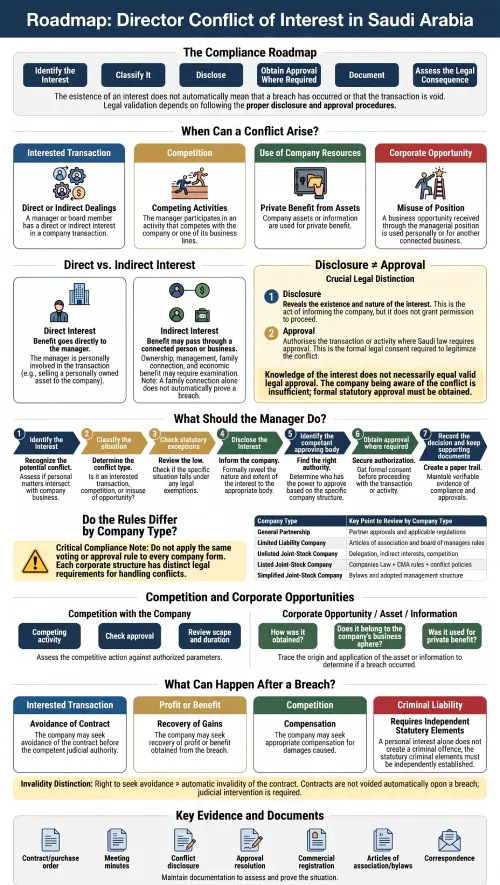
A practical review therefore follows seven connected steps: identify the interest, classify it, check any applicable exception, disclose it, obtain approval where required, document the decision, and then assess the legal consequence of any breach.
A Director Conflict of Interest may arise where a manager or board member has a direct or indirect interest in a company transaction, competes with the company, or uses company assets, information, or opportunities for private benefit. The existence of an interest alone does not prove a breach. Disclosure, approval, exceptions, and the company form must also be examined.
| Situation | What Should Be Checked? |
|---|---|
| Director has an interest in a contract | Nature of the interest, exception, disclosure, and approval |
| Other party is connected with the director | Whether an indirect interest exists |
| Competing activity | Nature of the competition, approval, and duration |
| Use of company assets, information, or opportunities | Whether the conduct falls within the relevant prohibition |
| Transaction already performed | Avoidance, recovery of benefit, or compensation depending on the breach |
Saudi Companies Law — Bureau of Experts at the Council of Ministers
particularly Articles 26 and 27. Checked: September 2026.
What Is a Director Conflict of Interest?
A conflict of interest exists where a manager’s private interest may interfere with the duty to exercise managerial authority for the company.
The benefit may go directly to the manager or indirectly through a connected person or business. Other situations may involve competition with the company or the use of an asset, information, or business opportunity obtained through the managerial position.
A Director Conflict of Interest does not become a breach merely because a benefit exists. Some transactions may proceed after proper disclosure and approval, while others may fall within a statutory exception. Different consequences may also apply depending on whether the conduct concerns a transaction, competition, or company resources.
The review should therefore identify the transaction, the person receiving the benefit, the approving body, and the records showing what was disclosed or authorised.
What Is the Difference Between Conflict of Interest and the Duty of Loyalty?
The duty of loyalty is broader than Director Conflict of Interest. It governs how a manager should exercise authority for the company’s interests and with independent judgment.
Conflict of interest is one situation in which that wider duty is tested. It arises when a private interest may affect the manager’s judgment or involvement in a company decision.
For the broader framework on authority, decision quality, independence, and reasonable care, see Duty of Care and Loyalty.
A disagreement with shareholders or a commercial loss is not enough by itself to establish a conflict. The key question is whether a private interest was connected with the decision and whether the applicable disclosure and approval requirements were followed.
How Do Direct and Indirect Interests Differ?
A direct interest is usually easier to identify because the benefit goes to the manager personally. For example, the manager may sell a personally owned asset to the company or may personally be the other party to the transaction.
An indirect interest requires closer examination of the connection between the manager and the person or entity receiving the benefit.
For certain company forms, the Implementing Regulations provide examples involving relatives of a board member and companies or businesses connected with the board member or those relatives. The detailed test should therefore be applied according to the relevant company form rather than treated as one universal definition.
| Situation | Initial Assessment |
|---|---|
| Manager sells personally owned property to the company | Clear direct interest |
| Company contracts with a business owned by the manager | Interest, disclosure, and approval should be examined |
| Contracting entity is connected with a relative | May constitute an indirect interest under the applicable rules |
| Personal relationship only | Does not establish a breach without a connected benefit or decision |
| Contract awarded through public competition | May fall within an Article 27 exception if the conditions are met |
Implementing Regulations of the Saudi Companies Law. Checked: September 2026.
What Should a Manager Do When an Interest Exists?
When a Director Conflict of Interest becomes apparent, the manager should not wait until the contract is signed or a dispute arises.
The first step is to classify the situation. Is the interest connected with a company transaction? Does it involve competition? Or does it involve a company asset, information, or corporate opportunity? Article 27 does not treat those categories in exactly the same way.
The next step is disclosure. Article 26 requires a manager or board member to disclose a direct or indirect interest in transactions conducted for the company.
The company must then determine whether approval is required and which corporate body has authority to grant it under the Companies Law, applicable regulations, and the company’s constitutional documents.
The Saudi Ministry of Commerce also publishes conflict-of-interest guidance forms, including disclosure and approval forms for several company structures.
Is Disclosure Alone Enough?
No. In a Director Conflict of Interest, disclosure and approval perform different functions.
Disclosure identifies the existence and nature of the interest. Approval concerns whether the relevant transaction or activity may proceed where authorisation is required.
The fact that partners, shareholders, or managers knew about the interest does not necessarily amount to valid statutory approval. The company should verify who had authority to approve the matter, how the decision was made, and whether the transaction stayed within the scope of that approval.
Competition is governed separately. The same is true of the use of company assets, information, and corporate opportunities. These situations should not be reduced to one general consent form.
Who Has Authority to Approve the Conflict?
Article 27 provides for approval by the partners, general assembly, shareholders, or a properly delegated body, depending on the company structure and the applicable rules.
The Implementing Regulations add further requirements for particular company forms. These can affect the approving body, the duration of an authorisation, and whether an interested manager or board member may participate in deliberation or voting.
How Do the Rules Differ by Company Type?
There is no single conflict-of-interest procedure for every Saudi company.
The Companies Law provides the general framework. The Implementing Regulations, articles of association, bylaws, and company form then determine many of the procedural details.
| Company Type | Key Point to Review |
|---|---|
| General partnership | Partner approvals required in cases governed by the regulations |
| Limited liability company | Articles of association and rules governing the board of managers |
| Unlisted joint-stock company | Delegation, indirect interests, and competition |
| Listed joint-stock company | Companies Law, CMA rules, and conflict-of-interest policies |
| Simplified joint-stock company | Bylaws and the adopted management structure |
Limited Liability Company
In a limited liability company, the articles of association are particularly important when reviewing management powers and the treatment of an interested manager.
Article 62 of the Implementing Regulations applies certain approval rules governing a joint-stock company’s board to the board of managers of an LLC, unless the articles of association provide different rules.
The constitutional documents may also affect whether an interested manager can participate in deliberation or voting.
This is why it is unsafe to apply a blanket rule that an interested manager is always prohibited from voting in every company. The analysis should begin with Saudi Companies Law and the applicable regulations, then move to the company’s own constitutional documents.
When Does Competition or a Corporate Opportunity Become a Problem?
A Director Conflict of Interest is not limited to contracts with related parties.
Article 27 also addresses participation in activities that compete with the company or with one of its business lines unless the required approval has been obtained.
For certain company forms, the Implementing Regulations add procedural requirements relating to disclosure, recording the matter in the minutes, abstention from voting, approval, and renewal of the authorisation.
Corporate opportunities require a different analysis. The regulations restrict a manager or board member from taking an opportunity presented because of the managerial position, or an opportunity presented to the company, where it falls within the circumstances protected by the regulations.
The same principle applies to company assets and information. Article 27 restricts their use for the direct or indirect benefit of a manager or board member.
What Are the Consequences of a Conflict-of-Interest Breach?
The legal consequence depends on the type of breach.
Where Article 27(1), dealing with an interest in company transactions, is breached, the company may seek avoidance of the contract before the competent judicial authority and may require the manager or board member to surrender any profit or benefit obtained from the breach.
This distinction matters. The provision gives the company a right to seek avoidance. It does not mean that every interested-party transaction becomes automatically void as soon as the interest is discovered.
Where the breach concerns competition under Article 27(2), the company may seek appropriate compensation.
Article 28 provides the wider framework for management liability for damage resulting from a breach of the Companies Law, the company’s constitutional documents, fault, negligence, or failure to perform duties.
Where the issue moves from identifying the conflict to pursuing compensation and determining who may bring the claim, see Liability Claim under Companies Law.
Saudi Companies Law — Articles 27 and 28. Checked: September 2026.
Can Criminal Liability Arise?
The existence of a Director Conflict of Interest or a personal interest does not by itself establish a criminal offence.
Article 260 of the Saudi Companies Law creates a separate criminal provision where a manager, officer, or board member uses company funds, powers, or votes held in that capacity while knowing that the use is contrary to the company’s interests, for the personal purposes or preferential benefits described in the Article.
The penalty stated in the provision may reach imprisonment for up to three years, a fine of up to SAR 5 million, or either penalty.
The distinction is therefore essential: an interest does not equal a crime. The elements of the criminal provision must be established independently.
How Do You Assess a Conflict Before a Decision?
A Director Conflict of Interest should be assessed through documents and identifiable facts rather than broad accusations.
- Identify the transaction: contract, purchase, sale, competition, asset, information, or corporate opportunity.
- Identify the interest: who benefits, and is the interest direct or indirect?
- Identify the company form: approval and voting rules may differ.
- Review the constitutional documents: articles of association, bylaws, and delegations.
- Check disclosure: was the interest explained clearly enough to understand its nature?
- Check approval: who issued it, what was its scope, and how long did it apply?
- Connect the decision to the records: minutes, disclosure, approval, agreement, ownership records, and correspondence.
| Document | What It May Help Establish |
|---|---|
| Contract or purchase order | Parties, terms, and obligations |
| Meeting minutes | Disclosure, deliberation, and voting |
| Approval resolution | Competent body and scope of approval |
| Commercial registration | Ownership or management of the other party |
| Articles or bylaws | Management powers and voting rules |
| Correspondence | Knowledge of the interest and decision process |
| Quotations or bids | Comparison of transaction terms |
| Financial records | Profit, benefit, or loss |
The absence of one record does not by itself establish every element of a breach. The documents should be read together to identify the interest, decision, approval, performance, and resulting effect.
Practical Disclosure and Approval Process
Guidance forms published by the Ministry of Commerce help companies document conflicts of interest according to their legal structure.
This makes the review more reliable than relying on a general consent letter that does not identify the interest, transaction, or competent approving body.
Practical Process
Identify the interest → collect the company documents and proposed decision → prepare the disclosure → identify the competent approving body → obtain approval where required → record deliberation and voting → perform the transaction within the approved limits → retain the records.
The existence of a document labelled “approval” is not enough by itself.
The reviewer should check who issued it, whether that person or body had authority, whether it identified the relevant transaction and scope, whether any time limit applied, and whether the actual conduct remained within what was approved.
Frequently Asked Questions About Director Conflict of Interest
متى يظهر تعارض مصالح مدير الشركة في السعودية؟
يظهر عندما تكون للمدير أو عضو مجلس الإدارة مصلحة مباشرة أو غير مباشرة مرتبطة بعمل أو عقد لحساب الشركة، أو عندما يدخل في منافسة معها، أو يستغل أصلًا أو معلومة أو فرصة تخصها. ولا يكفي ظهور المصلحة وحده؛ إذ يجب فحص الإفصاح والترخيص والاستثناءات والقواعد الخاصة بشكل الشركة.
هل يجوز للمدير أن يتعاقد مع الشركة التي يديرها؟
قد يكون هناك عقد للمدير فيه مصلحة، لكن النظام لا يعامل جميع الحالات بالطريقة نفسها. يجب تحديد شكل الشركة، وطبيعة المصلحة، وما إذا كان التعامل داخل أحد الاستثناءات، ثم التحقق من الإفصاح والترخيص والجهة التي تملكه قبل الحكم على صحة المسار المتبع.
هل الإفصاح عن المصلحة يغني عن الترخيص؟
لا. الإفصاح يبين وجود المصلحة وطبيعتها، أما الترخيص فهو موافقة تصدر من الجهة التي يمنحها النظام أو التفويض صلاحية السماح بالعمل أو العقد. ولذلك قد يكون الإفصاح موجودًا ومع ذلك تبقى الحاجة إلى ترخيص صحيح إذا كانت الواقعة من الحالات التي يشترطه فيها النظام.
هل يحق للمدير صاحب المصلحة التصويت؟
لا توجد إجابة واحدة لجميع الشركات. تختلف القاعدة بحسب شكل الشركة واللائحة ووثائقها. ففي الشركة ذات المسؤولية المحدودة قد يؤثر عقد التأسيس في مشاركة المدير صاحب المصلحة، بينما تخضع شركات المساهمة لقواعد أخرى. لذلك يجب فحص الوثيقة المنظمة قبل تقرير جواز التصويت.
هل العقد ذو المصلحة باطل تلقائيًا؟
لا. عند مخالفة حكم المادة 27/1 يمنح نظام الشركات الشركة حق المطالبة أمام الجهة القضائية المختصة بإبطال العقد وإلزام المدير أو عضو المجلس بأداء الربح أو المنفعة التي تحققت له. وهذا يختلف عن القول إن العقد يصبح باطلًا تلقائيًا بمجرد اكتشاف وجود المصلحة.
ما أهم مستندات إثبات تعارض المصالح؟
تعتمد الأدلة على الواقعة، لكن أبرزها العقد، ومحاضر الاجتماعات، وإفصاح المصلحة، وقرار الترخيص، والسجل التجاري، ووثائق الملكية، وعقد التأسيس أو النظام الأساس، والمراسلات والسجلات المالية. وتُقرأ هذه المستندات مجتمعة لتحديد المصلحة والجهة صاحبة القرار والمنفعة ومسار التنفيذ.
Legal Conclusion
A Director Conflict of Interest in Saudi Arabia is not determined merely by the existence of a benefit, family connection, or transaction with a related business.
The correct analysis identifies the interest first, then examines the company form, disclosure, statutory exceptions, approving authority, and documents created before the transaction was performed.
Three categories should remain separate: interested-party transactions, competition with the company, and use of company assets, information, or corporate opportunities. Saudi Companies Law does not apply the same legal consequence to each category.
The next practical step is to place the articles of association or bylaws, the interested transaction, disclosure, meeting minutes, approval, and documents linking the manager to the other party in one file, then compare the actual transaction with what those records authorised.
Disclaimer
This content is provided for general legal awareness only. It does not constitute legal advice for a specific matter and does not create a lawyer-client relationship. The outcome may differ according to the company form, constitutional documents, nature of the interest, corporate approvals, supporting records, and the facts of each case.
About the AuthorLawyer Mohammed Aboud Al-Dossary
Saudi-Licensed Lawyer — Licence No. 40462.
Professional verification:
Licensing and Membership