Mohammed Aboud Al-Dossary
Mohammed Aboud Al-Dossary
Published:
21 September 2026
Last Legal Review:
27 September 2026
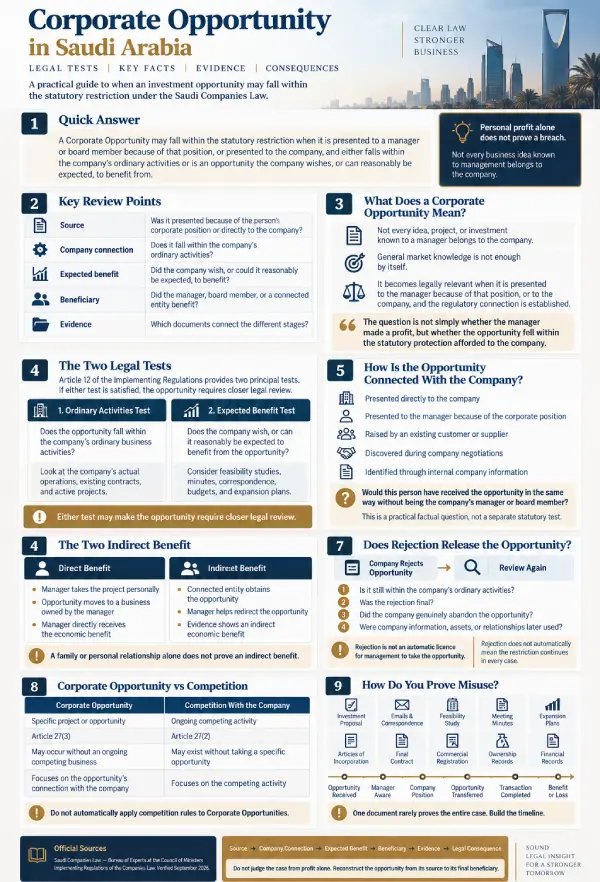
A Corporate Opportunity should be assessed by looking at where the opportunity came from and why it reached the manager or board member. Personal profit alone does not prove a breach. Not every business idea known to management belongs to the company, and not every independent investment falls within the statutory restriction.
Article 27 of the Saudi Companies Law addresses the use of company assets, information, and investment opportunities. Article 12 of the Implementing Regulations provides the main tests for deciding when an investment opportunity falls within that restriction.
The facts should be reviewed in sequence: how the opportunity arose, how it reached management, how it related to the company, what position the company took, who ultimately obtained it, and whether any benefit or loss followed.
A Corporate Opportunity may fall within the statutory restriction when it is presented to a manager or board member because of that position, or presented to the company, and either falls within the company’s ordinary activities or is an opportunity the company wishes, or can reasonably be expected, to benefit from.
| Review Point | Key Question |
|---|---|
| Source | Was it presented because of the person’s corporate position or directly to the company? |
| Company connection | Does it fall within the company’s ordinary activities? |
| Expected benefit | Did the company wish, or could it reasonably be expected, to benefit? |
| Beneficiary | Did the manager, board member, or a connected entity benefit? |
| Evidence | Which documents connect the different stages? |
Saudi Companies Law — Bureau of Experts at the Council of Ministers and Implementing Regulations of the Companies Law. Verified September 2026.
What Does a Corporate Opportunity Mean?
Saudi Companies Law does not make every idea, project, or investment known to a manager an opportunity belonging to the company. General knowledge that a market is growing, an asset is for sale, or a sector is attracting investment is not enough by itself.
A Corporate Opportunity becomes legally relevant when it is presented to the manager or board member because of that corporate position, or when it is presented to the company, and the connection required by the Implementing Regulations is established.
The first question is therefore not simply whether the manager made a profit. The better question is whether the opportunity fell within the statutory protection afforded to the company.
The Two Legal Tests for a Corporate Opportunity
Article 12 of the Implementing Regulations provides two principal tests. If either test is satisfied, the connection between the opportunity and the company requires closer review.
First test: the opportunity falls within the company’s ordinary activities. This test focuses on what the company actually does. If the opportunity concerns a line of business that the company regularly carries on, it may fall within the protected scope even if the company had not formally approved that particular transaction.
The company’s ordinary activities should not necessarily be determined from one general description alone. Existing contracts, active projects, and the nature of the company’s actual operations may help show whether the opportunity is connected with its business.
Second test: the company wishes, or can reasonably be expected, to benefit from the opportunity. This test may be relevant where the opportunity concerns planned expansion or a future investment. Feasibility studies, minutes, correspondence, budgets, and expansion plans may help show the company’s interest.
This article remains focused on investment opportunities themselves. Broader questions involving management duties belong to the wider corporate-governance framework rather than being repeated here.
How Is the Opportunity Connected With the Company?
The review should begin with the history of the opportunity, not with the identity of the person who ultimately completed the transaction.
An opportunity presented to a manager because of a corporate role is different from information obtained independently and without any connection to that position.
Relevant situations may include an investor sending a proposal to the manager as the company’s representative, a customer discussing a project during an existing relationship with the company, an opportunity arising from negotiations carried out for the company, or information discovered through internal company data.
Key factual question
Would this person have received the opportunity in the same way if they had not been the company’s manager or board member?
This is not a separate statutory test. It is a practical way to examine why the opportunity reached the person and whether access resulted from the corporate position.
What If It Was Sent to a Personal Email?
The email address alone does not decide the issue. A proposal may reach a personal address because the sender knows the recipient as the company’s manager. An email sent to a business account may also concern an entirely independent matter.
The relevant facts are the reason for the contact, the capacity in which the person was approached, the parties’ previous relationship, and the context in which the proposal was made.
What If the Manager Knew About It Before Appointment?
Prior knowledge matters, but it does not create an automatic answer. The timing and development of the opportunity should be established.
An idea may exist before the appointment but later be developed through company information, assets, data, employees, or business relationships. In that situation, the original opportunity and the later use of company resources may need separate analysis.
What If the Company Rejected the Opportunity?
A rejected Corporate Opportunity does not automatically become available for personal use by the manager or board member.
Article 12 does not rely only on whether the company wanted one particular transaction. It also contains a separate test based on whether the opportunity falls within the company’s ordinary activities.
If the opportunity remains within the company’s core business, that connection may still matter even after a particular proposal was rejected. If it falls outside the ordinary activities, evidence about the company’s expansion plans or decision to abandon the opportunity may become more important.
The review should therefore consider whether the rejection was final, why it was made, whether the opportunity remained within the company’s ordinary activities, and whether company information, relationships, or assets were later used.
Practical point:
Rejection is not an automatic licence for management to take the opportunity, but it also does not prove that the restriction continues in every case. The statutory tests and the surrounding facts remain decisive.
When Is the Benefit Direct or Indirect?
A Corporate Opportunity review should identify who ultimately obtained the benefit. A direct benefit may be clear where the manager acquires the project personally or transfers it to a business owned by that manager.
An indirect benefit requires closer examination. A family or personal relationship alone should not be treated as conclusive. The evidence should show the manager’s connection with the beneficiary, the role played in directing the opportunity, and any benefit that resulted.
| Situation | What Should Be Examined? |
|---|---|
| The manager takes the project personally | Whether a direct benefit arose from an opportunity connected with the company |
| The opportunity moves to a company owned by the manager | Ownership and how the opportunity was transferred |
| A connected entity obtains the project | Whether an indirect benefit to the manager can be shown |
| An independent third party obtains it | Whether the manager had a role or received a benefit |
| Company information is used | Whether there is a separate misuse of company information |
If the central issue instead concerns a personal interest in a company transaction, disclosure, or approval, the legal question changes. Those matters are addressed separately in Director Conflict of Interest in Saudi Arabia.
Corporate Opportunity vs Competition With the Company
The distinction matters because Article 27 addresses these situations separately. Taking an investment opportunity focuses on a particular project or transaction. Competition focuses on carrying on an activity that competes with the company or one of its business lines.
| Corporate Opportunity | Competition With the Company |
|---|---|
| Focuses on a specific opportunity or project | Focuses on a competing activity |
| Addressed under Article 27(3) | Addressed under Article 27(2) |
| May occur without an ongoing competing business | May exist without taking a specific opportunity |
| Requires proof of the opportunity’s connection with the company | Requires examination of the competing activity |
A manager may take one opportunity without establishing an ongoing competing business. The reverse is also possible: a manager may participate in a competing activity without diverting a specific investment opportunity.
The authorisation rules applicable to competition should therefore not automatically be applied to Article 27(3). The provisions address different conduct.
How Do You Prove Misuse of a Corporate Opportunity?
Evidence usually depends on a connected set of documents rather than one decisive record. The stronger approach is to reconstruct the transaction from the first appearance of the opportunity through to its final implementation.
| Document | What It May Help Establish |
|---|---|
| Investment or project proposal | Nature of the opportunity and when it arose |
| Emails and correspondence | Source of the opportunity and how it reached management |
| Feasibility study | The company’s interest in the project or sector |
| Meeting minutes | Management knowledge and the company’s position |
| Expansion plans | Expected company benefit |
| Articles of incorporation or association | Business activities and management structure |
| Final contract | Who ultimately obtained the opportunity |
| Commercial Registration and ownership records | Connection between the manager and beneficiary |
| Financial records | Profit, benefit, or loss where relevant |
What Timeline Should Be Proven?
An investment proposal may establish that an opportunity existed, but it does not by itself prove misuse. A Commercial Registration may show a connection between the manager and the benefiting entity, but it does not by itself explain why the opportunity moved to that entity.
Likewise, a feasibility study may show that the company was interested in a particular market, but it should be considered together with the remaining evidence. The value lies in connecting the documents into a coherent timeline.
What Are the Legal Consequences?
Article 27(3) prohibits the use of company assets, information, or investment opportunities to obtain a direct or indirect interest.
However, remedies expressly stated for breaches of other paragraphs of Article 27 should not automatically be transferred to Article 27(3). It would therefore be inaccurate to say that misuse of a Corporate Opportunity automatically results in rescission of a contract or surrender of profit merely by relying on a remedy attached to another paragraph.
Where the conduct causes loss, Article 28 becomes relevant. It addresses liability for damage resulting from a breach of the Companies Law, the company’s constitutional documents, or from error, negligence, or failure to perform management duties.
Three issues should be kept separate
- What act or breach is attributed to the manager or board member?
- What loss was suffered by the company or other entitled party?
- What causal connection exists between the conduct and that loss?
Questions about who may bring a claim, procedural requirements, and applicable time limits have a different search intent. Those issues are addressed in Liability Claim Under the Companies Law.
Saudi Companies Law — Articles 27 and 28. Verified September 2026.
What If the Manager Resigned Before Completion?
The resignation date alone does not decide the issue. The relevant timeline includes when the opportunity arose, when the manager became aware of it, what was done while the person remained in office, and whether company information or assets were used.
Conduct before resignation may therefore remain relevant even if the transaction was completed later. At the same time, not every investment made after a person leaves office automatically falls within Article 27(3). The facts remain essential.
How Should the Company Review a Corporate Opportunity?
Before classifying conduct as misuse of a Corporate Opportunity, the company should separate the opportunity issue from competition, conflicts of interest, use of company information, and general management liability.
- Identify the opportunity and its source: What project, asset, contract, or investment is involved, and how did it reach management?
- Compare it with the company’s activities: Does it fall within the ordinary business actually carried on by the company?
- Review expected company benefit: Was the company interested in the opportunity, or could it reasonably be expected to benefit from it?
- Identify the beneficiary: Did the manager, a connected entity, or an independent third party ultimately obtain the opportunity?
- Collect the evidence and build the timeline: Review proposals, emails, minutes, feasibility studies, ownership information, and contracts in chronological order.
- Separate the legal issues: Determine whether the facts concern an investment opportunity, competition, a conflict of interest, company information, or company assets.
- Assess loss and the legal basis: If compensation is being considered, identify the loss separately from the alleged breach and determine the appropriate legal basis.
This seven-step review is useful before a dispute arises as well. Clear records of material investment opportunities and the company’s position on them are more reliable than scattered correspondence or personal recollection.
Frequently Asked Questions About Corporate Opportunity
When does an investment opportunity become a company opportunity?
An investment opportunity becomes relevant under Article 12 when it is presented to a manager or board member because of that corporate position, or presented to the company, and either falls within the company’s ordinary activities or is an opportunity the company wishes, or can reasonably be expected, to benefit from.
Can a manager use an opportunity discovered outside work?
Not every independently discovered opportunity belongs to the company. The source of the opportunity, why the manager received it, its connection with the company’s ordinary activities, and any expected company benefit should be examined. Use of company information, assets, or relationships may also require separate legal analysis.
What if the opportunity was offered directly to the manager?
A personal offer does not automatically make the opportunity independent from the company. The relevant issue is why the offer was made. If the person was approached because of the corporate position and the opportunity also satisfies Article 12, the statutory restriction may become relevant.
Can a manager take an opportunity after the company rejects it?
Rejection alone does not automatically release the opportunity for personal use. It remains necessary to examine whether the opportunity falls within the company’s ordinary activities, whether the company’s interest genuinely ended, and whether company information, assets, or relationships were later used to pursue it.
How is Corporate Opportunity different from company competition?
A Corporate Opportunity concerns a specific project or investment addressed under Article 27(3). Competition concerns carrying on an activity that competes with the company or one of its business lines under Article 27(2). Either situation may exist without the other, depending on the facts.
What evidence is most useful in proving misuse?
Relevant evidence may include investment proposals, emails, feasibility studies, meeting minutes, expansion plans, final contracts, Commercial Registration records, ownership information, and financial records. Their evidential value is stronger when they form a timeline showing how the opportunity moved from the company to the ultimate beneficiary.
Legal Conclusion
A Corporate Opportunity is not established merely because a manager or board member made a profit from a new project. The review starts with the source of the opportunity, its connection with the company’s ordinary activities, whether the company wished or was expected to benefit, and who ultimately obtained it.
It is equally important to keep separate the rules on investment opportunities, competition, conflicts of interest, and management liability. Each has a different legal basis and may require different evidence.
The practical next step is to place the proposal, correspondence, meeting minutes, studies, contracts, ownership information, and beneficiary records into one chronological file before determining the legal effect of the conduct.
Disclaimer
This content is provided for general legal information only. It is not legal advice for a specific matter and does not create a lawyer-client relationship. The legal assessment may differ depending on the company type, constitutional documents, nature and source of the opportunity, available evidence, and the facts of each case.
Mohammed Aboud Al-Dossary
Licensed lawyer in the Kingdom of Saudi Arabia — Licence No. 40462.
Professional verification: