Legal Review Author:
Mohammed Aboud Al-Dossary
Saudi Lawyer — Licence No. 40462
Published: 23 September 2026
Reviewed by: Mohammed Aboud Al-Dossary
Last Legal Review: 27 September 2026
Board Decision Liability depends on how a board resolution was adopted and on each member’s position. A unanimous resolution is not treated in the same way as a majority decision, and the legal position of a member who approved the decision differs from that of a dissenting or absent member.
Liability does not arise simply because a decision caused a loss or failed to achieve the expected commercial result. The starting point is whether there was a breach of the Saudi Companies Law or the company’s constitutional documents, or an error, negligence, or failure to perform duties, together with damage linked to the decision.
This article focuses on seven issues: the basis of liability, unanimity, majority voting, dissent, absence, assessment of the decision, and the evidence identifying each board member’s position.
Questions about who may file a liability claim, filing conditions, and statutory time limits are addressed separately so that the legal position of a board member is not confused with litigation procedure.
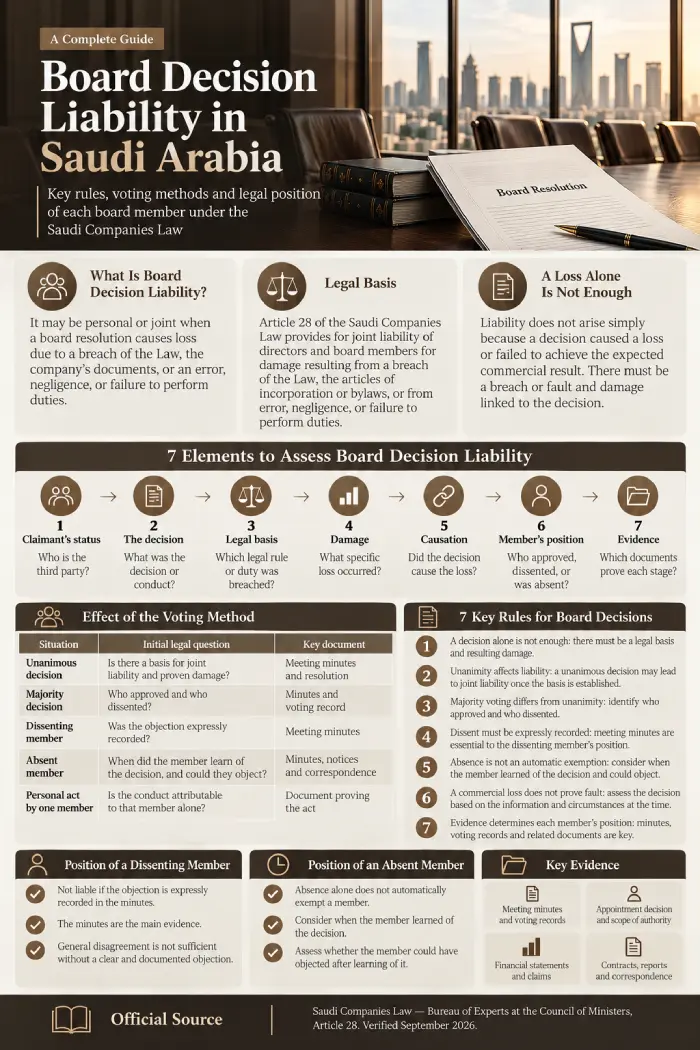
Board Decision Liability may be personal or joint depending on the source of the fault and how the decision was adopted. If the decision giving rise to liability was unanimous, joint liability may apply once the legal basis is established. If adopted by majority, a dissenting member is not liable when the objection is expressly recorded in the meeting minutes. Absence alone does not automatically exempt a member.
Official source:
Saudi Companies Law — Bureau of Experts at the Council of Ministers, Article 28. Verified September 2026.
When Does Board Decision Liability Arise?
Board Decision Liability starts with the decision said to have caused the damage and
the legal basis on which responsibility is alleged.
Article 28 of the Saudi Companies Law provides for joint liability of managers and board members for damage suffered by the company, partners, shareholders, or third parties where the damage results from a violation of the Law, the company’s articles of incorporation or bylaws, or from error, negligence, or failure to perform duties.
It is therefore not enough to say that the board made a poor decision. The review must identify the decision or conduct, the breach or fault, the damage, and the connection between that decision and the resulting damage.
Liability may be personal where the conduct is attributable to one member. It may be joint where the basis of liability arises from a collective board decision under the applicable statutory rules.
| Situation | Initial legal question | Key document |
|---|---|---|
| Unanimous decision | Is there a basis for joint liability and proven damage? | Meeting minutes and resolution |
| Majority decision | Who approved and who dissented? | Minutes and voting record |
| Dissenting member | Was the objection expressly recorded? | Meeting minutes |
| Absent member | When did the member learn of the decision, and could they object? | Minutes, notices, and correspondence |
| Personal act by one member | Is the conduct attributable to that member alone? | Document proving the act |
7 Rules for Collective Board Decisions
Board Decision Liability can be organised around seven rules that separate the existence of a collective decision from the question of whether each board member is legally responsible.
- A decision alone is not enough: there must be a legal basis for liability and resulting damage.
- Unanimity affects the allocation of liability: if the decision giving rise to liability was unanimous, joint liability may apply once the underlying basis is established.
- Majority voting differs from unanimity: the review must identify who approved and who dissented.
- Dissent must be expressly recorded: the meeting minutes are central to the dissenting member’s position.
- Absence is not an automatic exemption: knowledge of the decision and the ability to object after learning of it must be examined.
- Commercial loss alone does not prove fault: the decision-making process, available information, and circumstances must be reviewed.
- Documents determine each member’s position: minutes, voting records, reports, and disclosures may answer different legal questions.
What Is the Effect of a Unanimous Board Decision?
If the decision giving rise to liability was adopted unanimously, Article 28 provides that liability is joint among the board members.
That does not mean unanimity creates liability by itself. There must first be damage resulting from a violation of the Law or the company’s constitutional documents, or from error, negligence, or failure to perform duties.
Once that legal basis is established, unanimity becomes relevant to how responsibility is allocated among the board members.
The meeting minutes should therefore show how the decision was adopted, which members attended, how the vote was taken, and the information needed to reconstruct the decision if a dispute later arises.
What Is the Effect of a Majority Board Decision?
Board Decision Liability is assessed differently when a resolution is adopted by majority rather than unanimously.
Under Article 28, board members who opposed a majority decision are not liable for that decision when their objection is expressly recorded in the meeting minutes.
A later statement that the member disagreed is not equivalent to a contemporaneous record. The minutes are important because they show the member’s position when the decision was made.
An oral objection or later email should not automatically be treated as a substitute for the express objection that Article 28 requires to be recorded in the minutes.
How Should a Board Member Record an Objection?
The Saudi Companies Law does not prescribe fixed wording for a dissent. It requires the objection to be expressly recorded in the meeting minutes.
The minutes should make three points clear: the decision being voted on, the member’s position, and the fact that the member objected to that specific decision.
The objective is not to create a formula that the Law does not require. It is to remove ambiguity about the member’s position.
Could a reader who did not attend the meeting identify from the minutes alone that the member opposed the specific decision in dispute? The clearer the record, the less the later analysis depends on memory or scattered correspondence.
Does Absence Exempt a Board Member From Liability?
No. Absence from the meeting does not automatically exempt a board member from responsibility.
Under Article 28, failure to attend the meeting in which the decision was adopted is not by itself a ground for exemption unless the absent member proves that they did not know of the decision, or that they were unable to object after becoming aware of it.
The review should therefore separate absence from knowledge. A member may have missed the vote but learned of the resolution later, in which case the timing of that knowledge and the practical ability to object become relevant.
Meeting notices, attendance records, minutes, notifications, and correspondence can help reconstruct when the member became aware of the decision.
Second official source:
Saudi Companies Law — Ministry of investment Article 28, Verified September 2026.
Does a Loss-Making Decision Prove Liability?
No. A negative commercial result is not enough, by itself, to establish Board Decision Liability.
Article 31 provides a framework for assessing a decision made or voted on in good faith by a manager or board member.
The duty is treated as fulfilled where the member had no interest in the subject of the decision, was informed about the matter to an extent reasonably believed appropriate in the circumstances, and firmly and rationally believed that the decision served the company’s interests. The claimant bears the burden of proving otherwise.
For Article 31, a decision includes acting or not acting in a matter related to the company’s business. A failure to act may therefore require legal analysis as well.
| Article 31 question | What should be reviewed? |
|---|---|
| Did the member have an interest in the decision? | Any direct or indirect interest |
| Was the member sufficiently informed? | Reports, information, and risks available at the time |
| Did the member rationally believe the decision served the company? | Reasons, alternatives, and circumstances known when the decision was adopted |
For a broader analysis of management standards and information expected before a decision, see Duty of Care and Loyalty in Saudi Arabia.
Collective Board Decisions vs Conflict of Interest
A board decision may be collective while one member also has a direct or indirect interest in the matter.
That issue should not be reduced to a question of unanimity or majority voting. A personal interest may trigger a separate analysis of disclosure, approval, and conflict-of-interest rules.
Where the core issue is a personal benefit involving the member or a related party, the more relevant page is Director Conflict of Interest in Saudi Arabia.
This page remains focused on the member’s legal position in the collective board decision itself.
What If the Issue Is Authority Rather Than Voting?
A dispute may appear to concern voting, while the more basic question is whether the person or body making the decision had the required authority in the first place.
These issues should be separated. A collective decision analysis asks who approved, who dissented, and what the minutes show. Authority analysis asks whether the decision-maker had the legal power to take the action at all.
That separate issue is addressed in Director Authority Limits in Saudi Arabia.
What Evidence Matters for Board Decision Liability?
Evidence in Board Decision Liability should reconstruct the decision as it existed when it was made rather than judge it only after the outcome became known.
| Document | Question it helps answer |
|---|---|
| Board meeting minutes | Who attended, how was the decision adopted, and who objected? |
| Agenda and meeting notice | What issue was placed before the board? |
| Reports and studies | What information was available before the vote? |
| Voting record | Who approved and who dissented? |
| Interest disclosures | Did any member have a direct or indirect interest? |
| Bylaws | What powers did the board have and how were decisions to be adopted? |
| Correspondence | When did an absent member learn of the decision? |
These documents do not perform the same function. The minutes are central when the issue is a member’s voting position, while reports and studies become more important when assessing the information available before the board acted.
How Should the Decision Timeline Be Reconstructed?
This sequence identifies where evidence is needed and helps prevent the analysis from jumping directly from a later loss to an assumption that every board member is responsible.
5 Examples of Different Board Member Positions
The following examples are hypothetical and educational. They illustrate how Board Decision Liability may be analysed and are not actual cases, court judgments, or guaranteed outcomes.
- Unanimous decision with a proven breach:
if all members approved a decision that falls within Article 28 and caused damage, the analysis moves to joint liability. - Majority decision with a recorded dissent:
a member who expressly recorded an objection in the minutes has a different legal position from those who approved the decision. - Dissent not shown in the minutes:
where a member later says they objected but the minutes do not record it expressly, proving the statutory dissent position becomes more difficult. - Absent member who did not know of the decision:
proof of lack of knowledge may fall within the absence exception in Article 28. - Loss-making decision based on adequate information:
the loss does not determine liability. Article 31 requires the decision to be assessed against the information and circumstances existing when it was made.
Where Does a Liability Claim Begin?
This page ends with the board member’s legal position in the collective decision. Who may file a liability claim, the filing requirements, and applicable time limits are separate issues.
Once the question changes from “Is the member responsible for the decision?” to “Who may file the claim, how, and when?”, the more relevant page is Liability Claim under the Saudi Companies Law.
Keeping these issues separate prevents a page about collective board decisions from competing with a page focused on claim procedure.
This article explains how unanimity, majority voting, dissent, and absence affect a board member’s legal position in a collective decision.
Legal scope: Articles 28 and 31 of the Saudi Companies Law | Last verified: September 2026
Frequently Asked Questions About Board Decisions
What Happens If the Board Decision Was Unanimous?
If the decision giving rise to liability was unanimous, Article 28 provides for joint liability once the legal basis for liability is established. Unanimity alone is not enough. There must be damage resulting from a statutory or constitutional breach, error, negligence, or failure to perform duties.
When Is a Dissenting Board Member Not Liable?
A dissenting board member is not liable for a majority decision when the objection is expressly recorded in the meeting minutes under Article 28. The minutes should clearly identify the decision and the member’s position. An oral objection or later message should not automatically be treated as equivalent.
Does Absence From a Board Meeting Exempt a Member?
No. Absence alone does not create an exemption. The statutory exception applies where the absent member proves that they did not know of the decision, or that they were unable to object after learning of it. The timing of knowledge and the practical ability to object therefore matter.
Does a Commercial Loss Prove Board Member Liability?
No. A commercial loss is not independent proof of liability. Article 31 looks at whether the member had an interest in the decision, whether the member was sufficiently informed in the circumstances, and whether there was a rational belief that the decision served the company’s interests.
What Is the Most Important Evidence of a Board Member’s Dissent?
The meeting minutes are the central document because Article 28 ties the dissenting member’s position to an objection expressly recorded there. Reports, agendas, and correspondence may explain the context, but they do not remove the importance of a clear record of the member’s voting position.
Does Article 31 Cover a Failure to Act?
Yes. For Article 31, a decision includes acting or not acting in a matter related to the company’s business. The review may therefore need to examine why no action was taken and what information and circumstances existed at the relevant time.
Legal Conclusion
Board Decision Liability is not established merely because a board decision was made or because the company later suffered a loss. The analysis starts with a breach, error, negligence, or failure to perform duties and resulting damage, then turns to the voting method and each member’s position.
Where the decision was unanimous, joint liability may arise once the underlying basis is established. Where the decision was adopted by majority, an express objection recorded in the minutes is central to the dissenting member’s position. Absence alone does not exempt a member; knowledge and the ability to object must also be examined.
Article 31 also prevents a business decision from being judged only by its later outcome. The review returns to the member’s interest, the information available, the surrounding circumstances, and the rational belief that the decision served the company.
The practical next step in reviewing Board Decision Liability is to place the meeting minutes, agenda, pre-decision reports, voting record, disclosures, and correspondence into one timeline, then identify the correct legal issue before moving to any further action.
This article provides general legal information only. It is not legal advice for a specific matter and does not create a lawyer-client relationship. Liability depends on the company form, its constitutional documents, the decision-making process, the available evidence, the damage, and the facts of each case.
Mohammed Aboud Al-Dossary
Saudi Lawyer — Licence No. 40462.
Professional verification:
Licensing and Membership