Licensed lawyer in the Kingdom of Saudi Arabia — License No. 40462 — Professional practice since 2013.
Last legal review: October 2026
Drug weight discrepancy between a seizure report and a laboratory report does not automatically lead to one legal conclusion. Before assessing its significance, it is necessary to identify what each figure actually represents.
One number may refer to the full quantity seized. Another may concern only a sample sent for testing. A third may have been recorded at a different stage in the handling of the material.
The analysis should therefore begin with the source and type of each weight figure. It should then move to the description of the seized items, the exhibit details, the sample sent for testing, and the laboratory report. If the records explain the difference and the sample remains traceable, the issue is different from a situation in which the identity of the tested material becomes uncertain.
This article complements the broader framework discussed in Criminal Evidence in Saudi Arabia. Its focus is narrower: the effect of weight differences on sample identity and evidentiary continuity.
A drug weight discrepancy becomes important when it is more than a numerical difference between figures that refer to different quantities or stages. The key issue is whether the discrepancy creates a real problem in identifying the sample or linking it to the seized material.
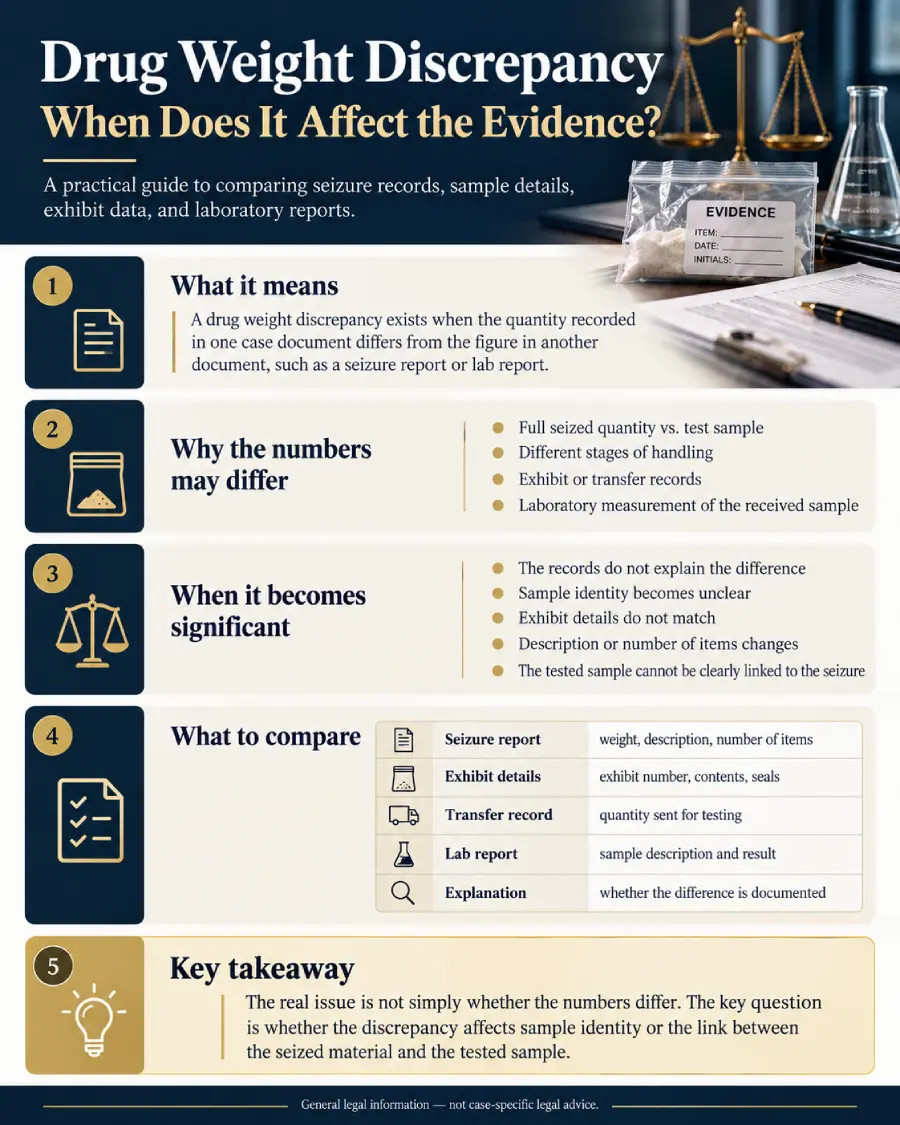
What does drug weight discrepancy mean?
A drug weight discrepancy exists when the weight or quantity recorded in one case document differs from the figure stated in another document, such as a sample transfer record or laboratory report.
The difference alone does not determine its legal significance. Each figure may relate to a different quantity, sample, or stage of the evidentiary process.
Do the two numbers describe the same material, the same quantity, and the same stage?
Why can the weight differ between the seizure record and laboratory report?
Different figures do not always refer to the same thing. One record may describe the full quantity seized, while another may concern only a sample taken from that quantity for laboratory testing.
The Implementing Regulations of the Saudi Anti-Narcotics and Psychotropic Substances Law address the taking of samples and quantities required for analysis, as well as the transfer of samples to the laboratory and identifying information connected with the substance, quantity, and exhibit.
For that reason, the correct comparison begins by identifying what was actually sent for testing.
| Type of Figure | What It May Represent | Main Question |
|---|---|---|
| Seized quantity | The total quantity recorded at seizure. | Does it represent the full quantity? |
| Exhibit weight | The material placed inside the sealed exhibit. | Does it match the description and number of items? |
| Sample weight | A portion taken from the seized material for testing. | Was only part of the material sent? |
| Laboratory figure | The sample received or examined by the laboratory. | Does it relate to the same sample? |
A difference in weight is not significant merely because two figures are different. The first question is whether they are supposed to represent the same thing.
When does a drug weight discrepancy become significant?
A drug weight discrepancy becomes more important when the issue moves beyond a simple numerical difference and begins to affect the identity of the evidence or the connection between the tested sample and the seized material.
Closer review is usually required when the discrepancy appears together with one or more of the following:
- A different description of the seized items.
- A change in the number of packages or units.
- Uncertainty over whether the laboratory report concerns the full quantity or only a sample.
- A mismatch in exhibit details.
- Missing records explaining the transfer of the sample.
- Difficulty matching the seizure report with the laboratory description.
If the documents themselves show that the two figures refer to different quantities, such as the full seizure and a smaller test sample, the difference may be explainable.
How does weight relate to sample identity and the sealed exhibit?
Article 50 of the Saudi Criminal Procedure Law regulates the sealing and preservation of seized items and documents, including recording identifying information connected with the exhibit.
For that reason, the weight figure should not be reviewed in isolation. It should be read together with:
- The exhibit number.
- The description of the contents.
- The number of packages or items.
- The date of the procedure.
- The authority or laboratory that received the sample.
- The report identifying what was actually tested.
The expression chain of custody is commonly used in practice to describe continuity between seizure, sealing, transfer, receipt, and examination. It should not be treated as though the phrase itself were a standalone statutory provision.
If the sample remains identifiable and traceable through the records, a weight difference is not assessed in the same way as a discrepancy that makes the tested sample uncertain.
Does every difference in weight weaken the evidence?
No single rule applies to every drug weight discrepancy.
It would be inaccurate to say that every difference automatically invalidates the evidence. It would be equally inaccurate to say that every difference is irrelevant.
| Type of Discrepancy | Analytical Meaning |
|---|---|
| Explained difference | The documents show that each figure relates to a different quantity or stage. |
| Difference requiring explanation | The records appear to concern the same sample, but the change in weight is not explained. |
| Identity-related discrepancy | The weight difference appears with other inconsistencies that make the tested sample uncertain. |
How should the seizure report and laboratory report be compared?
The correct comparison goes beyond the weight fields. It should follow the evidence from the initial seizure through the exhibit records and into the laboratory documentation.
| Point of Comparison | What to Review | Why It Matters |
|---|---|---|
| Seizure report | Weight, description, and number of items. | Establishes the starting point. |
| Exhibit details | Number, contents, and description. | Links the material to a specific exhibit. |
| Transfer record | Quantity, sample, and exhibit details. | Shows what was sent to the laboratory. |
| Laboratory report | Description of the sample and testing. | Identifies what was actually examined. |
| Numerical difference | Size of the difference. | Does not decide the issue by itself. |
| Explanation | Whether the records explain the difference. | Separates an explained discrepancy from an unexplained one. |
Practical Comparison Sequence
- Identify the figure stated in the seizure report.
- Record the description and number of seized items.
- Review the exhibit details.
- Determine what quantity was sent for testing.
- Check the sample description in the laboratory report.
- Compare only figures intended to represent the same type of quantity.
- Look for a documented explanation for any difference.
Practical evidence block: reviewing a drug weight discrepancy
Before assessing the effect of the discrepancy, identify each part of the document chain rather than starting with the conclusion.
| Review Point | Question |
|---|---|
| Figure | What weight is being compared? |
| Source | Which document contains it? |
| Type | Full quantity or sample? |
| Stage | Seizure, sealing, transfer, or testing? |
| Exhibit | Can the exhibit details be matched and traced? |
| Explanation | Do the records explain the difference? |
| Effect | Has the identity of the sample become unclear? |
Example
If the seizure report records the weight of the full quantity and the laboratory report later records a lower figure for a sample sent for testing, the two figures should not be treated as contradictory before confirming that the laboratory examined only part of the original quantity.
By contrast, if the documents indicate that both figures refer to the same sample, but the difference is not explained by the sealing, transfer, or testing records, the issue becomes more closely connected to sample identity and evidentiary continuity.
Source of figure → type of weight → sample → exhibit details → explanation → effect on identity.
When does the discrepancy require a full file review?
General analysis is no longer enough when the available documents cannot explain the drug weight discrepancy or clarify the relationship between the different figures.
A full review becomes more important where:
- It is unclear whether the figures relate to the same quantity.
- The connection between the sample and the full seizure is not documented.
- The weight difference appears with a mismatch in exhibit details.
- The description or number of items changes between documents.
- No clear explanation appears in the records.
- The issue can only be resolved by comparing several original documents together.
If the conclusion depends on comparing the seizure report, exhibit records, transfer documents, and laboratory report together, the issue is no longer merely numerical. It becomes a question of documentary continuity and sample identity.
Legal summary
A drug weight discrepancy cannot be assessed by simply subtracting one number from another.
The correct analysis begins by identifying the source of each figure and whether it relates to the full seized quantity or only to a sample. The description of the material, number of items, exhibit details, and laboratory sample should then be compared.
If the documents explain the difference and the sample remains traceable, the discrepancy has a different significance from an unexplained difference that makes the link between the seized material and the tested sample unclear.
The issue is not simply: “Is there a difference in weight?” The better question is: “Did the difference create a real problem in identifying the sample or linking it to the seized material?”
Frequently Asked Questions About Drug Weight Discrepancy
Why can the weight differ between the seizure report and the laboratory report?
Each figure may relate to a different quantity or stage. One may describe the full seized material, while another may refer only to a sample sent for testing. The meaning of each figure should therefore be identified before the difference is treated as a material inconsistency.
When does a weight difference become important in a drug case?
It becomes more significant when the documents do not explain it, or when it appears together with differences in the description, number of items, or exhibit details. These issues may affect the ability to identify the sample examined by the laboratory.
What is the difference between the seized quantity and the sample weight?
The seized quantity may represent the full amount recorded at the time of seizure. The sample weight may relate only to a portion taken for testing. The two figures should not be directly compared unless they are intended to describe the same quantity.
Does a lower sample weight mean the evidence was tampered with?
Not by itself. The type of weight, the sample taken, exhibit details, transfer records, and testing documents should first be reviewed. A lower figure alone does not establish tampering.
What should be checked when the recorded weights differ?
Review the seizure report, the description and number of items, exhibit details, the quantity sent to the laboratory, and the sample description in the laboratory report. Compare only figures that are intended to represent the same quantity.
When is specialist legal review needed?
A detailed review becomes important when the difference remains unexplained, appears together with inconsistencies in exhibit or sample information, or when the case depends on establishing that the tested material is the same material recorded at seizure.