Licensed lawyer in the Kingdom of Saudi Arabia — License No. 40462 — Professional practice since 2013.
Last legal review: October 2026
Drug case evidence should be reviewed by first identifying the fact each item is meant to prove. A laboratory result confirming that a tested sample contains a narcotic substance does not, by itself, establish who possessed it. Likewise, connecting an item to a person does not automatically prove knowledge or the purpose behind the possession.
A structured review therefore asks where the evidence came from, whether its identity can be traced, what connects it to the accused, what it actually proves, and whether the conclusion fits the rest of the case file.
This article focuses on the evidentiary structure of a Saudi drug case. It does not primarily address penalties, acquittal strategies, or the legality of a search.
Drug case evidence should be reviewed through seven connected issues: the fact to be proved, the source of the evidence, its integrity, its identity, its attribution to the accused, the limits of what it proves, and its consistency with the rest of the file. The number of exhibits alone does not determine evidentiary strength.
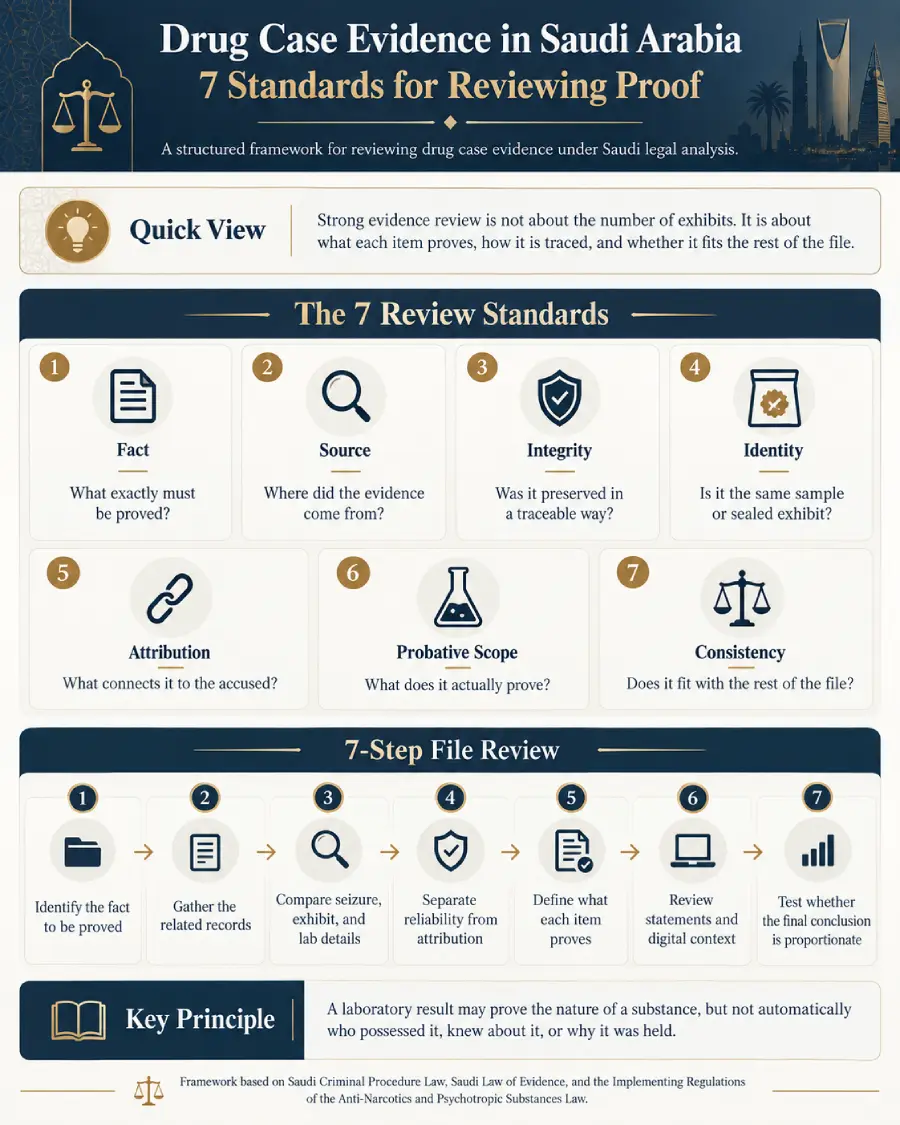
How should drug case evidence be analyzed?
Drug case evidence should not be treated as one undivided body of material. Each report, seized item, statement, or digital record should be linked to the specific fact it is capable of proving.
A case may begin with a technical issue: what is the seized substance? It may then move to a separate issue: is the tested sample the same material described in the seizure report? The next question may be whether that material can be attributed to a particular person, followed by knowledge or intent where relevant.
| Review Standard | Core Question |
|---|---|
| Fact | What exactly must be proved? |
| Source | Where did the evidence come from and how did it enter the file? |
| Integrity | Was the evidence preserved in a traceable way? |
| Identity | Is the tested sample or sealed exhibit the same one connected to the incident? |
| Attribution | What connects the evidence to the accused? |
| Probative Scope | What does the evidence actually prove, and what does it not prove? |
| Consistency | Does the rest of the file support the conclusion or reveal a material inconsistency? |
This framework avoids a common error: assuming that one item of evidence establishes every element of the allegation. A piece of evidence may be strong on one issue and have little value on another.
What can each item in the case file prove?
No two drug cases contain exactly the same material. A reliable review starts by identifying the role of each item before assessing its weight.
| Item in the File | Main Point to Review |
|---|---|
| Seizure report | Place of seizure, description, persons present, and sequence of events. |
| Seized substance | Nature of the item, where it was found, and its connection to a place or person. |
| Sealed exhibit | Whether the identity of the material can be traced after seizure. |
| Laboratory report | The identity of the sample examined and the technical result. |
| Accused’s statements | What facts were addressed and how the account compares with other evidence. |
| Witness evidence | What the witness personally observed and its connection to the disputed fact. |
| Digital evidence | Source, user attribution, context, and content. |
The Saudi Criminal Procedure Law provides the procedural framework for presenting and examining evidence before the court. It also regulates matters connected with seizure, search, preservation of exhibits, statements, and witness testimony.
Analytical Rule
Seizure reports: focus on the details
A seizure report may be central to the factual record, but it should not be read only for its final statement that a prohibited substance was found.
The review should focus on the exact location of the items, their initial description, the recorded quantity or number, the persons present, the relationship of each person to the location, the exhibit details, and whether those details match later technical documents.
- Where exactly were the items found?
- How were they described at the time of seizure?
- Who was present?
- Was the location private or shared?
- What identifying information was recorded for the exhibit?
- Do those details match the later documents?
Laboratory reports: what do they prove?
A laboratory report becomes important when the identity of the seized substance requires technical confirmation. Its evidentiary value, however, must be kept within its proper limits.
The Implementing Regulations of the Saudi Anti-Narcotics and Psychotropic Substances Law address approved laboratories, analysis of seized substances and samples, and the transfer of material for testing, including identifying information connected with the package and exhibit.
If the report confirms that the tested sample contains a narcotic substance, it answers an important technical question about that sample. It does not, by itself, prove where the material was found, who possessed it, whether the accused knew about it, or what purpose may be inferred from possession.
Substance identity and attribution are separate questions
Proving the type of substance is one step. Proving that the tested material is the same material described in the seizure report is another. Linking that material to a particular person is a third.
Evidence sealing and chain of custody
Article 50 of the Saudi Criminal Procedure Law regulates the sealing and preservation of seized items and documents. It addresses placing seized material in a closed exhibit, sealing it, recording identifying information, and preserving it under the applicable procedures.
The expression chain of custody is commonly used in practice to describe the continuity of seizure, sealing, storage, transfer, and examination that allows the identity of the evidence to be traced. The phrase should not be treated as though it were itself a standalone statutory rule.
| Stage | What should be reviewed? |
|---|---|
| Seizure | Location, description, quantity, or number. |
| Sealing | Exhibit details and identifying marks. |
| Storage | Whether the exhibit remained identifiable. |
| Transfer | Package, sample, and exhibit information. |
| Testing | The sample actually received and examined by the laboratory. |
| Matching | Whether the documents refer to the same seized material without a material gap. |
A discrepancy does not automatically make the evidence unusable. Nor should a potentially important discrepancy be ignored. The key issue is whether it affects the ability to identify and trace the material.
Linking seized substances to the accused
Establishing that a substance is prohibited does not automatically establish that it belongs to a particular person. Attribution is a separate stage in the assessment of drug case evidence.
Sometimes the connection is direct. In other cases, the analysis depends on where the substance was found, who could access the location, whether the place was shared, whether personal belongings were connected to the area, and what other statements or records support the alleged link.
The more people who had access to the place where the substance was found, the more important it becomes to identify evidence that connects the item to the particular accused rather than relying only on that person’s general connection to the location.
It is therefore useful to distinguish between connection to the location, control over the relevant area, and knowledge of the seized material. These concepts may overlap, but they are not the same.
Knowledge and intent: when does the inference go too far?
After the substance and its connection to a person are considered, a different question may arise: what can the proven facts reasonably show about knowledge or purpose?
A careful review separates four issues:
- Was the substance present?
- Was it connected to the accused?
- Was there evidence of knowledge?
- What facts support the alleged purpose?
Quantity, packaging, messages, financial transfers, or other surrounding circumstances may have evidentiary significance. Their meaning, however, depends on context and how they interact with the rest of the case.
A conclusion should remain within what the evidence and surrounding facts can reasonably support. It should not be broader than the facts that have actually been established.
This article therefore does not fully examine whether multiple bags support an inference of intent to distribute or whether the absence of messages on a phone affects that inference. Each issue deserves its own focused analysis.
Statements and digital evidence
A case may contain statements from the accused alongside messages, device data, or financial records. These forms of evidence should not be treated as if they perform the same function.
When reviewing statements, identify the fact addressed, the stage at which the statement was made, and how it compares with physical and technical evidence. For a focused discussion, see Contradictory Accused Statements. Digital evidence is addressed by the Saudi Law of Evidence, subject to its scope of application, the nature of criminal proceedings, and the rules contained in the Criminal Procedure Law.
- Is the digital content authentic and capable of verification?
- Which device or account is connected to it?
- What shows that the accused was the actual user when the content was created?
When do inconsistencies in drug case evidence matter?
Saying that “the evidence is contradictory” is not enough. Before assessing the effect of an inconsistency, the first step is to identify the fact it affects and whether that fact is material.
| Type of Issue | Correct Question |
|---|---|
| Direct conflict | Are there two conclusions about a material fact that cannot reasonably be reconciled? |
| Minor discrepancy | Does the difference actually affect the fact to be proved? |
| Attribution gap | Is the evidence valid, but its connection to the accused incomplete? |
| Continuity gap | Is the issue the identity of the evidence or its movement between stages? |
| Overstated inference | Is the conclusion broader than what the evidence establishes? |
This approach makes the review of drug case evidence more precise because it identifies where the problem lies before asking what effect it may have.
Practical drug case evidence review: 7 questions
Instead of starting by looking for a “weakness,” use these seven questions to structure the review:
| Standard | Review Question | Why It Matters |
|---|---|---|
| Fact | What is being proved? | Prevents different elements from being mixed together. |
| Source | Where did the evidence come from? | Determines how it should be verified. |
| Integrity | Can it still be traced? | Tests continuity. |
| Identity | Are we dealing with the same sample or exhibit? | Prevents confusion between seized items. |
| Attribution | What connects it to the person? | Separates evidence from attribution. |
| Probative scope | What does it actually prove? | Prevents overstatement. |
| Consistency | How does it interact with the rest of the file? | Shows support or contradiction. |
A practical order for reading the file
2. Gather the documents connected to that fact.
3. Compare the seizure description, exhibit details, and technical report.
4. Separate evidentiary reliability from attribution to the accused.
5. Identify what each item proves and what it does not prove.
6. Review statements, messages, and circumstantial evidence in chronological context.
7. Test whether the final conclusion is proportionate to the evidence supporting it.
When a general review is not enough
A reliable case-specific assessment may not be possible where key records are missing, exhibit details are incomplete, digital conversations are shown without context, or several accused persons, locations, and seized items must be compared across the original documents.
When does a case need individual legal assessment?
A legal article can explain how drug case evidence is reviewed, but it cannot determine the result of a specific case without the actual facts, documents, and procedural stage.
Individual assessment becomes more important where there is more than one accused person, multiple exhibits or samples, substances found in a shared location, conflicting records, disputed digital attribution, or several circumstances relied on to establish a particular intent.
Legal summary
Reviewing drug case evidence does not begin by asking which item is the strongest or weakest. It begins by identifying the function of each item. A laboratory report addresses the tested sample, evidence sealing helps trace its identity, and the seizure report records the circumstances of the procedure. Attribution, knowledge, and intent may require additional evidence.
The clearest method is to review seven issues: fact, source, integrity, identity, attribution, probative scope, and consistency. If documents differ, the result is not automatic. The first question is whether the difference affects a material fact, the identity of the evidence, its attribution, or the limits of the inference drawn from it.
This is the difference between collecting documents and analyzing the structure of proof. Readers may also review the site’s Articles and Insights for related legal analysis and professional content.
Frequently Asked Questions About Drug Case Evidence
What does evidence analysis in a Saudi drug case involve?
It involves identifying the fact to be proved, determining the role of each report, exhibit, statement, or digital record, and reviewing the integrity, identity, attribution, and probative limits of that material. The goal is to assess the evidentiary structure as a whole rather than label one item strong or weak in isolation.
Does a laboratory report prove possession of drugs?
A laboratory report establishes the technical result for the sample it examined according to its contents. It does not, by itself, establish every element of possession or prove attribution to a particular person. Attribution requires review of the seizure circumstances, exhibit information, and other relevant evidence.
Why is evidence sealing important in drug cases?
Evidence sealing helps preserve the identity of seized material and allows the item to be traced through storage, transfer, and testing. Its analytical importance lies in whether the records connect the sample examined by the laboratory with the material described in the original seizure documents.
Does every difference between a seizure report and a laboratory report weaken the evidence?
No single rule applies to every discrepancy. The issue is whether the difference can be explained from the documents and whether it affects the identity of the sample or its connection to the incident. A minor clerical difference is not the same as uncertainty about what material was actually tested.
Is finding a prohibited substance in a place linked to the accused enough?
Not necessarily. The review should consider exactly where the item was found, who had access to the location, whether the area was shared, what evidence shows control over it, and what other statements or circumstances support attribution. Shared locations usually require a closer review of the individual link.
How can I tell if a conclusion goes beyond the evidence?
Compare the fact directly established by the evidence with the conclusion drawn from it. If one item proves only a limited point but is used to support a broader conclusion that requires additional steps, the inference should be tested against the rest of the evidence and surrounding circumstances.
This content is provided for general legal education and analysis only. It is not legal advice, does not assess any specific case file, and does not create a lawyer-client relationship. Legal assessment depends on the facts, documents, procedural stage, and applicable Saudi laws and regulations.