Legal content prepared by:
Attorney Mohammed Aboud Al-Dossary
Saudi-licensed attorney — License No. 40462 — practicing since 2013.
Last statutory source check: October 16, 2026
A bank statement vs salary discrepancy in a Saudi maintenance case does not automatically mean that the difference represents additional or concealed income. A bank account may show the salary itself together with loan proceeds, money from the sale of an asset, transfers between the same person’s accounts, investment returns, or business-related transactions.
For that reason, the correct way to assess bank statement vs salary evidence is not to subtract the declared salary from total deposits. The analysis should begin with the source of each material payment, its nature, how often it appears, and the document that explains it.
This article is a focused extension of the broader issue of proving the maintenance payer’s income.
It does not repeat the broader topic. Instead, it addresses a narrower question: how should bank activity be read when it presents a different financial picture from the salary certificate?
The wider statutory benchmark is the payer’s financial capacity. Article 46 of the Saudi Personal Status Law requires maintenance assessment to take into account the circumstances of the person entitled to maintenance and the financial capacity of the person liable to pay it. A bank statement therefore does not replace a salary certificate, and a salary certificate does not prevent other financial resources from being examined.
Direct answer:
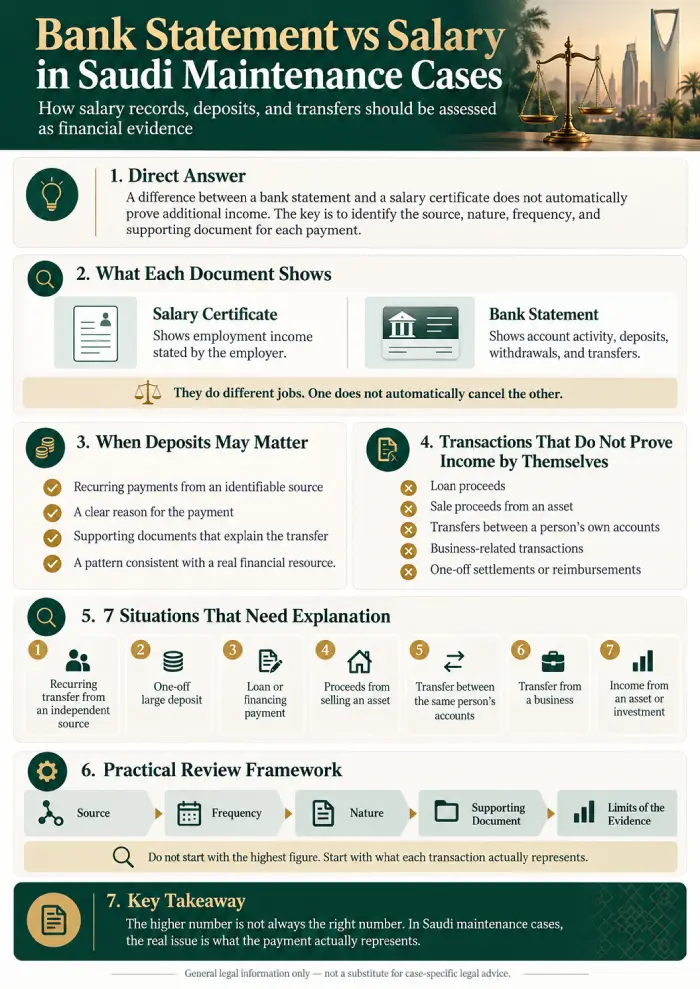
In a bank statement vs salary review, the difference between the two figures is not automatically additional income. The analysis starts with the source, frequency, and nature of the deposits and the documents explaining them. A recurring payment from an independent source is different from a loan; sale proceeds are different from asset income; and transfers between a person’s own accounts do not create new income.
Do the salary records differ from the transfers shown in the financial documents? Before reaching a conclusion, it is important to identify what each document actually proves and what still requires explanation. Different figures do not, by themselves, establish hidden income or a specific level of financial capacity.
Find Out When a Legal Review May Be Appropriate
If you first want to understand the documents, continue reading to see how different financial transactions should be assessed.
What Does a bank statement vs salary Difference Mean?
In a bank statement vs salary issue, the apparent difference is between employment income recorded by the employer and money that actually moved through the bank account. That difference does not automatically invalidate either document or make one document more reliable in every respect.
A salary certificate helps establish the employment income stated by the employer. A bank statement shows incoming and outgoing transactions. It may therefore show the salary together with payments that have no connection to employment.
The Saudi Law of Evidence requires the fact to be proved to be relevant to the dispute and capable of affecting its outcome. It also regulates the assessment of evidence where different pieces of evidence conflict and cannot be reconciled.
There is therefore no universal rule that a bank statement always overrides a salary certificate, or that a salary certificate makes other financial transactions irrelevant. The better question is: what fact does each document actually prove?
| Item | What it shows | Common mistake |
|---|---|---|
| Salary certificate | Employment income stated in the document. | Treating it as proof that no other financial resource exists. |
| Bank statement | Account activity, deposits, withdrawals, and transfers. | Treating every incoming amount as net income. |
| Financial resource | Money whose source and nature can be identified. | Assuming a resource exists from the figure alone. |
| Financial capacity | The broader financial position relevant to maintenance. | Reducing it to salary or total deposits alone. |
When Can Bank Deposits Indicate Additional Income?
The significance of bank statement vs salary evidence increases when the account shows a recurring pattern of payments from an identifiable source that is separate from the payer’s employment income.
Frequency alone, however, does not establish income. Repeated transfers may represent repayment of a debt, contribution toward a shared financial obligation, or another type of payment that does not constitute income for the maintenance payer.
The inference becomes stronger when several factors appear together: an identifiable source, a clear reason for the payment, a recurring pattern that can be explained, and supporting documentation.
If the source remains unclear, the bank statement proves that the transaction occurred. It does not necessarily prove the financial or legal character of the payment.
Reading rule:
Repetition makes the source more important to investigate, but it does not prove income by itself. Likewise, a large payment requires an explanation, but its size alone does not turn it into recurring monthly income. A stronger evidential picture exists when the source, nature, and supporting documents can all be identified.
Which Bank Transactions Do Not Prove Income on Their Own?
A bank statement proves that money moved through an account, but it does not always explain why. For this reason, a bank statement vs salary analysis should not simply total every deposit and treat the result as income.
A payment may represent loan proceeds, money from the sale of an asset, a transfer between the person’s own accounts, or funds connected with a business. Its source, nature, and supporting documents should be identified before it is treated as additional income.
| Transaction shown | Possible explanation | What may help verify it |
|---|---|---|
| Recurring transfer | Possible additional resource, debt repayment, or another recurring payment. | Source, reason for payment, and supporting agreement or record. |
| One large deposit | Asset sale, financing, settlement, or reimbursement. | Sale agreement, financing document, or source record. |
| Transfer between accounts | Movement of existing funds between the same person’s accounts. | Account ownership and matching outgoing and incoming transactions. |
| Transfer from a business | Salary, profit distribution, reimbursement, or business transaction. | Transaction description and supporting business records. |
| Amount connected with an asset | Sale proceeds or income generated by the asset. | Documents distinguishing sale proceeds from rent or recurring returns. |
One important error is counting the same money more than once. If funds leave one account and enter another account owned by the same person, two banking transactions do not create two separate sources of income.
Similarly, receiving financing proceeds does not turn a loan into salary or recurring income. Loan proceeds have a separate financial character that should be established from the relevant documents.
The same distinction applies to asset sales. Money received from selling property, a vehicle, shares, or another investment is different from recurring income generated by that asset.
Bank Statement vs Salary: Which Carries More Weight?
A bank statement vs salary question should not be resolved by asking which document is stronger in the abstract. The evidential value of each document depends on the fact that needs to be established.
If the issue is the employment income recorded by the employer, the salary certificate is the more direct document for that particular fact.
If the issue is whether other financial movements exist outside the salary, a bank statement may reveal them. But the statement does not, by itself, determine what those payments represent.
For example, if the salary enters the account and separate recurring transfers also appear, the issue is not necessarily that the salary certificate is incorrect. The real question is the nature of the additional transfers.
Conversely, if the difference results from loan proceeds, an asset sale, or transfers of existing funds between accounts, the entire difference should not automatically be described as additional income.
Key distinction:
A salary certificate shows the employment income stated in that document. A bank statement shows account activity. Determining whether another payment is a separate financial resource may require both documents together with evidence explaining the source of the transfer.
How Should Transfers From a Business or Asset Be Read?
A bank statement vs salary discrepancy may become more complex where the account receives money from a company, establishment, or business connected with the maintenance payer.
The fact that money came from a business does not, on its own, establish its nature. The transfer could represent salary, a profit distribution, reimbursement of an expense, or another business-related transaction.
Business revenue is also not automatically the owner’s personal income. Business accounts may reflect sales, operating expenses, supplier payments, salaries, and other liabilities. The analysis should separate business cash flow from money that actually reaches the individual as a personal financial resource.
The same principle applies to real estate and other assets. Ownership of an asset is different from income generated by that asset. Selling a property is also different from receiving recurring rental income.
This article does not expand into the separate question of how variable income or self-employment income should be assessed. That search intent is better addressed in a separate supporting article.
What if Employment Records and Bank Activity Do Not Match?
A bank statement vs salary issue may be especially visible when employment records state one figure while the bank account receives additional amounts.
Even then, the higher figure should not automatically be selected, and the difference should not simply be ignored.
Start with three questions:
- Did the additional amount come from the employer or from another source?
- Is the payment recurring, or was it exceptional?
- What document explains why the payment was made?
If the employer made the additional payment, it may relate to another employment component that requires documentary verification.
If the payment came from an independent source, the analysis shifts to the nature of that source and the reason for the transfer.
There is therefore no general rule that bank activity always takes priority over employment records, or vice versa. Each document should be assessed according to the fact it proves.
How Can Financial Documents Be Requested?
Interpreting bank statement vs salary evidence may require a document that is not available to the party who needs it.
Article 34 of the Saudi Law of Evidence regulates specified circumstances in which a party may request that the opposing party be ordered to produce a relevant document in its possession. The request must satisfy the statutory requirements, including identifying the document and the fact for which it is sought.
Article 37 also allows the court, subject to the statutory conditions, to request a document or certified copy from a public authority where a party cannot obtain it. Relevant information held by the public authority may also be requested in accordance with the law.
The practical question is therefore not simply: “How can I obtain all of the other party’s financial information?”
The better question is: what fact needs to be proved, and what document is connected to that fact?
These provisions do not mean that every bank record or financial item will automatically be requested in every maintenance case. Relevance depends on the circumstances of the dispute and the evidence sought.
When Can Expert Evidence Help?
Expert evidence may be useful where personal and business accounts overlap, there are several sources of funds, or the accounting data requires technical analysis beyond simply adding deposits.
Article 110 of the Saudi Law of Evidence allows the court to appoint one or more experts where technical expertise is required to decide an issue in the case.
Article 121 provides that an expert opinion does not bind the court. If the court does not adopt all or part of the expert opinion, the reasons must be stated in the judgment.
Important:
Expert evidence does not turn every deposit into income and does not make business turnover equivalent to personal income. Its role, where required, is to assist with technical interpretation within the scope of the expert assignment. The assessment of the evidence and the final determination remain with the court.
7 Situations That Need Explanation Before the Difference Is Income
The following situations provide a practical structure for a bank statement vs salary review. They are not statutory conditions or an exhaustive legal test. Their purpose is to prevent an account figure from being treated as additional income before the transaction has been properly identified.
- A recurring transfer from an independent source:
Regularity makes the payment worth examining, but does not define its nature. The reason for the payment and the relationship producing it should be identified. - A one-off large deposit:
It may arise from an asset sale, financing, reimbursement, or settlement. Its size alone does not make it monthly income. - A loan or financing payment:
The deposit shows that liquidity entered the account, but it does not automatically establish recurring income. - Proceeds from selling an asset:
Selling property, a vehicle, or an investment is different from recurring income generated by that asset. - Transfers between the person’s own accounts:
Moving the same money between accounts does not create a new financial resource. - A transfer from a business:
It should be determined whether the payment is salary, profit, reimbursement, or another business-related transaction before treating it as personal income. - Income from an asset or investment:
It may represent an additional resource where the source, nature, and recurrence of the return can be established through suitable documents.
Practical Review Framework: How Should the Difference Be Checked?
When reviewing bank statement vs salary evidence, do not begin with the question, “How much higher are the deposits than the salary?” Instead, classify each material transaction according to five factors.
| Review factor | Practical question |
|---|---|
| Source | Where did the money come from: employer, company, individual, bank, or another account? |
| Frequency | Does it recur in a consistent pattern or appear only once? |
| Nature | Is it salary, an asset return, loan proceeds, sale proceeds, reimbursement, or an internal transfer? |
| Supporting document | What document explains why the transaction occurred? |
| Limit of the evidence | What does the document actually prove, and what cannot be concluded from it alone? |
This approach turns a simple difference between figures into specific evidential questions instead of an assumed financial conclusion.
What if Your Question Is About the Amount of Maintenance?
This article does not calculate a fixed maintenance amount or a percentage of salary. The amount of maintenance is a different legal and search intent from the evidential question of explaining bank activity and salary records.
FAQs About Bank Statement and Salary Discrepancies
Does Every Deposit Above the Salary Count as Additional Income?
No. A deposit proves that money entered the account, but it does not establish the nature of that money by itself. It may be an independent resource, loan proceeds, sale proceeds, reimbursement, or an internal transfer. The source, reason, supporting documents, and frequency should be examined before the amount is treated as additional income.
Is a Bank Statement Stronger Than a Salary Certificate?
There is no general rule that makes one document stronger in every situation. A salary certificate directly addresses employment income stated by the employer, while a bank statement shows account activity. If additional transfers appear, their evidential value depends on their source, nature, and the documents explaining them.
When Can a Recurring Transfer Indicate Additional Income?
A recurring transfer becomes more significant when it comes from an identifiable source and can be linked to a clear financial reason and supporting documents. Regularity alone is not enough. Repeated payments may also represent debt repayment or another obligation, so the source and reason for the transfer should be established first.
Does a Transfer From a Company Owned by the Payer Count as Income?
Not necessarily. The payment may represent salary, distributed profit, reimbursement of an expense, or another business transaction. Business revenue is also not automatically the owner's personal income. The nature of the payment and the relevant business records should be reviewed before it is treated as part of the payer's financial resources.
Can Financial Records Held by Another Party or Public Authority Be Requested?
The Saudi Law of Evidence regulates requests for relevant documents held by the opposing party and, in specified circumstances, documents or information held by public authorities. The requested material should be connected to a fact relevant to the dispute. These provisions do not create an automatic right to obtain every financial record.
Which Documents Are Useful When Salary Records and Bank Activity Differ?
The answer depends on the reason for the difference. Useful records may include the salary certificate, relevant bank statements, and documents explaining material transfers, such as financing agreements, sale agreements, lease documents, or business records. The objective is to explain significant transactions, not simply to increase the number of documents submitted.
Conclusion
A bank statement vs salary difference in a Saudi maintenance case is not resolved by selecting the higher number or adding every deposit to the salary.
The correct starting point is to identify what each document proves and then determine the source, nature, and frequency of the payments that created the apparent difference.
A salary establishes employment income within its evidential scope. A loan has a different character. Sale proceeds are different from income generated by an asset. Transfers between accounts do not create new income merely because money moved. Business turnover is also not necessarily the maintenance payer’s personal income.
The review can therefore be reduced to five questions:
Source → Frequency → Nature → Supporting Document → Limits of the Evidence.
If the issue has moved beyond a general information question and into an active court file, the documents should be assessed in their full factual context rather than by applying a single mathematical rule to isolated figures.
About the Author
Attorney Mohammed Aboud Al-Dossary is a Saudi-licensed attorney, License No. 40462, practicing since 2013. Professional licensing information can be verified through the
Licensing and Membership page.
Disclaimer:
This article is provided for general legal information only. It does not constitute an assessment of any particular bank statement, maintenance claim, or individual financial file. It is not case-specific legal advice and does not replace a review of the relevant facts, documents, procedural status, and evidence. Reading this article does not create an attorney-client relationship.