Legal Review Reviewed by:
Attorney Mohammed Al-Dossary
Licensed Attorney in the Kingdom of Saudi Arabia — License No. 40462.
Scope of review:
The Saudi Law of Criminal Procedure, its Implementing Regulations, and the statutory rules governing detention orders, written reasons for detention, and detention during criminal investigation.
Legal review date:
19 October 2026
This review addresses the general legal accuracy of the article and its consistency with the cited Saudi legal sources. It is not an assessment of any specific detention order, investigation, or criminal case.
A reasoned detention order in Saudi Arabia is not simply a document that names the alleged offence. Saudi criminal procedure distinguishes between identifying the offence attributed to the accused and stating the reasons for detention. That distinction matters because the two elements perform different legal functions.
The better question is therefore not only, “What is the charge?” It is also: What does the detention order say about why detention was ordered in this particular case?
This does not mean that every detention order must follow one fixed sentence or formula. It also does not mean that any drafting defect automatically makes the detention unlawful. The order must be read together with the applicable legal rule, the wording actually used, and the facts recorded in the investigation file.
This article forms part of the broader analysis of Criminal Evidence in Saudi Arabia.
A detention order is a procedural document. Its meaning should therefore be assessed within the wider investigation record rather than treated as proof of guilt.
Quick Answer:
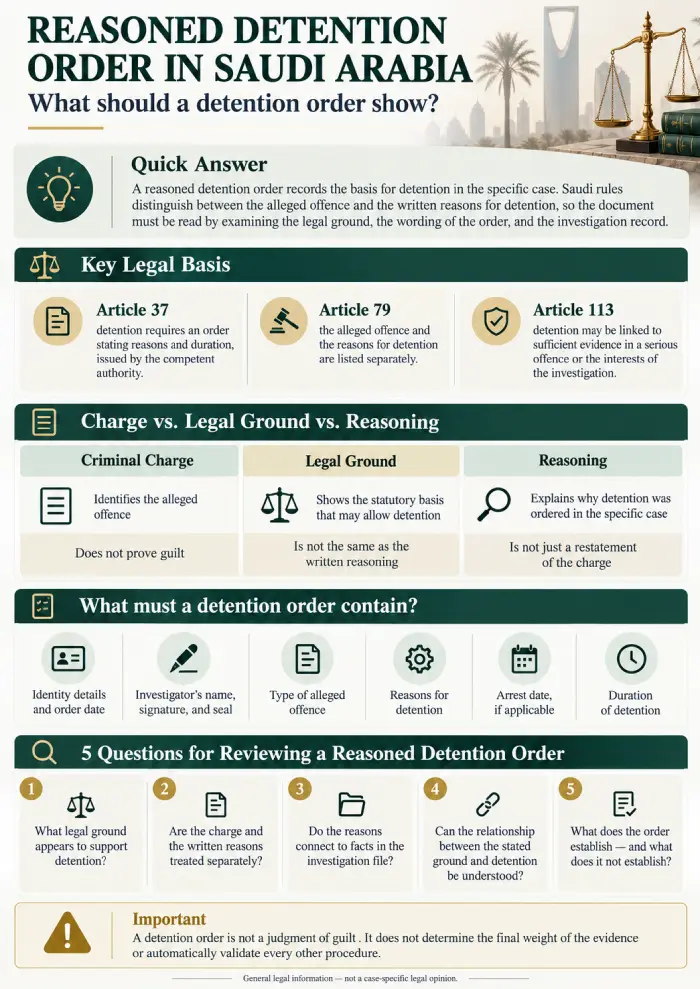
A reasoned detention order states the basis for detaining the accused in the particular case. Saudi rules separately identify the alleged offence and the reasons for detention. The order should therefore be reviewed by asking what reason is actually recorded, what legal ground supports it, and how that reason relates to the investigation file.
Key Saudi Legal Basis
Article 37 of the Saudi Law of Criminal Procedure requires detention to be based on an order issued by the competent authority that states the reasons and specifies its duration.
Article 79 of the Implementing Regulations of the Law of Criminal Procedure separately identifies the type of offence attributed to the accused and the reasoning for the detention order among the required information.
What Does a Reasoned Detention Order Mean in Saudi Arabia?
A reasoned detention order explains the stated basis for using detention in the specific case. It is different from the accused person’s identity, the description of the alleged offence, and the duration of the detention.
Each element answers a different question. The charge explains what offence is being investigated. The legal ground identifies the statutory basis on which detention may be available. The reasoning explains why detention was ordered in the individual case.
| Element | What It Does | What It Does Not Mean |
|---|---|---|
| Criminal charge | Identifies the alleged offence being investigated. | It does not establish guilt by itself. |
| Legal ground | Identifies a statutory basis that may permit detention when its requirements are met. | It is not automatically the same as the reasoning written in a specific order. |
| Reasoning | Explains the stated basis for ordering detention in the particular case. | It does not require one fixed form of wording unless the law expressly requires it. |
The Reasoning Is Not a Restatement of the Charge
Stating the alleged offence tells the reader what conduct is under investigation. The reasoning addresses a different issue: why detention was ordered.
This distinction is reflected in Article 79 of the Implementing Regulations. The provision lists the type of offence attributed to the accused and the reasoning for detention separately. A reasoned detention order therefore cannot be analysed simply by checking whether the name of an offence appears in the document.
What Is the Difference Between the Legal Ground and the Reasoning?
The legal ground and the reasoning are connected, but they are not identical. A legal ground is the statutory condition or basis that can permit detention. The reasoning is what the order states about why detention was used in the particular case.
A statute may therefore establish a ground on which detention is legally available. The next step is to read the actual detention order and identify what was recorded as the basis for using that power in the case under review.
Practical distinction:
A legal rule that permits detention is one issue. The written explanation for using detention in an individual case is another. A reasoned detention order should therefore be read by separating the statutory ground from the reasoning recorded in the document.
What Must a Detention Order Contain?
Article 79 of the Implementing Regulations identifies the information that must appear in a detention order issued under the relevant provisions of the Saudi Law of Criminal Procedure.
| Information | Why It Matters |
|---|---|
| Identity details and date of the order | Identifies the person concerned and the timing of the order. |
| Investigator’s name, signature, and official seal | Identifies the authority responsible for issuing the order. |
| Type of alleged offence | Identifies the criminal allegation connected to the procedure. |
| Reasons for detention | Records the stated basis for ordering detention. |
| Date of arrest, where applicable | Identifies the relevant procedural date. |
| Duration of detention | Defines the period covered by the order. |
| Direction to the detention facility | Directs the competent facility to implement the order. |
The important point is that the alleged offence, the reasons for detention, and the duration of detention are separate pieces of information. They should not be treated as interchangeable.
For that reason, reviewing a reasoned detention order requires more than confirming that the document contains the name of the alleged offence.
What Are the Statutory Grounds for Detention During Investigation?
The statutory grounds provide the legal background against which the reasoning should be read. They are not, however, the main search topic of this article.
Article 24 of the Implementing Regulations addresses grounds connected to detention during an investigation. These include a serious offence requiring detention, the interests of the investigation, failure to provide an address accepted by the investigator, a risk of flight or disappearance, or failure to undertake to appear when required.
Article 113 of the Saudi Law of Criminal Procedure also connects a detention order, within its scope, to sufficient evidence concerning a serious offence or to circumstances in which the interests of the investigation require detention.
The purpose of discussing these provisions here is not to create a separate guide to every ground for detention. It is to provide the legal context needed to understand the reasoning written in a particular order.
How Do Investigation Interests Relate to a Detention Order?
The interests of the investigation may form part of the statutory basis for detention. The phrase, however, should not be converted into a fixed list of assumptions that automatically applies to every criminal case.
When reviewing a reasoned detention order, the more useful question is what the written order reveals about the connection between the investigation and the decision to detain the accused.
The analysis should remain tied to the actual record. A reviewer should not invent a reason that does not appear in the order or the investigation documents.
Is “Interest of the Investigation” Enough on Its Own?
There is no responsible universal answer such as “always enough” or “never enough” without reviewing the document and the file. The legal analysis depends on what was actually written and how the stated ground relates to the facts recorded in the investigation.
This distinction also prevents a common error: treating a general statutory expression as though it automatically explains why detention was necessary in every individual case.
How Does Sufficiency of Evidence Relate to a Detention Order?
Article 113 refers, within its statutory context, to sufficient evidence against the accused in relation to a serious offence, or to detention being required by the interests of the investigation.
This is a procedural stage. It is not the same as a final determination of guilt.
A reasoned detention order does not establish that the accused will be convicted. It also does not determine the final weight that a court will give to each item of evidence.
What detention does not mean:
A detention order is not a judgment of guilt. It does not determine the final strength of the prosecution evidence, replace the criminal trial, or prove that every investigative procedure was legally valid.
For a wider analysis of how evidence and procedure interact, see Criminal Evidence in Saudi Arabia.
A related example of why evidence must be assessed in context is explained in Contradictory Accused Statements.
5 Questions for Reviewing a Reasoned Detention Order
The following questions provide a practical framework for reviewing a reasoned detention order. They are not five new statutory conditions. Their purpose is to organise the analysis before drawing conclusions about the legal effect of the document.
| Review Point | Question to Ask | Why It Matters |
|---|---|---|
| Legal ground | What statutory basis appears to support the detention? | It keeps the analysis tied to the applicable legal rule. |
| Charge vs. reasoning | Are the alleged offence and the reasons for detention being treated separately? | Saudi rules list them as separate components. |
| Case-specific facts | Does the reasoning relate to facts recorded in the particular investigation? | It helps distinguish document-based analysis from assumption. |
| Connection to detention | Can the relationship between the stated ground and the detention decision be understood? | A general legal ground and its application to a case are different questions. |
| Limits of the document | What does the order establish, and what does it not establish? | It prevents detention from being treated as proof of guilt. |
Practical Review Rule
Do not look only for the word “reasoned.” When reviewing a reasoned detention order, follow this sequence:
legal ground → wording of the order → case facts → limits of what can be inferred.
The description of the alleged offence does not perform the same function as the written reasons for detention.
What Cannot Be Inferred from a Detention Order Alone?
A detention order is an important procedural document, but it does not answer every legal question in the criminal case.
First, detention does not prove guilt. A detention decision is made at a procedural stage and does not replace the final judicial assessment of the charge.
Second, it does not determine the final strength of all evidence. A court may later assess statements, forensic evidence, digital evidence, witness testimony, reports, and other material within a broader evidentiary context.
Third, a detention order does not automatically prove that every other procedure was lawful. Arrest, search, seizure, questioning, and other investigative steps must be reviewed under the rules that govern each procedure.
Finally, a possible defect in a reasoned detention order should not automatically be described as making the entire case invalid. The nature of the defect, the statutory requirement involved, and its procedural effect must first be identified.
Frequently Asked Questions About a Reasoned Detention Order
What is a reasoned detention order in Saudi Arabia?
A reasoned detention order is a detention order that records the stated basis for detaining the accused in the particular case. It should be distinguished from the description of the alleged offence. The legal review considers the statutory ground, the wording of the order, and its relationship to the investigation record.
Is stating the alleged offence enough to explain the detention?
Not by itself. Article 79 of the Implementing Regulations separately refers to the type of offence attributed to the accused and the reasoning for the detention order. They perform different functions. Any legal effect of a missing or incomplete element, however, should be assessed from the actual document and applicable procedural rules.
How do investigation interests relate to detention?
The interests of the investigation may provide a statutory basis connected to detention. The analysis of a specific case should examine what the order actually says and how that reason relates to the investigation record. A reviewer should avoid adding hypothetical reasons that are not supported by the order or case documents.
Does sufficient evidence mean that the accused is guilty?
No. The sufficiency of evidence referred to in the detention framework operates at an investigative and procedural stage. It does not amount to a final conviction. Guilt remains a separate question for adjudication after the evidence, defence, procedures, and other relevant parts of the case have been considered.
What information appears in a Saudi detention order?
Article 79 identifies information including the person's identifying details, the date of the order, the investigator's details and signature, the alleged offence, reasons for detention, the arrest date where applicable, the detention period, and the direction for placement in the detention facility. Each item serves a separate procedural function.
Does a defect in the reasons automatically invalidate the detention?
A possible defect should not automatically be treated as producing one predetermined result. The first step is to identify the statutory requirement, the exact defect, and the part of the procedure it affects. The legal consequence then depends on the applicable procedural rules and the facts and documents of the particular case.
Legal Conclusion
A reasoned detention order should be read by connecting the legal basis for detention with the wording of the order and the facts recorded in the investigation. One of the most important distinctions is that the alleged offence and the written reasons for detention perform separate functions.
The order also does not establish guilt, determine the final weight of the evidence, or automatically validate every other investigative procedure.
The clearest review sequence is:
legal ground → written reasons → case facts → limits of inference.
About the Author
Attorney Mohammed Al-Dossary
Licensed Attorney in the Kingdom of Saudi Arabia — License No. 40462 — Practicing since 2013.
Professional licensing information can be reviewed through the
Licensing and Membership.
Disclaimer:
This article provides general legal information about Saudi criminal procedure. It is not a legal opinion on any specific detention order, criminal investigation, or individual case. The legal assessment may differ according to the facts, documents, procedural stage, and statutory provisions applicable to the particular matter. Reading this article does not create an attorney-client relationship.