Many business owners search for Commercial Registration Cancellation when they stop operating, close a sole establishment, or end a company’s business in Saudi Arabia. In legal terms, however, the more accurate concept is usually the deletion or striking off of the commercial registration entry.
This article does not treat “cancellation” and “deletion” as two completely separate procedures in every case. Instead, it explains how the common search term “cancellation” relates to the legal effect of deleting the registration entry, when deletion may be voluntary or mandatory, and how it differs from suspension, liquidation, licences, labour obligations, tax matters, debts, and trade names.
Before deciding to cancel or delete a commercial registration, it is important to understand Commercial Registration in Saudi Arabia as the official record connected to the business data, activity, and legal effects of the establishment or company.
Last updated: August 2026.
This guide is based on the Commercial Registration Law, Companies Law, and Ministry of Commerce and Saudi Business Center services related to deleting commercial registrations and lifting suspension. It does not replace legal review of the registration status and related obligations before filing.
Quick Answer
Commercial Registration Cancellation is the term commonly used by business owners, while deleting or striking off the registration entry is the legal effect that ends the registration status. Filing a deletion request is not enough if the business is a company that needs dissolution or liquidation, has licences to cancel, employees, tax obligations, debts, or active contracts. Saudi official services also differ according to the type of registration and entity, such as a sole establishment, company branch registration, or company registration deleted under a court judgment. The Ministry of Commerce provides an electronic service to delete a sole establishment commercial registration through the Saudi Business Center when the business activity has ended.
Before deleting a commercial registration, review licences, employees, tax files, debts, and contracts. Deletion ends the registration entry, but it does not automatically erase prior obligations.
What Does Deleting a Commercial Registration Mean?
When discussing Commercial Registration Cancellation, the first point is to understand what deletion of the registration entry means. Deletion means ending the status of the commercial registration in the official commercial register. In practical terms, the registration no longer remains an active commercial entry for the establishment or company once the deletion process is completed through the correct route.
Deletion is not the same as simply stopping business activity. A business may stop operating in practice, but the registration may remain active unless the owner files a deletion request or a legal event leads to deletion.
It is also different from suspension. Suspension is a restricted or interrupted status that may still be capable of being lifted if the registration remains in existence. Deletion, by contrast, ends the registration entry itself.
This distinction matters because commercial registration data has legal effect for or against the trader from the date of registration, and required data generally cannot be relied on against third parties unless it has been registered or updated. The Commercial Registration Law also regulates deletion, suspension, annual confirmation, extracts, and registration certificates, which confirms that deletion is a legal status, not merely a platform button.
Is There a Difference Between Cancellation and Deletion?
The difference in Commercial Registration Cancellation is mostly practical and linguistic. Users often say “cancel the commercial registration,” while the more precise legal wording is deletion or striking off of the commercial registration entry.
Cancellation as a Common Search Term
Business owners usually use “cancellation” when they want to close a business, stop an activity, or end a commercial registration. Some official service descriptions also use cancellation language when explaining the deletion of a sole establishment registration upon completion of the business activity.
For SEO and user intent, it is correct to use Commercial Registration Cancellation because this reflects how users search. The important point is not to create a false legal distinction between cancellation and deletion where the actual issue is ending the registration entry.
A better legal explanation is this: cancellation is the common expression used by business owners, while deletion of the registration entry is the legal result that changes the status of the commercial registration.
Deletion as the More Precise Legal Term
Deletion is the better term when discussing the legal effect. It describes the ending of the registered entry in the commercial register.
This becomes especially important with companies. A company may need dissolution, liquidation, and registration steps before the final deletion of its commercial registration. A sole establishment may have a simpler registration structure, but deletion still does not automatically settle labour, tax, licence, debt, or contract issues.
For this reason, the correct question is not only “How do I cancel the registration?” It is: what is the entity type, why is the registration being deleted, and what obligations remain before or after deletion?
When Is Deletion Voluntary or Mandatory?
| Type of deletion | When it happens | Practical example | What to check |
|---|---|---|---|
| Voluntary deletion | When the trader stops carrying on the activity and applies to delete the registration | Closing a sole establishment or ending an activity that is no longer carried out | It may not be suitable if the closure is temporary, because deletion ends the registration and may require a new registration later |
| Mandatory deletion | When a legal event requires deletion, not only because the owner wants it | Final court judgment, completion of company liquidation, or another legal event leading to deletion | The reason and entity type must be identified before selecting the service, because a sole establishment differs from a company or judicial deletion |
Suspension vs Deletion of Registration
In Commercial Registration Cancellation, suspension is not the same as deletion. Suspension restricts or interrupts the effects of the registration because a required obligation has not been met, while deletion ends the registration entry itself.
This difference is important in practice. If a registration is suspended because the annual confirmation was not completed, the correct route may be to lift the suspension, not to delete the registration immediately. If the activity has ended, the company has entered liquidation, or a court judgment requires deletion, then deletion may become the relevant path.
Where a registration is suspended because annual confirmation was missed, the issue should be reviewed before choosing deletion. If the related English article has been published, this sentence can be linked later to: Commercial Registration Renewal.
The Ministry of Commerce provides an electronic service for lifting suspension of a sole establishment commercial registration after the 90-day period from the annual confirmation due date, which confirms that suspension and deletion are separate statuses.
Sole Establishment vs Company Registration Deletion
The correct path for Commercial Registration Cancellation depends on the entity type. Deleting a sole establishment registration is usually simpler in structure because it is directly connected to its owner and does not normally pass through company dissolution and liquidation. Deleting a company registration is different because a company is a legal structure involving partners or shareholders, assets, debts, contracts, and possible liquidation before final deletion.
| Comparison point | Sole establishment | Company |
|---|---|---|
| Nature of entity | Directly connected to the owner | Legal entity with partners or shareholders and a separate financial position depending on company type |
| Deletion path | Usually through the sole establishment deletion service after the activity ends | May require dissolution, liquidation, or documents connected to the end of the company’s affairs |
| Main pre-filing checks | Employees, social insurance, licences, tax, debts, and business accounts | Dissolution decision, liquidation, creditor rights, contracts, licences, and existing obligations |
| Common mistake | Assuming deletion ends all obligations connected to the owner | Treating company deletion like sole establishment deletion without reviewing liquidation and debts |
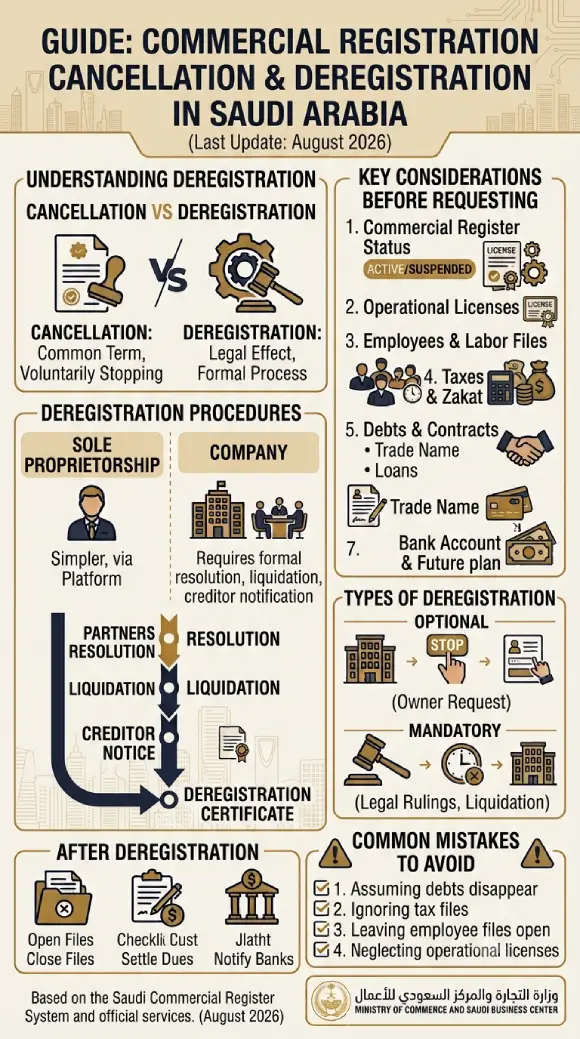
What Should Be Reviewed Before Filing?
Before Commercial Registration Cancellation, the business should complete a focused review. The purpose is to avoid later disputes with a government authority, creditor, employee, partner, or contracting party.
The key checks are:
- Registration status: Is it active, suspended, or already under another procedure?
- Entity type: Is it a sole establishment, company, foreign company branch, or branch registration?
- Operating licences: Are there municipal or sector-specific licences connected to the activity?
- Employees and labour files: Are there employment contracts or registered employees?
- Social insurance: Are there contributions, liabilities, or employees to address?
- Zakat and tax: Are there filings, a tax number, or VAT registration?
- Debts and contracts: Are there loans, supply contracts, lease contracts, or claims?
- Trade name: Does the owner want to keep, transfer, or reuse the trade name?
- Bank accounts and payment tools: Are there business accounts, POS devices, or payment gateways?
- Claims or disputes: Are there existing or potential legal claims?
Cancelling Licences Before Deletion
Deleting the commercial registration does not necessarily cancel every licence linked to the business. A municipal licence, sector-specific licence, civil defence approval, or other operating approval may need separate handling.
This point appears in official service requirements. For example, the Saudi Business Center service for deleting a company branch commercial registration refers to providing evidence that licences do not exist, or that licences have been cancelled for activities that require a licence before issuance. It also notes the position of the trade name in some cases.
This does not mean every deletion request requires the same document. It means that a licensed activity may change the deletion path. The licence position should therefore be reviewed before filing.
A business that ignores licences may later face fees, violations, or an unresolved government file even after the commercial registration entry has been deleted.
Employees and Social Insurance After Deletion
Deleting a commercial registration does not automatically end employees’ rights. If the business has employees, the owner or company should review employment contracts, wages, end-of-service rights, transfer issues where relevant, and the correct way to end the employment relationship.
Social insurance files also require attention. A business may need to review contributions, remove employees when the legal basis exists, and settle any outstanding liabilities or records with the relevant authority.
In companies, employee entitlements should be part of the obligations reviewed before liquidation is completed or before the business is operationally closed. Treating deletion as the only step may leave unresolved employment or insurance issues.
Zakat, Tax, and Registration Numbers
Commercial registration deletion does not automatically remove zakat or tax obligations. If the business is registered with the Zakat, Tax and Customs Authority, has a tax number, or is registered for VAT, the relevant file should be reviewed before and after deletion according to the case.
In a sole establishment, liability may remain connected to the owner depending on the type of obligation. In a company, zakat and tax issues usually form part of the financial review and liquidation process where the company is being dissolved.
The practical rule is simple: deletion of the commercial registration is an important step, but it is not a clearance certificate from every authority. Zakat and tax files should be reviewed before assuming that closure is complete.
Debts, Contracts, and Claims
Deleting the commercial registration does not erase previous debts or automatically end active contracts. If the business has loans, leases, supply contracts, service agreements, cheques, or customer obligations, each item should be handled according to its legal nature.
In companies, debts are usually reviewed as part of liquidation. Liquidation is not only a formal step; it is tied to creditors’ rights, identifying assets, paying liabilities, and determining what remains for partners or shareholders.
For sole establishments, obligations may remain connected to the owner, especially where the obligation existed before deletion. It is therefore inaccurate to assume that deleting the establishment registration makes debts disappear or prevents creditors from bringing claims.
Trade Name After Registration Deletion
The trade name may be affected by deletion of the commercial registration. Before filing, the business owner should review whether they want to keep, transfer, or reuse the name later.
The Trade Names Law addresses deletion of a trade name in certain cases, including cases connected to deletion of the commercial registration entry. This means the trade name should not be treated as a minor detail when the business is closing.
Some official services also refer to identifying the position of the trade name or retaining it in certain cases. Where the name has commercial value, its position should be clarified before deletion.
Electronic Steps to Delete the Registration
Details vary depending on the registration type and entity. In general, the filing path revolves around business closure services and choosing the deletion service that matches the entity and registration.
The usual steps are:
- Access the Saudi Business Center or the official Ministry of Commerce service path.
- Choose the business closure or termination section.
- Select the suitable deletion service according to the entity type.
- Select the registration to be deleted.
- Choose the reason for deletion.
- Identify the trade name position where the service requires it.
- Attach proof of licence cancellation where requested.
- Accept the declaration of correct data.
- Submit the request.
- Follow up on the request and keep the deletion certificate or evidence.
For a sole establishment, the Ministry of Commerce provides an electronic service for deletion when the business activity has ended. For companies, services may differ depending on whether the registration is a main or branch registration, national or foreign company, or deletion based on a court judgment. The Saudi Business Center also has a service for deleting a company main commercial registration under a court judgment.
What Happens After Deletion?
After deletion, the business may still need to close government files, terminate licences, keep records, deal with claims, and notify banks or contracting parties.
Common follow-up steps include keeping evidence of deletion, reviewing zakat and tax status, reviewing social insurance, addressing labour files, closing or updating municipal and sector licences, handling the business bank account, and notifying relevant contractual parties when needed.
For companies, some liquidation-related documents, creditor matters, records, and responsibilities may remain relevant after operational closure. Deletion changes the registration status, but it does not by itself cancel every previous legal relationship.
Can a Deleted Registration Be Challenged or Restored?
A suspended registration is different from a deleted registration. If the registration is suspended, it may be possible to review the requirements for lifting suspension. If the registration has already been deleted, the position depends on the reason and legal path of deletion.
The first question should always be: is the registration suspended or deleted? These are not the same status.
A deleted registration should not be presented as something that can always be restored through a simple request. Depending on the case, the practical route may be opening a new registration, challenging a decision, reviewing a court judgment, or examining why the deletion occurred.
Common Mistakes Before Deletion
Common mistakes in Commercial Registration Cancellation include confusing suspension with deletion. In some cases, the registration may be eligible for lifting suspension, but the owner moves toward deletion without checking the available options.
Another mistake is trying to delete a company registration before the liquidation position is clear. A company differs from a sole establishment, and deleting its registration cannot be separated from dissolution and liquidation where they apply.
Business owners may also assume that debts disappear after deletion, ignore employees, leave tax or zakat files unresolved, keep operating licences active, fail to review the trade name position, or fail to keep evidence of deletion.
These mistakes do not necessarily invalidate every deletion. But they may leave obligations or claims that appear later.
When Is Legal Review Needed?
Legal review is needed before Commercial Registration Cancellation where the registration belongs to a company, or where debts, employees, operating licences, tax obligations, contracts, disputes, suspension, a foreign company, or potential objection to deletion exist.
Review is also important where it is unclear whether the correct route is lifting suspension, updating registration data, deleting the registration, or starting dissolution and liquidation of a company.
Legal review is not intended to complicate the process. Its purpose is to identify the effect of deletion before filing and clarify what should be completed before or after the deletion request.
Professional note: If the registration is suspended, or the business has employees, debts, licences, or tax obligations, reviewing the obligations before deletion helps identify what should be settled before or after filing.
This article is prepared for general legal awareness about Commercial Registration Cancellation in Saudi Arabia. It does not replace legal review of the registration status, entity type, licences, employees, zakat and tax, debts, contracts, or liquidation requirements before filing a deletion request.
FAQ About Commercial Registration Cancellation
What is the difference between cancellation and deletion?
Cancellation is the common expression used by business owners. Deletion or striking off of the commercial registration entry is the more precise legal concept that ends the registration status.
How should Commercial Registration Cancellation start?
Start by identifying the entity type and registration status. Then review licences, employees, tax files, debts, and contracts before selecting the correct deletion service.
When is deletion voluntary?
Deletion is usually voluntary when the trader stops carrying on the business activity and applies to delete the registration entry through the suitable official service.
What is the difference between suspension and deletion?
Suspension restricts or interrupts the effects of the registration without necessarily ending it. Deletion ends the registration entry.
Can a sole establishment registration be deleted online?
Yes. The Ministry of Commerce provides an electronic service, through the Saudi Business Center, to delete a sole establishment commercial registration when the business activity has ended.
Can a company registration be deleted without liquidation?
A company is not always treated like a sole establishment. Where dissolution and liquidation apply, the liquidation position should be reviewed before deleting the company’s commercial registration.
Does deletion automatically cancel licences?
No. Municipal or sector-specific licences should be checked, and proof of licence cancellation may be required depending on the service and case.
Do debts disappear after deleting the registration?
No. Deletion does not erase previous debts or obligations. Company debts are usually handled through liquidation, while sole establishment obligations may remain connected to the owner.
What happens to employees after deletion?
Employees’ rights do not end automatically. Employment contracts, wages, end-of-service rights, labour files, and social insurance matters should be reviewed.
What is the tax effect of deletion?
Deletion does not automatically close zakat or tax obligations. Filings, tax registration, VAT status, and the related account should be reviewed where applicable.
Legal Conclusion
Commercial Registration Cancellation is not merely closing an account on a platform. Cancellation is the phrase users commonly search for, while deletion or striking off is the more precise legal effect that ends the commercial registration entry.
Deletion does not automatically end every obligation. Debts, contracts, employees’ rights, tax files, operating licences, and liquidation obligations may remain. The entity type, registration status, and related obligations should therefore be reviewed before filing.
Official Sources: