Criminal Judgment Reasoning is central to assessing whether a Saudi criminal judgment has been properly constructed. A judgment should not simply end with a conviction or acquittal. It should explain the facts, the evidence, the defence arguments, and the legal or Sharia basis that led the court to its conclusion.
Insufficient reasoning arises when reasons are stated, but they do not adequately explain how the court moved from the case facts and evidence to the final ruling.
Under the Saudi Law of Criminal Procedure, the written judgment should include the substance of the case, the parties’ requests and defence, the evidence and arguments relied upon, and the reasons and legal basis for the ruling.
Quick Answer
Criminal Judgment Reasoning is the court’s explanation of the facts it accepted, the evidence it relied on, the legal significance of that evidence, and why those matters support the final ruling. A judgment is not defective merely because it is brief. The key question is whether the reasons are sufficient to understand and review the result.
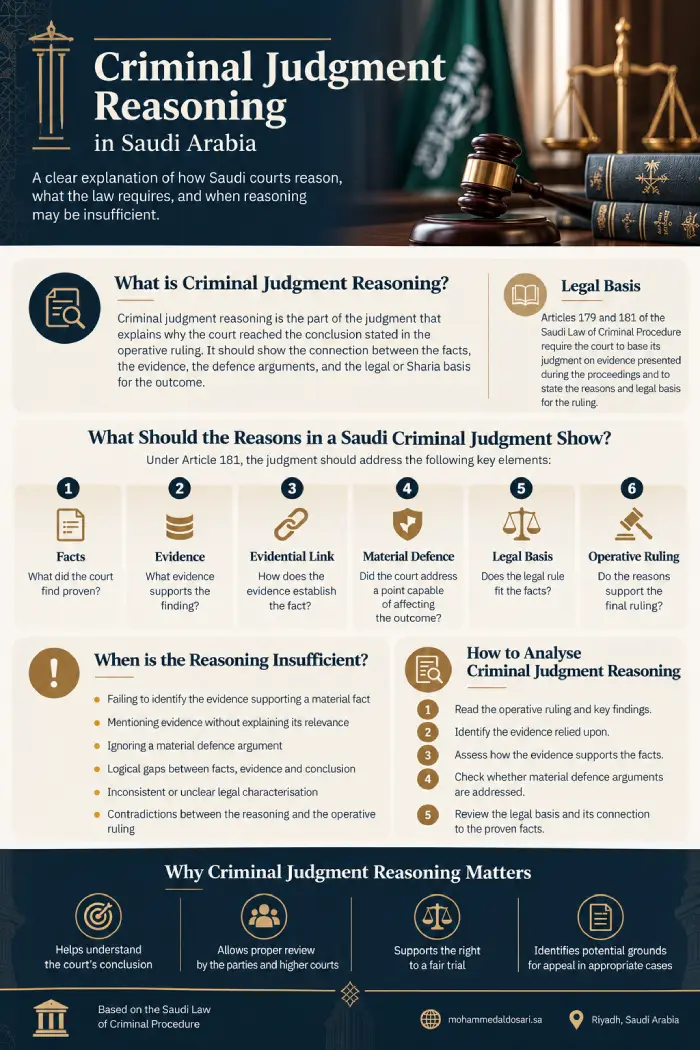
What Is Criminal Judgment Reasoning?
Criminal Judgment Reasoning is the part of the judgment that explains why the court reached the conclusion stated in the operative ruling.
In a Saudi criminal case, it is not enough to repeat the allegation or reproduce investigation records. The judgment should show the connection between the facts the court found proven, the evidence supporting those facts, the material defence arguments, and the legal or Sharia basis for the outcome.
Article 179 of the Saudi Law of Criminal Procedure provides that the court must base its judgment on evidence presented during the proceedings. The judge may not decide the case based on personal knowledge.
Article 181 sets out the main components of the written judgment. These include the parties’ requests and defence, the evidence and arguments relied upon, the summary of the case, and the reasons and legal basis for the ruling.
The practical value of Criminal Judgment Reasoning is that it allows the parties and a higher court to answer four basic questions: What was proven? By what evidence? How was the evidence interpreted? Why did it lead to this particular result?
What Should the Reasons in a Saudi Criminal Judgment Show?
Saudi law does not impose one fixed writing format for every criminal judgment. However, Article 181 provides a clear framework for assessing whether the reasoning is sufficient.
The more complex the facts, evidence, and defence arguments are, the more important it becomes for the judgment to address the material issues clearly.
| Element | Key Question | Possible Defect |
|---|---|---|
| Facts | What did the court find proven? | The facts are vague or the alleged conduct is not clearly identified. |
| Evidence | What evidence supports the finding? | The judgment states a conclusion without identifying its evidential basis. |
| Evidential Link | How does the evidence establish the fact? | The reasoning jumps from evidence to conclusion without a clear link. |
| Material Defence | Did the court address a point capable of affecting the outcome? | A material defence argument is ignored or answered without addressing its substance. |
| Legal Basis | Does the legal rule fit the facts found by the court? | The legal basis is disconnected from the facts or the conduct is mischaracterised. |
| Operative Ruling | Do the reasons support the final ruling? | The reasoning conflicts with, or is insufficient to support, the operative ruling. |
When Is Criminal Judgment Reasoning Insufficient?
Understanding Criminal Judgment Reasoning requires distinguishing a brief judgment from an inadequately reasoned judgment.
A short judgment is not automatically defective. Likewise, a lengthy judgment is not necessarily well reasoned.
The real test is whether the stated reasons allow the reader to understand why the court reached its conclusion and whether that conclusion is connected to the evidence, facts, and applicable legal rules.
Potential signs of insufficient reasoning include:
- failing to identify the evidence supporting a material fact;
- mentioning evidence without explaining its relevance;
- ignoring a defence argument that directly affects an element of the alleged offence;
- relying on a technical finding but drawing a conclusion not supported by the expert report;
- reaching an operative ruling that is not adequately supported by the reasons stated in the judgment.
Key Analytical Rule
Insufficient reasoning is not measured by the number of pages in the judgment. A concise judgment may clearly identify the facts, evidence, evidential link, and legal basis. A lengthy judgment may still be defective if it leaves a material question unanswered.
7 Defects That Should Not Be Confused With Insufficient Reasoning
A common weakness in criminal appeals is the use of “insufficient reasoning” as a label for every possible defect in a judgment.
For a proper review of Criminal Judgment Reasoning, the type of defect should first be identified. An evidential problem is not the same as a legal-characterisation error, and contradictory reasons are not the same as an absence of reasons.
| Defect | Meaning | Practical Question |
|---|---|---|
| Absence of Reasons | The judgment does not reveal the basis for the result. | Are there actual reasons, or only general statements and a ruling? |
| Insufficient Reasoning | Reasons exist but are not sufficient to explain or support the outcome. | What link is missing between the facts, evidence, and ruling? |
| Defective Inference | The conclusion does not logically follow from the evidence relied upon. | Do the stated facts actually support the conclusion? |
| Contradictory Reasons | One reason conflicts with another on a material issue. | Can both reasons be reconciled? |
| Conflict Between Reasons and Ruling | The reasons point to a result different from the final operative ruling. | Do the stated reasons genuinely support the ruling? |
| Misstatement of the Record | A reason is based on a fact that does not match a document or record in the case file. | Where in the case record is that fact established? |
| Error in Legal Characterisation | The facts are accepted but given an incorrect criminal description. | Does the legal characterisation match the facts found by the court? |
Does Failure to Address a Material Defence Always Make the Judgment Defective?
No.
Not every argument raised by a party requires a separate and lengthy response.
The practical test is whether the argument could affect the reasoning or result.
A defence point becomes more important when it:
- challenges evidence relied on by the court;
- disputes causation;
- concerns intent or knowledge;
- challenges attribution of the conduct;
- questions the legality of a procedure used to obtain evidence;
- could change the legal classification of the act.
If the argument concerns a point that cannot affect the outcome, the lack of a separate response may not be material.
However, where it concerns evidence carrying the judgment, causation, intent, attribution, or the legality of a procedure, the way the judgment addresses that defence becomes an important part of assessing Criminal Judgment Reasoning.
Conflicting Statements and Evidence
If the accused changes a statement, or oral evidence conflicts with a forensic or digital record, identifying the contradiction is only the first step.
The analysis should determine:
- what exactly changed;
- whether the difference concerns a material fact;
- which evidence the court preferred;
- why the court preferred one version over another.
The relevant question is therefore not merely whether evidence conflicted, but whether the judgment explained how that conflict affected the court’s assessment.
This is where Criminal Judgment Reasoning connects directly with criminal evidence analysis. A court may prefer one item of evidence over another, but the reasoning should make the basis for that preference understandable. Where the issue concerns changes in the accused’s account, the evidential effect should be assessed separately through the analysis of Contradictory Accused Statements.
Is Insufficient Reasoning an Independent Ground for Cassation?
This issue requires particular care.
Article 198 of the Saudi Law of Criminal Procedure sets out the statutory grounds for cassation before the Supreme Court.
They include:
- violation of Sharia principles or laws that do not conflict with them;
- a judgment issued by a court that was not properly constituted;
- lack of jurisdiction;
- an error in the legal characterisation or description of the facts.
The provision does not list “insufficient reasoning” as a separate fifth statutory ground.
This does not mean that a defect in the reasons is legally irrelevant.
A reasoning defect may be significant, but its relevance to cassation depends on the nature of the defect and whether it falls within one of the statutory grounds recognised by law.
At the Court of Appeal level, the court considers the objection, its grounds, and the supporting material, and may uphold or overturn the judgment in whole or in part according to the applicable rules.
Important Legal Point
Saying that “the judgment lacks sufficient reasoning” does not by itself determine the outcome of an appeal. A stronger challenge identifies the exact defect, explains its connection to the evidence or legal classification, and shows how it could have affected the result.
How to Review Criminal Judgment Reasoning in 6 Steps
Instead of reading the judgment as one long document, review Criminal Judgment Reasoning in six stages:
- Identify the fact the court found proven.
Do not start with the sentence or penalty. Start with what the judgment says happened. - Identify every item of evidence linked to that fact.
This may include a confession, witness evidence, forensic report, seizure record, digital evidence, or circumstantial evidence. - Identify the evidential link.
What did the court say the evidence actually proves? - Identify the material defence.
Is there a defence point that, if accepted, could alter the interpretation of the evidence or the legal classification? - Test consistency.
Do the reasons agree with each other and with the final ruling? - Classify the defect correctly.
Is the problem insufficient reasoning, defective inference, incorrect legal characterisation, or inconsistency with the case record?
Quick Judgment Test
Can you answer four questions from the judgment itself? What fact was proven? What evidence proved it? What was the evidential significance? Why did the court reach this particular ruling? If one material answer is missing, that is where closer review should begin.
Appeal Deadlines and Why Timing Matters
Once the issue moves from analysis to an actual objection, statutory deadlines become important.
Article 194 of the Saudi Law of Criminal Procedure provides a 30-day period for filing an appeal or requesting review, subject to the rules governing judgments that must be referred for review.
Article 199 also provides a 30-day period for filing a cassation challenge.
A challenge based on Criminal Judgment Reasoning is often weakened when it relies on general wording such as “the court failed to give reasons” without identifying:
- the relevant paragraph;
- the evidence in question;
- the defence argument allegedly ignored;
- the nature of the defect;
- the connection between the defect and the outcome.
The objection should explain the defect, not merely label it.
Before Seeking a Criminal Judgment Review
If you are reviewing an existing criminal judgment, prepare the full case material that is relevant to the court’s reasoning. This type of review falls within the broader professional interest in criminal cases, evidence analysis, and criminal procedures.
This may include:
- the complete written judgment, not only the operative ruling;
- any defence memorandum filed in the case;
- any previous objection or appeal document;
- material investigation records;
- forensic or expert reports;
- documents and digital evidence discussed by the court.
The purpose of a professional review is not to search for a standard phrase such as “insufficient reasoning.” It is to determine whether the real issue concerns reasoning, inference, legal characterisation, evidence, or another part of the judgment. This reflects the site’s professional methodology for reviewing facts, documents, evidence, and legal options before choosing a procedural course.
Frequently Asked Questions About Criminal Judgment Reasoning
Does a short criminal judgment automatically have insufficient reasons?
No. Length is not the legal test.
A concise judgment may still clearly identify the relevant facts, evidence, evidential link, and legal basis. A lengthy judgment may remain inadequate if it leaves a material issue unresolved.
What is the difference between insufficient reasoning and defective inference?
Insufficient reasoning concerns missing or inadequate reasons needed to understand or support the result.
Defective inference concerns the logical relationship between the evidence and the conclusion. The reasons exist, but the conclusion does not properly follow from them.
Both defects may appear in the same judgment.
Does failure to discuss a document or defence argument automatically invalidate the judgment?
No.
The key question is whether the omitted point could affect the result. If it is irrelevant or immaterial, separate discussion may not be necessary.
If it could change the interpretation of important evidence or an element of the offence, the omission requires closer review.
Does insufficient reasoning guarantee cassation by the Saudi Supreme Court?
No.
Article 198 sets out the statutory grounds for cassation and does not list insufficient reasoning as an independent ground.
The defect must therefore be analysed according to its nature and connected to a statutory ground where appropriate.
How can I distinguish a reasoning defect from an error in legal characterisation?
If the problem is that the court did not adequately explain why the evidence supports the outcome, the issue is closer to reasoning.
If the court accepted certain facts but applied an incorrect criminal description to those facts, the issue is closer to legal characterisation.
What documents are needed to review a Saudi criminal judgment?
The full judgment is essential.
A proper review may also require defence submissions, investigation records, expert reports, seizure records, digital evidence, and any other documents specifically discussed by the court.
These materials allow the reasons to be compared with what was actually before the court.
Conclusion
Criminal Judgment Reasoning should be assessed by tracing the chain from fact to evidence, from evidence to evidential meaning, and from that meaning to the legal basis and final ruling.
The analysis should distinguish insufficient reasoning from defective inference, contradiction, misstatement of the record, and error in legal characterisation. Each defect has a different legal nature and may affect the judgment differently.
The most useful question is not whether the judgment is long or short. It is whether the reasons allow a reader to understand why the court accepted particular facts and why those facts legally support the result.
A structured review of Criminal Judgment Reasoning therefore focuses on the actual reasoning path used by the court, rather than on general labels or formulaic objections.
Disclaimer: This article provides general legal information only. It does not assess a specific judgment or criminal case, does not constitute legal advice, and does not create a lawyer-client relationship. The effect of any reasoning defect depends on the judgment, case facts, evidence, defence arguments, and procedural stage. For information on how legal sources and published content are selected and reviewed, see the site’s Sources and Methodology.