Legal Review Author:
Mohammed Aboud Al-Dossary
Saudi Lawyer — Licence No. 40462
Published: 22 September 2026
Reviewed by: Mohammed Aboud Al-Dossary
Last Legal Review: 27 September 2026
Director Authority Limits should be assessed by asking what authority the manager or board member had when the transaction was made, what restriction applied, and whether that restriction had legal effect. A later disagreement by shareholders or partners does not, by itself, prove that authority was exceeded.
Under the Saudi Companies Law, a manager or board member must act within the powers assigned to them. Article 28 separately addresses liability for damage resulting from a violation of the Law, the company’s constitutional documents, error, negligence, or failure to perform duties.
These issues must be kept separate. A manager may breach an internal restriction while the effect of the transaction on the company and the third party still requires a different legal analysis.
The review therefore follows seven points:
source of authority → restriction → effective date → transaction → effect on the company and third parties → damage → liability.
Quick Answer
Director Authority Limits do not mean that every transaction made beyond an internal restriction is automatically void or that compensation is automatically due. First identify the authority that existed when the transaction was made. Then separate the internal breach from the transaction’s effect on third parties. Liability under Article 28 also requires a legally relevant loss linked to the breach.
A company may remain bound by a transaction under the applicable rules while the manager may still face internal liability for damage caused by acting beyond their authority.
Saudi Companies Law — Bureau of Experts at the Council of Ministers. Verified September 2026.
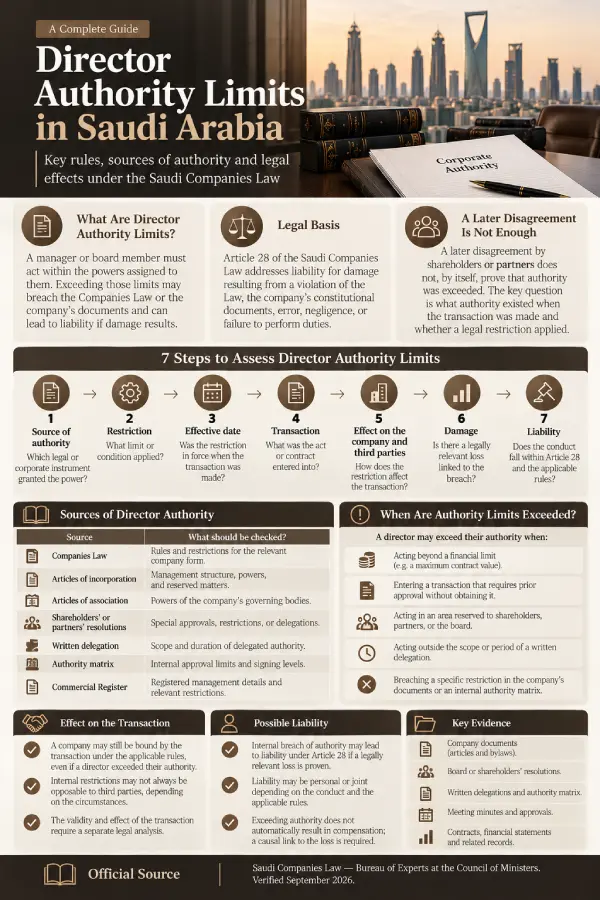
Where Do Director Authority Limits Come From?
A manager’s title does not give unlimited power to enter every contract or financial commitment. Director Authority Limits must therefore be identified from the legal or corporate instrument that granted the power in the first place.
Authority may come from the Companies Law, the articles of incorporation, the articles of association, a partners’ or shareholders’ resolution, or another competent corporate decision. Written delegations and internal authority matrices may also define approval thresholds, signing rules, and transactions that require additional approval.
It is important to distinguish the source of authority from the document used to prove it. The articles of incorporation may establish the management structure, while a later resolution or written delegation may set narrower authority for a specific transaction or period.
| Source | What should be checked? |
|---|---|
| Companies Law | Rules and restrictions for the relevant company form |
| Articles of incorporation | Management structure, powers, and reserved matters |
| Articles of association | Powers of the company’s governing bodies |
| Partners’ or shareholders’ resolutions | Special approvals, restrictions, or delegations |
| Written delegation | Scope and duration of delegated authority |
| Authority matrix | Internal approval limits and signing levels |
| Commercial Register | Registered management details and relevant restrictions |
For a limited liability company, Article 161 provides that the articles of incorporation or a partners’ resolution determine the management method and, where there are multiple managers or a board of managers, the majority required for decisions.
Article 162 addresses the manager’s representation of the company and the effect of restricting the manager’s powers against third parties. The broader standards governing the use of management powers remain part of the wider corporate governance framework.
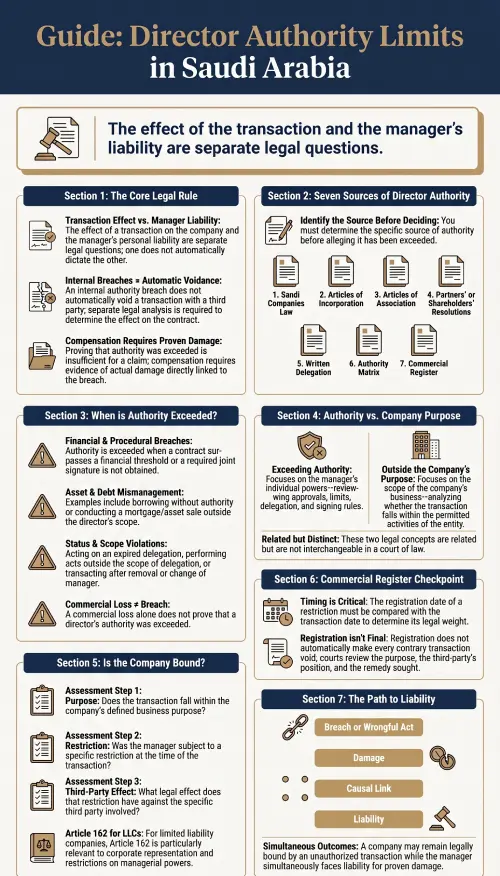
When Are Director Authority Limits Exceeded?
Director Authority Limits are exceeded when a manager carries out an act that falls outside the authority granted to them, or when a required condition for exercising that authority is not met.
The restriction may be financial, such as a maximum contract value that the manager may approve alone. It may be procedural, such as a requirement for two managers to sign jointly. It may also relate to the type of transaction, such as borrowing, mortgaging assets, or selling a particular asset without additional approval.
A breach may also arise where a delegation has expired or where a specific delegation is used for an act outside its stated scope.
A commercial loss, however, does not by itself prove that authority was exceeded. A manager may make a poor business decision while still acting within the authority granted. The correct question is: did the manager have the power to enter the transaction in the manner used at that time?
| Scenario | First question to ask |
|---|---|
| Contract exceeds a financial threshold | Where was the threshold set, and was further approval required? |
| One manager signs alone | Did the management rules require joint signature? |
| Borrowing in the company’s name | What document granted borrowing authority? |
| Mortgage or sale of an asset | Was the manager authorised to make that transaction? |
| Expired delegation | Was the delegation still valid on the signing date? |
| Former manager signs after removal | What were the dates of removal, registration, and contract? |
| Transaction outside the company’s purpose | Does the act fall within the company’s stated purpose? |
What Is the Difference Between Exceeding Authority and Acting Outside the Company’s Purpose?
Exceeding authority concerns the manager’s own power. A transaction may fall within the company’s normal business, but the manager may have exceeded a financial threshold or failed to obtain a required approval or signature.
Acting outside the company’s purpose concerns the scope of the company’s business. A manager may have general signing authority, but the transaction itself may raise a different question about whether it falls within the company’s purpose.
The two concepts should not be treated as interchangeable. Each requires separate evidence and a separate legal analysis.
Is the Company Bound If the Manager Exceeds Authority?
This is one of the central issues in Director Authority Limits because an internal breach does not, by itself, determine the effect of the transaction on a third party.
For a limited liability company, Article 162 provides that the manager represents the company before courts, arbitral tribunals, and third parties, and may delegate certain powers to another person for specific acts.
The same article provides that a decision appointing or changing a manager, or restricting the manager’s powers, is not effective against third parties until it is registered in the Commercial Register. It also states that the company is bound by acts of the manager that fall within the company’s purpose.
Three Separate Questions
1. Does the transaction fall within the company’s purpose?
2. Was the manager subject to a restriction?
3. What effect did that restriction have against the third party?
It is inaccurate to say that every transaction signed by a manager automatically binds the company. It is equally inaccurate to assume that every breach of an internal authority matrix automatically defeats the transaction against the other contracting party.
Saudi Companies Law — Ministry of Commerce, Articles 161 and 162. Verified September 2026.
What Is the Effect of Registering a Restriction?
For a limited liability company, Article 162 makes registration in the Commercial Register important when determining whether a restriction on the manager’s powers can operate against third parties.
Registration does not mean that every transaction contrary to that restriction is automatically void. The legal effect still depends on the type of transaction, the company’s purpose, the wording and timing of the restriction, the position of the third party, and the legal remedy being pursued.
The better question is therefore not simply whether a restriction existed, but whether it was effective at the relevant time, whether it could be relied on against the third party, and what legal consequence follows in the particular case.
When Do Director Authority Limits Lead to Liability?
Director Authority Limits become a liability issue when the breach is connected to damage that can be proved.
Article 28 provides for liability of managers and board members for damage arising from a violation of the Companies Law, the articles of incorporation or association, or from error, negligence, or failure in the performance of their duties.
The analysis should therefore separate three elements:
A manager may exceed an internal limit without causing a compensable loss. In another case, the company may remain bound by the transaction toward a third party, yet the internal breach may have caused a financial loss to the company.
Practical Rule
A transaction binding the company does not, by itself, prevent liability of the manager for damage caused by exceeding their authority, where the legal elements of liability are established.
Questions about who may bring the claim, procedural requirements, and limitation issues are addressed separately in the liability claim under the Saudi Companies Law.
What If the Decision Was Made by More Than One Manager?
Where a decision is made by several managers, meeting minutes become especially important because they show who participated, who approved the decision, and who objected.
Article 28 addresses collective decisions, including the effect of unanimous or majority decisions and the position of a manager who expressly records an objection in the meeting minutes.
The minutes should therefore be reviewed not only to prove that a decision was made, but also to establish each manager’s position and the timing of any objection.
How Can a Company Prove That Authority Was Exceeded?
Evidence relating to Director Authority Limits should begin with the authority itself. A large transaction value does not prove that the manager lacked power to sign it.
The first step is to identify the source of authority and the restriction that was effective when the transaction was made. Those documents should then be matched to the contract or decision in dispute.
| Document | Purpose in the review |
|---|---|
| Articles of incorporation or association | Establish management structure and core powers |
| Manager appointment resolution | Prove status, term, and any special powers |
| Partners’ or shareholders’ resolutions | Prove approvals, restrictions, or delegations |
| Authority matrix | Identify internal approval limits |
| Commercial Register at the relevant date | Verify registered management data and restrictions |
| Written delegation | Establish the scope and duration of authority |
| Disputed contract | Show the nature, value, and signature of the transaction |
| Meeting minutes | Record approval, rejection, or objection |
| Correspondence | Show knowledge of the restriction and decision context |
| Financial records | Prove loss and financial impact where compensation is claimed |
How Should the Timeline Be Built?
A current authority matrix is not enough to prove a breach that allegedly occurred in an earlier period. The document effective on the transaction date must be identified.
If the dispute concerns a manager who was removed or whose status changed, the date of the corporate decision, the registration date, and the contract date should be examined separately.
Where compensation is sought, add a second question: how did the authority breach cause the claimed loss? The amount should not be assumed from the contract value alone.
7 Checks for Director Authority Limits
Before reaching a conclusion on Director Authority Limits, organise the file around these seven checks:
- Identify the transaction: the contract, borrowing, mortgage, sale, or other commitment in dispute.
- Identify the source of authority: the Law, constitutional document, resolution, or delegation.
- Identify the restriction: financial, procedural, time-based, transaction-specific, or signing-related.
- Confirm the relevant date: determine whether the restriction was effective when the transaction occurred.
- Separate internal and external effects: the manager’s internal liability is not the same question as the contract’s effect on a third party.
- Identify the damage: if liability under Article 28 is being considered, define the loss and evidence supporting it.
- Build the timeline: connect the grant of authority, the restriction, the transaction, and the alleged damage.
If the transaction also gave the manager or a related party a personal benefit, the matter may raise a separate legal issue. That issue is addressed in director conflict of interest in Saudi Arabia.
Frequently Asked Questions About Director Authority Limits
What Happens If a Company Manager Exceeds Their Authority?
The first step is to identify the authority the manager actually held and the restriction in force when the transaction occurred. The internal breach should then be separated from the transaction’s effect on third parties. If compensation is claimed, the company must also establish damage and a legal connection between that damage and the breach.
Who Determines a Company Manager’s Authority in Saudi Arabia?
Authority depends on the Saudi Companies Law, the company’s legal form, its articles of incorporation or association, competent corporate resolutions, and any valid delegation. There is no single document that defines every manager’s powers in every company, so the documents effective on the transaction date must be reviewed together.
Is the Company Bound by a Contract Signed Without Required Approval?
The absence of internal approval does not produce one result in every case. The analysis depends on the company form, the type of restriction, whether registration was required, the company’s purpose, and the restriction’s effect on third parties. Limited liability companies are subject to specific rules under Article 162.
What Happens If a Manager Exceeds a Financial Limit?
If a valid financial threshold applied to the manager at the relevant time, exceeding it may establish an internal authority breach. That does not by itself determine the contract’s effect on the other party, and it does not establish compensation unless damage and a causal link to the breach can also be proved.
Does Registering a Restriction Make a Contrary Contract Void?
Not automatically. Registration can be important in determining whether a restriction on an LLC manager’s powers is effective against third parties, but the final legal effect depends on the transaction, the company’s purpose, the restriction, its timing, the third party’s position, and the remedy being sought.
What Evidence Is Most Useful in Proving Exceeded Authority?
The key documents usually include the articles of incorporation or association, the manager’s appointment resolution, partners’ or shareholders’ resolutions, delegations, the authority matrix, the Commercial Register at the relevant date, and the disputed contract. Financial records are also needed where the claim includes compensation for loss.
Legal Conclusion
Director Authority Limits are not determined by whether a transaction was commercially successful. The starting point is whether the manager had authority to enter the transaction in the way it was made.
The review should identify the source of authority and the restriction in force at the relevant time, then separate the internal breach from the third party’s legal position. For limited liability companies, Article 162 is particularly relevant to representation and restrictions on managerial powers, while Article 28 addresses liability for resulting damage.
The practical next step is to place the authority documents, restrictions, Commercial Register records, contract, and meeting minutes into one timeline, then identify any proven loss and its connection to the transaction before deciding on a legal claim.
Disclaimer
This article provides general legal information only. It is not legal advice for a specific matter and does not create a lawyer-client relationship. The legal outcome depends on the company form, its constitutional documents, the manager’s authority, the transaction, the parties’ positions, and the available evidence.
Mohammed Aboud Al-Dossary
Saudi Lawyer — Licence No. 40462.
Professional verification:
Licensing and Membership