Legal content prepared by:
Lawyer Mohammed Al-Dosari
Licensed lawyer in the Kingdom of Saudi Arabia — License No. 40462 — Professional practice since 2013.
Last legal source review: October 14, 2026
Reasons for an administrative decision are the factual or legal grounds that a public authority states as the basis for its decision. However, the underlying ground on which a decision rests is different from the authority’s written explanation of that ground. For this reason, the absence of written reasons does not automatically mean that the decision had no legal basis or that it is unlawful in every case.
This distinction matters because Saudi laws do not treat all administrative decisions in the same way. In some situations, the governing law expressly requires the decision to be reasoned, including certain disciplinary decisions, decisions rejecting grievances, and decisions refusing registration in the Commercial Register.
Once the authority discloses its reasons, the review moves to a different question: are those reasons sufficiently clear, and does the issue concern the way they were stated, or the accuracy of the facts or legal basis on which the authority relied?
A more detailed review of factual accuracy, legal characterization, defects in the underlying grounds, and violations of applicable law falls within the broader framework of judicial review of administrative decisions.
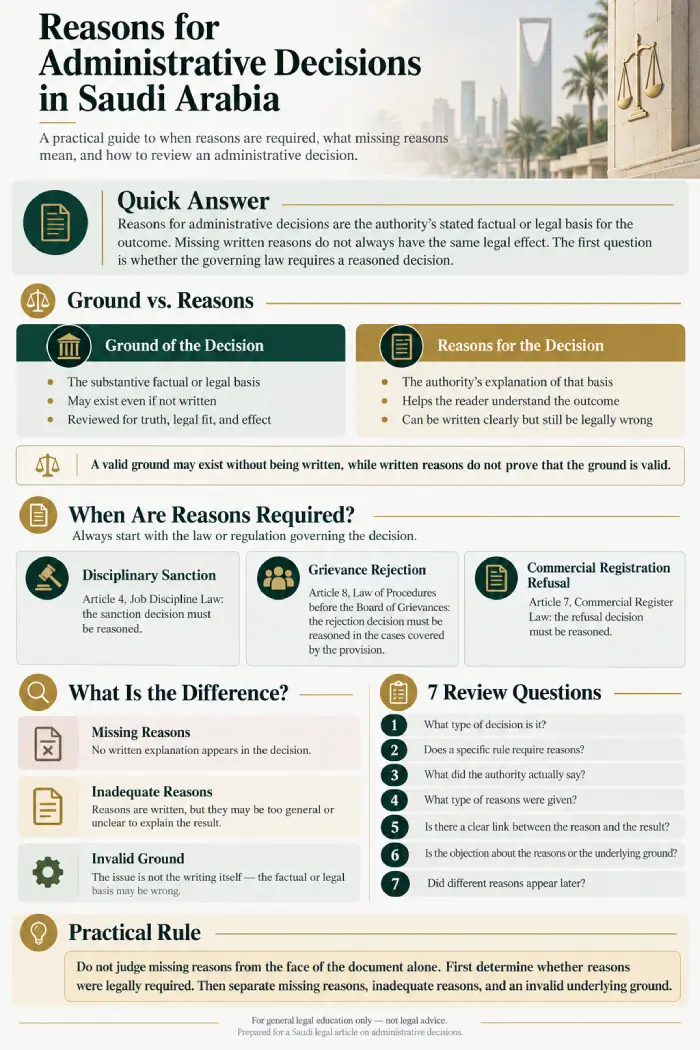
Quick Answer:
reasons for administrative decisions are the authority’s stated factual or legal basis for the outcome. Missing written reasons do not have the same legal effect in every case. The first question is whether the governing Saudi law or regulation requires a reasoned decision. The second is whether the issue concerns missing reasons, inadequate reasons, or an invalid underlying ground.
Three Saudi statutory examples where reasons are expressly required
- Disciplinary sanction against a public employee: Article 4 of the Job Discipline Law requires the sanction decision to be reasoned.
- Rejection of a grievance: Article 8 of the Law of Procedures before the Board of Grievances requires the rejection decision to be reasoned in the situations governed by that provision.
- Refusal of commercial registration: Article 7 of the current Saudi Commercial Register Law requires a refusal decision to be reasoned.
What Do Reasons for Administrative Decisions Mean?
In practical terms, reasons for administrative decisions explain why an authority reached the result stated in its decision.
The operative part tells the affected person what the authority decided. The reasons explain why it reached that result, to the extent required by the law or regulation governing that type of decision.
This distinction matters because the person concerned can identify the fact, legal rule, condition, or other basis on which the authority relied instead of facing a result whose basis is unknown.
For example, a statement that simply says “the application is rejected” gives the result only. A statement identifying the specific statutory condition that was not satisfied provides a basis for understanding why the application was rejected.
Reasons can also reveal the real nature of the dispute. The parties may disagree about whether an event occurred. In another case, the event may be established but the dispute may concern how Saudi law applies to it.
A clear explanation does not automatically make a decision lawful. The stated fact may still be unsupported, the legal rule may not apply, or the outcome may not follow from the basis relied on by the authority.
Quotable Definition:
Reasons for an administrative decision are the authority’s stated factual or legal basis for reaching its result. They are different from the underlying ground itself: the ground is the substantive basis of the decision, while the reasons are the authority’s explanation of that basis.
What Is the Difference Between the Ground of a Decision and Its Reasons?
The distinction between the underlying ground and the written reasons is not merely academic. It changes the legal question being examined.
The Ground of the Decision Is Its Substantive Basis
The ground is the factual event or legal situation that existed before the decision and led the authority to act.
It may consist of employee misconduct, failure to satisfy a statutory requirement, or another event to which the applicable law attaches an administrative consequence.
A ground may therefore exist in the administrative record even when it is not written in the decision itself.
Whether that ground actually exists, whether the fact is proven, and whether the authority gave the fact the correct legal characterisation are separate questions.
The Reasons Explain the Basis Relied on by the Authority
The reasons bring the authority’s stated basis out of the background file and place it into an explanation that the affected person can understand.
The explanation may identify the relevant facts, the legal provision applied, an unmet statutory condition, or a combination of these matters.
But written reasons cannot create a valid ground where none exists. A detailed explanation does not cure a decision based on an event that did not occur.
| Review Point | Ground of the Decision | Reasons for the Decision |
|---|---|---|
| Meaning | The factual or legal basis on which the decision rests. | The authority’s explanation of that basis. |
| Main review | Whether the basis exists, is correct, and supports the result. | Whether the explanation exists, is clear, and is sufficient where reasons are required. |
| Does one prove the other? | A ground may exist even if it is not written. | Written reasons do not prove that the ground is valid. |
| Common mistake | Treating missing reasons as proof that no ground exists. | Treating a detailed explanation as proof that the decision is lawful. |
Key Distinction:
The ground is substantive; the reasons are explanatory. A valid ground may exist without being written, while a stated reason may later prove factually or legally incorrect.
When Are Reasons for Administrative Decisions Required?
There is no single Saudi rule requiring the same form of reasons for administrative decisions in every administrative matter.
The correct starting point is the law or regulation governing the specific type of decision.
Saudi legislation contains express examples where a reasoned decision is required.
| Type of Decision | Legal Basis | Requirement |
|---|---|---|
| Disciplinary sanction against a public employee | Article 4, Job Discipline Law | The decision imposing the sanction must be reasoned. |
| Rejection of a grievance under Article 8 | Law of Procedures before the Board of Grievances | The rejection decision must be reasoned in the cases governed by the provision. |
| Refusal of a commercial registration application | Article 7, current Commercial Register Law | The refusal decision must be reasoned. |
When the Law Expressly Requires Reasons
Where the governing law or regulation states that a decision must be reasoned, giving reasons is no longer merely good administrative practice.
It becomes a legal requirement attached to that type of decision.
A disciplinary sanction under the Job Discipline Law is a clear example. Article 4 requires investigation of the employee, confrontation with the alleged violation, an opportunity to respond, written recording of those steps, and a reasoned sanction decision.
When No Specific Duty to Give Reasons Has Been Identified
Where no specific provision requiring written reasons has been identified, legality should not be reduced to one question:
“Were reasons written?”
The real dispute may instead concern whether the underlying ground existed, whether the authority relied on accurate facts, or whether the applicable legal rule was correctly applied.
For this reason, it is too broad to state that every administrative decision without written reasons is automatically invalid.
When the Authority Chooses to Give Reasons
An authority may explain its decision even where no express statutory requirement has been identified.
Once the authority gives a specific explanation, that explanation becomes important to understanding how it says it reached the result.
If it relies on a particular event, the event can be compared with the administrative record. If it relies on a statutory condition, the applicability of that condition can be reviewed.
Practical Rule:
Start with the law or regulation governing the particular decision. If it requires a reasoned decision, the duty to state reasons applies in that context. Do not apply one universal rule to every administrative decision.
Questions about grievance periods and challenge deadlines belong to a different part of the administrative-law analysis. For that issue, see: Administrative Decision Finality
How Do You Know Whether the Reasons Actually Explain the Decision?
A paragraph labelled “Reasons” does not by itself prove that the explanation performs its function.
The better question is:
Can the affected person understand why the authority reached this particular result?
There is no universal rule requiring a fixed number of words, paragraphs, or pages. The following points are analytical indicators rather than independent statutory conditions.
The Reason Should Be Specific, Not a Restatement of the Outcome
A statement such as “the application was rejected because it was unacceptable” does not meaningfully explain why the application failed.
Identifying the statutory requirement that was not satisfied gives a clearer basis for understanding the decision.
The Relevant Fact Should Be Identifiable
If the decision depends on a particular event or factual allegation, the explanation should make it possible to identify the fact on which the authority relied.
The Legal Basis Should Be Clear Where It Drives the Outcome
Where the result depends on a statutory condition or legal provision, identifying that basis can help distinguish a dispute about the facts from a dispute about interpretation or application of law.
There Should Be a Clear Link Between the Reason and the Result
The stated facts may all be true, yet the explanation may still fail to show why those facts led to the particular administrative outcome.
| Explanation That Helps | Explanation That Needs Closer Review |
|---|---|
| Identifies the material fact. | Uses a general statement without identifying the relevant fact. |
| Explains the connection between the fact and the result. | Lists information without showing why it affected the decision. |
| Identifies the applicable legal basis where it drives the result. | Repeats the outcome and presents it as though it were the reason. |
| Makes the authority’s basis identifiable. | Leaves the real basis of the decision unclear. |
A decision does not need to be lengthy to be adequately reasoned. A short explanation may be sufficient where it clearly identifies the relevant basis and performs the function required by the governing law.
What Is the Effect of Missing or Inadequate Reasons?
Missing reasons, inadequate reasons, and an invalid underlying ground are three different legal problems.
They should not be treated as interchangeable.
Missing Reasons: No Written Explanation
Missing reasons arise where the decision does not state the basis that led the authority to the outcome.
There is no single legal consequence that applies to every administrative decision.
Where the governing law expressly requires a reasoned decision, failing to state reasons affects a requirement imposed on that type of decision.
Where no specific duty to give reasons has been established, the absence of written reasons alone does not prove that the underlying substantive ground did not exist.
Inadequate Reasons: An Explanation Exists but May Not Be Sufficient
Inadequate reasoning means that reasons are stated but may not clearly show why the authority reached the particular outcome.
This does not mean every short explanation is inadequate.
A concise explanation may be sufficient where it identifies the relevant fact, condition, and legal basis clearly.
The opposite is also possible. A lengthy decision may contain many paragraphs while still failing to explain the decisive connection between the facts and the result.
Invalid Ground: The Problem Is Not the Writing
If the authority clearly states its reasons but the objection is that the event did not occur, or that the legal rule does not apply to that event, the issue is no longer merely one of reasoning.
The review has moved to the validity of the underlying ground and the broader legality of the administrative decision.
| Situation | Main Issue | First Question |
|---|---|---|
| No written reasons. | Missing reasons. | Was a reasoned decision legally required? |
| Reasons are general or unclear. | Adequacy of the explanation. | Does the explanation reveal the basis of the result? |
| The stated reason is clear, but the fact is wrong. | Validity of the ground. | Is the fact supported by the administrative record? |
| The fact is established, but application of law is disputed. | Legal characterisation or application. | Was the correct legal rule applied to that fact? |
Practical Rule:
Do not assess missing reasons from the face of the document alone. First determine whether reasons were legally required. Then separate missing reasons, inadequate reasons, and an invalid underlying ground. Each leads to a different legal analysis.
What Happens When the Authority States Its Reasons?
Giving a specific explanation makes a decision easier to review because it identifies the basis on which the authority says it acted.
If the authority says that its decision was based on a particular violation, that statement can be checked against investigation records, reports, correspondence, and other documents.
If an application was refused because a specific condition was not satisfied, the review can focus on that condition instead of trying to guess why the application was rejected.
This is one reason why reasons for administrative decisions are important in judicial review: they can make the authority’s stated basis identifiable and testable.
But stated reasons do not make the decision immune from review.
The underlying fact may still be unsupported. The legal rule may have been applied incorrectly. Or the result may not follow from the basis stated by the authority.
If additional explanations appear later in the dispute, their effect should not be assumed in advance.
The first question is whether the later material merely explains a basis that already existed when the decision was issued or introduces a materially different basis.
Why Do Reasons Matter in Disciplinary and Employment Decisions?
The importance of reasons for administrative decisions is especially clear in some public-employment matters, but not every employment decision is governed by the same reasoning requirement.
Disciplinary Decisions
The Job Discipline Law provides a direct statutory example.
Article 4 requires investigation of the employee, confrontation with the alleged violation, hearing the employee’s statements, consideration of the defence, written documentation of those steps, and a reasoned sanction decision.
The duty to give reasons therefore comes from an express statutory rule in this context.
Termination of Service and Removal from Employment Records
Termination of service or removal from an employment record may arise under different legal provisions and for different reasons.
It would therefore be inaccurate to state that every termination decision without written reasons is automatically invalid.
The proper approach is to identify the provision under which the decision was issued and determine whether the applicable rule requires a reasoned decision.
Transfers and Other Employment Decisions
Transfer decisions and other employment measures may rely on operational needs or administrative considerations.
Where an authority states a specific reason, its connection to the administrative record can be reviewed.
But disagreement with the authority’s administrative assessment does not by itself establish inadequate reasoning.
Practical Evidence Block: 7 Questions for Reviewing Reasons for Administrative Decisions
Before describing a decision as “unreasoned” or alleging inadequate reasoning, reasons for administrative decisions can be reviewed through seven practical questions.
This framework helps organise the file. It is an analytical tool and not a separate statutory test.
| Review Question | What to Identify | What to Review |
|---|---|---|
| 1. What type of decision is it? | Disciplinary, employment-related, refusal of an application, rejection of a grievance, or another type. | The decision itself and its legal classification. |
| 2. Does a specific rule require reasons? | Whether the law or regulation requires a reasoned decision. | The statute and implementing regulation governing the decision. |
| 3. What did the authority actually say? | Separate the operative decision from the explanation given for it. | The decision, notice, attachments, and related correspondence. |
| 4. What type of reasons were given? | Facts, legal rules, statutory conditions, or a combination of them. | Reports, minutes, investigation material, and legal provisions relied on. |
| 5. Is there a clear link between the reason and the result? | Whether the stated basis actually explains the outcome. | Compare the reasons with the operative part of the decision. |
| 6. Is the objection about the reasons or the underlying ground? | Missing explanation versus an allegedly incorrect fact or legal basis. | The pre-decision record and evidence supporting the stated ground. |
| 7. Did different reasons appear later? | Whether later explanations clarify the original basis or introduce another one. | The decision, later submissions, correspondence, and chronology of the file. |
What documents may help with this review?
The administrative decision, the notice communicating it, the governing law or regulation, investigation or committee records where relevant, pre-decision correspondence, documents supporting the factual ground relied on by the authority, and any later response, grievance decision, or explanation.
Frequently Asked Questions About Reasons for Administrative Decisions
What Is the Difference Between Missing Reasons and an Invalid Ground?
Missing reasons mean that the authority did not state the basis on which it acted. An invalid ground means that the factual or legal basis itself is absent, incorrect, or legally insufficient. A substantive ground may exist without being written, while a written reason may still turn out to be wrong.
Is Every Administrative Decision Without Reasons Invalid?
No. The first question is whether the Saudi law or regulation governing that particular decision requires reasons to be stated.
Where an express duty applies, failure to give reasons has a different legal significance from a decision for which no such requirement has been identified.
When Can Failure to State Reasons Become Legally Significant?
It becomes particularly important where the governing law expressly requires a reasoned decision.
Where no such requirement has been established, the absence of written reasons alone does not prove that the decision lacked a valid substantive basis.
Is a General Statement Such as “Public Interest” Enough?
It cannot be assessed in isolation. The answer depends on the type of decision, the governing statutory rule, the facts surrounding the decision, and what the applicable law requires the authority to explain.
In some disputes, the real issue may concern the validity of the underlying ground rather than the amount of detail used in the written explanation.
How Do You Distinguish Inadequate Reasons From a Defective Ground?
Inadequate reasons concern whether the authority's explanation clearly reveals the basis for its decision. A defective ground concerns the substantive basis itself.
If the authority clearly states a factual reason but the fact did not occur, the main problem concerns the validity of the ground, not merely the quality of the explanation.
Can a Decision Be Reasoned and Still Be Unlawful?
Yes. A written explanation does not establish legality by itself. The stated fact may be wrong, the legal characterisation may be incorrect, or the governing legal rule may not permit the result reached by the authority.
Can Later Reasons Replace the Original Basis of the Decision?
There is no safe universal answer. The analysis should distinguish between later material that explains a basis that already existed when the decision was issued and material that introduces a materially different basis.
Its effect depends on the administrative record, the governing legal provisions, and the applicable judicial analysis.
Legal Conclusion
reasons for administrative decisions are not the same as the substantive grounds on which those decisions rest.
The ground is the factual or legal basis for the decision. The reasons are the authority’s explanation of that basis.
This distinction matters because missing written reasons do not automatically prove that no valid ground existed. Conversely, a written explanation does not automatically prove that the stated ground was factually or legally correct.
A sound review begins with three questions:
Does the governing law require a reasoned decision? What did the authority actually say? Is the dispute about the adequacy of the explanation or the validity of the underlying ground?
Saudi legislation expressly requires reasoned decisions in specific contexts, including disciplinary sanctions, grievance-rejection decisions governed by Article 8 of the Law of Procedures before the Board of Grievances, and refusals of commercial registration under the current Commercial Register Law.
The practical approach is therefore to identify the type of decision, locate the governing legal rule, review the reasons actually given, and then separate reasoning issues from broader questions concerning the facts, legal characterisation, and overall legality of the decision.
Disclaimer:
This content is provided for general legal education only. It does not constitute legal advice for any individual matter, and reading it does not create an attorney-client relationship. The legal assessment may differ depending on the administrative decision, governing Saudi law or regulation, facts, documents, procedural stage, and applicable statutory deadlines.