Legal content prepared by
Saudi-Licensed Lawyer • Licence No. 40462
Published: 14 September 2026
Last updated: 14 September 2026
Choosing the right Saudi Bankruptcy Procedure starts with one practical question: can the business realistically continue if its debts are restructured, or has liquidation become more consistent with its actual financial position?
Losses or delayed payments alone do not answer that question. Each procedure addresses a different financial situation, depending on liquidity, asset value, creditor exposure, debt structure, and the business’s ability to generate future income.
A protective settlement may suit a viable business that mainly needs time or a workable arrangement with creditors. Another business may require financial restructuring under greater supervision. Liquidation may become more realistic when the prospects of recovery have materially declined.
The decision should therefore follow a structured review of the company’s financial position, contracts, security interests, liabilities, creditors, and realistic ability to continue trading.
A Saudi Bankruptcy Procedure should not be selected solely by looking at the amount of debt. The decision should consider business viability, liquidity, asset value, debt structure, creditor composition, and whether the company can continue operating. Where recovery remains realistic, protective settlement or financial restructuring may be considered. Where continued operation is no longer realistic, liquidation or administrative liquidation may become more relevant.
| Procedure | When It May Be More Relevant | Main Effect |
|---|---|---|
| Protective Settlement | The business remains viable and a workable settlement with creditors may be possible. | The debtor remains in control of the business. |
| Financial Restructuring | Restructuring is possible, but the position requires greater supervision and organisation. | The debtor continues operating under the supervision of a bankruptcy trustee. |
| Liquidation | Continued operation is unlikely to preserve value and selling assets is more realistic. | Claims are identified, assets are sold, and proceeds are distributed. |
| Small Debtor Procedures | The debtor meets the applicable small-debtor threshold and the other statutory requirements. | Simplified settlement, restructuring, or liquidation routes may apply. |
| Administrative Liquidation | Available assets are not expected to cover the ordinary expenses of liquidation. | The estate is dealt with under the specific rules governing this procedure. |
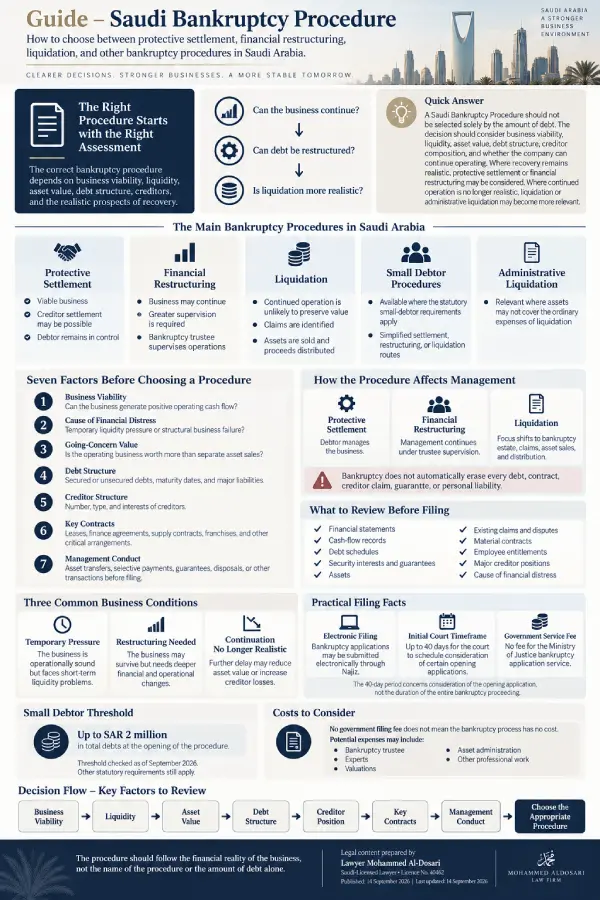
What Determines the Right Saudi Bankruptcy Procedure?
Saudi bankruptcy law does not treat every financially distressed business in the same way. A company may face temporary liquidity pressure while its core operations remain viable. Another may be unable to meet debts as they fall due. In more serious cases, continued operation may no longer be financially realistic.
For that reason, choosing a Saudi Bankruptcy Procedure requires an assessment of the debtor’s actual financial and operational position. The objective should not simply be to delay creditor action or accelerate access to company assets.
Saudi bankruptcy legislation provides seven procedures:
- Protective settlement.
- Financial restructuring.
- Liquidation.
- Protective settlement for small debtors.
- Financial restructuring for small debtors.
- Liquidation for small debtors.
- Administrative liquidation.
These procedures do not lead to the same outcome. Some focus on preserving a viable business. Others are intended to bring the business to an orderly financial end.
Business viability is particularly important in rescue procedures. In protective settlement, for example, the statutory framework considers whether continuation of the debtor’s activity and settlement of creditor claims within a reasonable period are realistically possible.
Business viability is therefore more than a management preference. It can become a legally relevant part of deciding whether a particular procedure is suitable.
Saudi Bankruptcy Law — Bureau of Experts at the Council of Ministers
See Article 2 regarding the seven bankruptcy procedures and the provisions governing commencement and management of proceedings.
How Do Saudi Bankruptcy Procedure Options Differ?
The main procedures differ in purpose, management control, degree of supervision, and the financial condition they are designed to address.
Protective Settlement
Protective settlement is generally more relevant where the underlying business remains viable but faces pressure from debt maturity, creditor demands, or temporary liquidity shortages.
The debtor normally remains responsible for managing the business while seeking an arrangement with creditors within the statutory framework.
This procedure may therefore be more suitable where the main problem is financial restructuring rather than a failure of the underlying business model.
Financial Restructuring
Financial restructuring may be considered where continued operation remains possible, but the relationship between assets, liabilities, creditors, and cash flow has become more complex.
The debtor generally continues operating the business under the supervision of a bankruptcy trustee. The procedure therefore involves greater supervision than a straightforward settlement process.
Liquidation
Liquidation becomes more relevant where there is no realistic basis for preserving the business as a going concern.
The focus shifts from rescuing operations to identifying creditor claims, protecting the bankruptcy estate, selling assets, and distributing proceeds according to the applicable statutory framework.
Liquidation should not, however, be treated as the automatic result of every loss or payment default. The business must be assessed as a whole.
Small Debtor Procedures
Saudi bankruptcy law also provides specific procedures for small debtors.
According to the official guidance issued by the Bankruptcy Commission, a debtor is treated as a small debtor where total debts at the opening of the procedure do not exceed SAR 2 million, based on the threshold applicable as of September 2026.
Meeting that threshold alone does not automatically determine eligibility. The other requirements of the relevant procedure must also be satisfied.
Bankruptcy Commission — Frequently Asked Questions Guide
Small-debtor threshold checked: September 2026.
What Seven Factors Should Be Reviewed Before the Decision?
Selecting a Saudi Bankruptcy Procedure requires several indicators to be reviewed together. High debt does not automatically mean that a business should be liquidated, and substantial assets do not necessarily mean that continued operation is viable.
1. Business Viability
Can the business generate positive operating cash flow if debt pressure is reduced or repayment dates are reorganised?
2. Cause of Financial Distress
Is the problem temporary and mainly connected with liquidity, or has the business itself lost its ability to generate sustainable revenue?
3. Going-Concern Value
Is the value of the company as an operating business higher than the amount that could reasonably be realised by selling its assets separately?
4. Debt Structure
Which debts are secured or unsecured? When do they fall due? Are there substantial liabilities that must be paid in the near term?
5. Creditor Structure
Are most debts owed to a small number of creditors, or are liabilities spread across several creditor groups with different priorities and interests?
6. Key Contracts
Does continued operation depend on leases, finance arrangements, supply contracts, franchise agreements, or other contracts that may be affected by financial distress?
A company may appear viable on paper but still be unable to continue if a critical lease, funding arrangement, or supply agreement is at risk. For that reason, its commercial contracts should be reviewed as part of the distress analysis rather than after the bankruptcy path has already been selected.
7. Management Conduct Before Filing
Have there been asset disposals, transfers, selective payments, new security interests, unusual guarantees, or other transactions that require review before proceedings begin?
Asset value should also be separated from business value. A company may own valuable inventory or equipment, yet the recoverable value may fall substantially if those assets are sold separately from the operating business.
In other cases, an orderly sale may preserve more value for creditors than continuing to operate a company that consumes cash without a credible recovery plan.
How Does the Procedure Affect Management and Creditors?
The effect of a Saudi Bankruptcy Procedure on management depends on the procedure selected.
Under protective settlement, the debtor generally remains responsible for managing the business.
Under financial restructuring, management normally continues but operates under the supervision of the bankruptcy trustee.
In liquidation, the purpose changes. The focus becomes administration of the bankruptcy estate, identification of creditor claims, sale of assets, and distribution of proceeds.
Opening bankruptcy proceedings also does not mean that every debt, contract, or creditor claim disappears. Rules governing suspension of claims differ according to the procedure and the stage of the case.
Continuing contracts, debts, creditor rights, and claims must therefore be analysed under the framework governing the particular procedure. The statement that “bankruptcy stops everything” is too broad.
Bankruptcy also does not automatically remove personal liability that may arise from a separate guarantee, statutory obligation, management decision, or independent wrongful act.
Where the issue concerns the legal position of partners and the liability attached to different company structures, the broader framework is explained in partner Liability in Companies.
If alleged loss results from the conduct of a manager or board member, that question should be examined separately. The relevant framework is discussed in liability claims under Companies Law.
If the matter later develops into litigation, the competent judicial forum becomes a separate issue. The general framework is explained in
commercial court jurisdiction.
What Should Be Reviewed Before Proceedings Are Opened?
Before a Saudi Bankruptcy Procedure is finally selected, financial distress should be converted from a general impression into verifiable data.
The review should normally include:
- Financial statements.
- Cash-flow records.
- Debt schedules.
- Security interests and guarantees.
- Assets.
- Existing claims and disputes.
- Material contracts.
- Employee entitlements.
- Major creditor positions.
- The underlying cause of financial distress.
It is useful to distinguish between three broad situations.
First: the business is operationally sound but faces temporary liquidity pressure.
Second: the business may survive, but requires deeper financial and operational restructuring.
Third: the business has lost the conditions required for continued operation, and further delay may reduce asset value or increase creditor losses.
This distinction helps prevent two opposite errors.
The first is moving to liquidation before testing whether going-concern value can be preserved.
The second is trying to keep the business operating simply because management does not want to close it, even where the financial information no longer supports a realistic restructuring plan.
Financial and legal analysis should therefore remain connected. An accountant can assess liquidity, liabilities, and financial value. The legal review must also consider contracts, security interests, creditor positions, management powers, and restrictions that may arise once a procedure is opened.
Practical Guide Before Selecting a Saudi Bankruptcy Procedure
Three points can be checked before the process begins.
1. What Happens When an Application Is Filed?
The Saudi Ministry of Justice provides an electronic service for submitting bankruptcy applications through Najiz.
The process includes identifying the applicant’s legal capacity, the type and reason for the request, the relevant court, the required information, and the supporting documents. The application can then be submitted electronically and its status followed through the platform.
These steps are included to explain the practical effect of selecting a procedure. They are not intended to turn this article into a complete filing manual.
Bankruptcy Application Service — Saudi Ministry of Justice
Information checked: September 2026.
2. What Is the Initial Statutory Timeframe?
Under the Saudi Bankruptcy Law and official Bankruptcy Commission guidance, the court schedules consideration of an application to open protective settlement, financial restructuring, or liquidation proceedings within a period not exceeding 40 days from the date the application is registered.
This period relates to consideration of the application to open the procedure. It is not an estimate of how long the entire bankruptcy process will take.
3. Is There a Government Filing Fee?
The Ministry of Justice bankruptcy application service states that the service fee is “No fee.”
In addition, the Saudi Judicial Costs Law excludes claims and applications arising from the application of the Bankruptcy Law from judicial costs.
| Item | Official Position | Checked |
|---|---|---|
| Bankruptcy application service fee | No fee | September 2026 |
| Judicial costs for applications arising under the Bankruptcy Law | Excluded under Article 2 | September 2026 |
Saudi Judicial Costs Law — Bureau of Experts at the Council of Ministers.
Article 2 addresses the exclusion of claims and applications arising from the Bankruptcy Law.
The absence of a government filing fee does not mean that bankruptcy proceedings have no economic cost.
Depending on the procedure, costs may arise in connection with bankruptcy trustees, experts, valuations, asset administration, or other professional work.
Government filing fees should therefore be distinguished from the broader cost of administering a bankruptcy case.
Frequently Asked Questions About Saudi Bankruptcy Procedure
What Is a Saudi Bankruptcy Procedure?
A Saudi Bankruptcy Procedure is a legal framework used to deal with financial distress, debt restructuring, or liquidation. The appropriate procedure depends on business viability, liquidity, asset value, creditor structure, and whether the debtor can realistically continue operating.
How Do I Choose the Right Saudi Bankruptcy Procedure?
The correct procedure depends on whether the business can continue, whether debts can be restructured, the value of the assets, and the position of creditors. Protective settlement or financial restructuring may suit viable businesses, while liquidation may be more relevant where recovery is no longer realistic.
What Is the Difference Between Protective Settlement and Financial Restructuring?
Protective settlement generally allows the debtor to remain in control while seeking an arrangement with creditors. Financial restructuring also allows the business to continue, but under the supervision of a bankruptcy trustee and with a greater level of formal oversight.
When May Liquidation Be More Appropriate?
Liquidation may be more appropriate when the business no longer has a realistic prospect of continuing as a going concern. The focus then shifts to identifying creditor claims, protecting the bankruptcy estate, selling assets, and distributing proceeds under the applicable legal framework.
What Is the Small Debtor Threshold in Saudi Arabia?
According to the official Bankruptcy Commission guidance cited in the article, a debtor may fall within the small-debtor category where total debts do not exceed SAR 2 million when the procedure is opened. Other statutory requirements must also be satisfied.
Is There a Government Fee for Filing a Bankruptcy Application?
The Saudi Ministry of Justice bankruptcy application service states that there is no service fee for filing the application. However, bankruptcy proceedings may still involve other costs, including trustee fees, expert work, valuations, asset administration, and related professional expenses.
Legal Conclusion
Choosing a Saudi Bankruptcy Procedure should come before any focus on application forms or filing platforms.
The analysis should begin with business viability, the cause of financial distress, going-concern value compared with liquidation value, and the structure of debts, security interests, creditors, contracts, and earlier management transactions.
Where the business remains commercially viable and the main problem is financial pressure, a rescue-oriented procedure may deserve consideration.
Where continued operation is no longer realistic, liquidation may provide a clearer framework for preserving remaining value and organising creditor rights.
There is therefore no single bankruptcy route that fits every company. The appropriate path depends on the debtor’s financial position, legal structure, assets, liabilities, creditors, contractual position, and realistic prospects of recovery.
If the matter moves beyond general evaluation and requires analysis of a specific company, preparation of an application, or review of financial statements and creditor documents, use the dedicated legal-service channels through the
official law firm website
.
This content is provided for general legal awareness only. It does not constitute legal advice for a specific company, transaction, or dispute and does not create a lawyer-client relationship. The appropriate bankruptcy procedure may vary according to the debtor’s financial position, legal form, assets, debts, creditors, security interests, contracts, supporting documents, and the facts of each case.
About the Author
Saudi-Licensed Lawyer — Licence No. 40462 — practising since 2013.
Professional verification:
Licensing and Membership